All published articles of this journal are available on ScienceDirect.

Understanding University Students' Intentions to Adopt AI Technology: Key Influencing Factors in the Use of ChatGPT

Abstract
Introduction
This research investigates the variables influencing university students' willingness to use ChatGPT by employing the Technology-to-Performance Chain theory and the Technology Acceptance Model frameworks.
Methods
A quantitative research approach was used, with online questionnaires distributed to 209 university students. Structural Equation Modeling was employed to analyze the associations between task characteristics, technology characteristics, individual characteristics, task–technology fit, attitude, and adoption intention.
Results
The findings revealed that task characteristics, technology characteristics, individual characteristics, task–technology fit, and students’ attitudes toward ChatGPT all had significant positive effects on their intention to adopt the tool. These results confirm the strength of the integrated theoretical framework, demonstrating that both the Technology-to-Performance Chain and the Technology Acceptance Model effectively explain students’ adoption behavior in the context of AI-assisted learning.
Discussion
The findings provide actionable insights for educators, policymakers, and developers to design AI-based learning environments that align with students' academic tasks, enhance usability, and foster positive attitudes, thereby supporting effective technology integration in higher education.
Conclusion
The study’s focus on a single public university, with a sample primarily composed of undergraduate business students, limits the generalizability of the findings. Future research should include diverse institutions and examine additional mediating variables. This study contributes to technology adoption literature by applying established theories to AI education contexts and by incorporating Task–Technology Fit as an independent variable to deepen understanding of AI–learning alignment.
1. INTRODUCTION
Higher education institutions have undergone significant changes due to the increasing adoption of information technology and artificial intelligence in academic settings over the past few years. The teaching and learning process has been strengthened by ChatGPT and other emerging technologies, which have become prominent tools for educational enhancement [1].
Javaid et al. [2] state that ChatGPT is an advanced artificial intelligence (AI) language model that provides a strong framework for e-learning initiatives. ChatGPT supports a number of instructional processes, including the organization and storage of educational content and the delivery of teaching materials. Furthermore, effective task management and the establishment of contextually appropriate communication channels are essential for improving teaching and learning activities.
OpenAI developed ChatGPT as a specific type of information system stemming from advanced artificial intelligence research to serve as an educational support tool. The system has gained substantial attention in higher education, holding the highest user percentage, 12.12%, among educational institutions in the U.S. educational system. The platform also demonstrates strong user engagement, with a growth rate of 7.61%, while Brazil and Japan show engagement rates of 3.32% and 4.17%, respectively [3].
The rapid acceptance of ChatGPT across different educational settings does not eliminate the significant gap in implementing pedagogical strategies needed to fully realize its potential. There is still a lack of evidence on the influence of AI in education, and more specifically, on the effects of ChatGPT on educational and learning outcomes, which further widens this knowledge gap.
Current research lacks a comprehensive study that investigates both the implementation and the educational effects of ChatGPT in academic environments. The overall process of ChatGPT adoption remains unclear, particularly regarding its impact on student learning outcomes. Systematic research into these factors can help educators and stakeholders develop informed strategies that maximize ChatGPT’s potential to enhance learning experiences for students worldwide.
This paper seeks to explore the impact of the Technology-to-Performance Chain theory on ChatGPT adoption. It evaluates the educational value of ChatGPT while examining the conditions that influence its adoption to enhance the quality of student learning.
2. LITERATURE REVIEW
2.1. ChatGPT: Evolution, Adoption, and Impact on Education and Academia
Menon & Shilpa [4] explain that ChatGPT is an advanced language model developed by OpenAI, first released in 2018 and based on the Generative Pre-trained Transformer (GPT) architecture. It can produce grammatically accurate, human-like responses to text inputs because it was trained on a large amount of textual data. ChatGPT is designed for conversational applications and generates highly realistic responses that demonstrate a deep understanding of context. Its applications include virtual assistants, customer service, language translation, and personalized tutoring. However, significant concerns regarding data privacy, decision-making transparency, and data quality must be addressed before widespread adoption in academic and research environments can occur.
A qualitative study by Raman et al. [5] states that OpenAI launched ChatGPT as its state-of-the-art AI language model in November 2022. The platform reached one million users within its first five days, followed by 100 million users in three months, setting a new record for technology adoption. The model gained widespread recognition through publications in scientific journals and mainstream media. The rapid adoption rate of ChatGPT highlights its importance in natural language processing, as it has surpassed the growth trajectories of major social media platforms. The GPT-3-based system demonstrates superior human-like response generation capabilities despite the educational and creative concerns associated with its use in various business applications.
The authors Alshammari & Alshammari [6] describe ChatGPT as an AI chatbot developed by OpenAI in November 2022, which gained popularity due to its human-like text generation abilities achieved through processing large datasets using machine learning algorithms. The potential of ChatGPT to transform education, teaching, and assessment methods is undeniable; however, its effects on colleges, particularly concerning assessment practices and students’ writing and critical thinking abilities, remain a point of concern. Although the academic applications of ChatGPT are promising, researchers have not yet adequately examined how students adopt and utilize this technology.
Recent research in the Gulf region has begun to explore the relationship between ChatGPT and academic performance. Al-Mamary et al. [7] applied the technology-to-performance chain theory to investigate Saudi Arabian university students’ use of ChatGPT and found that task characteristics, technology characteristics, and individual characteristics influence task–technology fit, which subsequently affects ChatGPT utilization and academic performance.
2.2. Balancing the Benefits and Drawbacks of Incorporating ChatGPT in Higher Education
The implementation of ChatGPT within educational settings offers multiple advantages that benefit university students through improved academic outcomes. Tajik & Tajik [8] and Rasul et al. [9] both highlight that the adoption of ChatGPT has substantial potential to enhance student performance. The platform provides two major benefits: it reduces barriers for students who speak English as a second language and supports students with disabilities. The system includes inclusive features that generate effective responses for visually impaired learners, create concise summaries for students with learning difficulties, and translate instructional materials to align with students’ language abilities.
Tajik & Tajik [8] also describe how ChatGPT assists students by offering relevant and engaging learning sessions and responding to their questions. The tool serves two key functions: it supports the organization and retrieval of scholarly literature, and it helps students retain information learned through conversational interactions. Firat [10] further supports this by stating that the supplementary resources generated by ChatGPT are beneficial for academic work and research, enhancing students’ writing abilities through the production of activity summaries.
According to Mhlanga [11], ChatGPT is flexible because students can access learning materials at any time and from any place. This flexibility enables students to take charge of their education and develop independent learning skills, helping them balance academic work and personal responsibilities. Through personalized support and constructive feedback, ChatGPT assists students in understanding course material and overcoming learning obstacles. Personalized learning approaches also help students connect with one another, creating an integrated learning environment.
While the benefits of ChatGPT are well recognized, it is important to acknowledge the potential risks and disadvantages of over-reliance on technology, including the possible decline in students’ analytical skills.
2.3. Technology-to-Performance Chain theory (TPC)
The Task-Technology Fit (TTF) Model proposed by Goodhue & Thompson [12] in 1995 explains technology adoption based on the degree of fit between a technology and the user’s tasks and needs. According to Marikyan & Papagiannidis [13], the TTF Model identifies a knowledge gap concerning the effects of technology use on individual performance. The TRA, TPB, and TAM models have been criticized for emphasizing perceived usefulness and attitudes rather than actual performance and personal judgment. In contrast, the TTF Model demonstrates that a strong fit between technology and job requirements leads to improved performance outcomes, as supported by research on task–technology fit and technology use.
The Technology-to-Performance Chain (TPC) Theory, also developed by Goodhue & Thompson [12] in 1995, expands the rationale for technology implementation by explaining how technology supports task performance. TPC focuses on both the nature of the tasks and the suitability of the technology used. This theory is particularly useful for understanding how ChatGPT can support college students in various learning activities through interactive exercises and instructional materials.
The TAM model incorporates task–technology fit as a performance indicator and integrates user attitude as a predictor of use. Nisak et al. [14] and Mbangata & Abayomi [15] state that task–technology alignment is influenced by task features, technology attributes, and individual characteristics. This alignment directly affects performance and indirectly affects technology use through factors such as expected outcomes, social norms, and facilitating conditions.
The initial study by Goodhue and Thompson demonstrated how task–technology fit influences performance outcomes, and the model has since been applied in fields such as software development, administrative decision-making, and healthcare. However, the application of TPC Theory in e-learning and ChatGPT implementation remains an underdeveloped research area. The TPC framework provides academic researchers with an opportunity to examine ChatGPT performance variables, given its essential role in explaining technology-to-performance relationships.
The Technology-to-Performance Chain (TPC) framework is a useful structure for analyzing and influencing intentions to use ChatGPT. The first step involves examining task characteristics, technological characteristics, and individual characteristics to assess readiness for and adoption of ChatGPT. These attributes provide a holistic view of user orientations and needs. Task–Technology Fit ensures that ChatGPT is well-matched to organizational requirements and functions efficiently. The final component, Utilization, emphasizes the value of actual use by highlighting the adoption and effective implementation of ChatGPT across the organization.
The research by Al-Mamary et al. [7] supports this approach, as they applied the technology-to-performance chain theory to study ChatGPT adoption in educational settings and found that task characteristics, technology characteristics, and individual characteristics determine task–technology fit and subsequent performance outcomes.
2.4. Technology Acceptance Model (TAM)
The Technology Acceptance Model (TAM) is one of the most widely used models for predicting individual users’ acceptance and use of information systems and technology. Surendran [16] identifies TAM as a leading model that explains technology adoption, while Agrawal [17] emphasizes that it is one of the most frequently applied frameworks in studies on IS/IT acceptance. The individual-level IS adoption prediction model known as TAM was developed by Davis [18]. TAM consists of two essential components: perceived ease of use and perceived usefulness.
Davis [18] defined perceived usefulness as the degree to which a person believes that using a system will improve their job performance. A system is more likely to be used if the individual believes it will help them perform their work more effectively. This variable captures the user’s belief in the system’s ability to enhance their performance. Perceived ease of use, on the other hand, refers to the extent to which the user believes the system is easy to operate or how much effort they think is required to use it [18].
The TAM model illustrates how attitude influences user intentions according to its design. Users form their attitudes toward a system based on perceived ease of use and perceived usefulness, which directly shape their behavioral intentions. When users believe a system is both useful and easy to use, they develop positive attitudes that increase their intention to adopt it. Individuals with positive attitudes toward a system demonstrate stronger intentions to use it, which ultimately leads to actual system usage.
2.5. The Conceptual Model
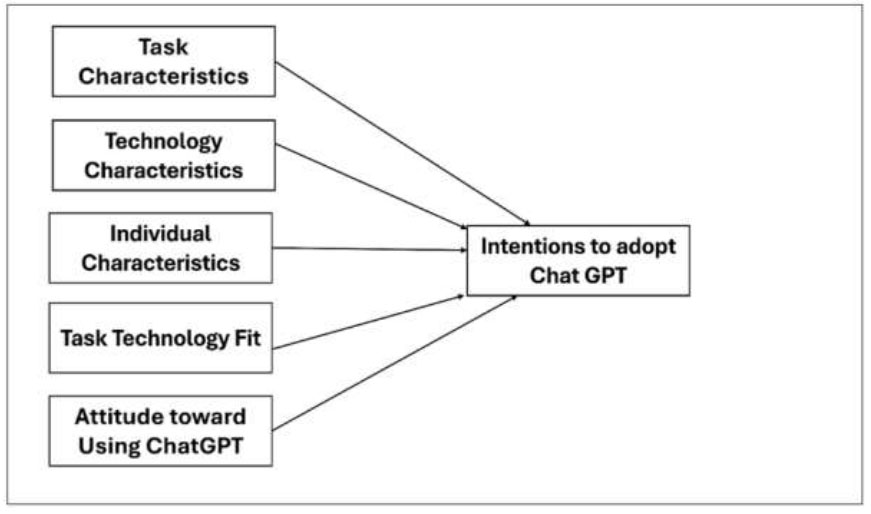
This research introduces a comprehensive conceptual framework to analyze the factors influencing individuals’ willingness to use OpenAI’s advanced AI-powered chatbot, ChatGPT. Five main independent variables form the basis of this model: Task Characteristics, Technology Characteristics, Individual Characteristics, Task–Technology Fit, and Attitude.
Users evaluate ChatGPT through two key dimensions. Task Characteristics represent the nature and difficulty level of the tasks they intend to perform, while Technology Characteristics reflect their perceptions of the chatbot’s qualities and capabilities. Individual Characteristics encompass users’ backgrounds, personal perspectives, and traits that shape their willingness to adopt the technology. Task–Technology Fit assesses how well users’ tasks align with the features and functions offered by ChatGPT. Attitude toward using ChatGPT indicates users’ overall positive or negative evaluation of the tool based on its perceived usefulness and ease of use.
This model examines these variables in detail to provide valuable insights into ChatGPT adoption intentions, offering benefits for researchers, practitioners, and policymakers working on AI adoption and implementation. Figure 1 presents the study model.
2.6. Research Hypotheses
To investigate university students’ intention to adopt ChatGPT, five hypotheses were developed based on the Technology-to-Performance Chain (TPC) and Technology Acceptance Model (TAM). Each hypothesis is supported by relevant literature, as explained below:
2.7. Task Characteristics
Task characteristics refer to the nature, complexity, and requirements of academic tasks students engage in. When students perceive that a technology tool helps them accomplish their academic tasks efficiently, their likelihood of adopting it increases. Fang et al. [19] and Alcover and Topa [20] found that task relevance and clarity significantly influence individuals’ acceptance of technological tools.
H1: Task characteristics have a positive and significant effect on students’ intention to adopt ChatGPT.
The study model.
2.8. Technology Characteristics
Technology characteristics include usability, reliability, and compatibility with students’ learning tools. Students who perceive ChatGPT as easy to use and reliable are more inclined to adopt it. Aziz and Wahid [21] and Mohamad et al. [22] confirmed that positive technology perceptions are strong predictors of adoption behavior.
H2: Technology characteristics have a positive and significant effect on students’ intention to adopt ChatGPT.
2.9. Individual Characteristics
Individual characteristics reflect students' personal traits, including digital literacy, openness to new technologies, and self-efficacy. Students who are comfortable with new tools and possess higher digital competence are more likely to use AI-based systems. This is supported by Chadegani et al. [23] and Tabak and Barr [24].
H3: Individual characteristics have a positive and significant effect on students’ intention to adopt ChatGPT.
2.10. Task-technology Fit (TTF)
Task-Technology Fit measures how well ChatGPT’s features align with the academic requirements of students. A strong fit enhances perceived usefulness and intention to use. Alyoussef [25], El Said [26], and Lu and Yang [27] found that a better fit between task and technology promotes technology adoption.
H4: Task-Technology Fit has a positive and significant effect on students’ intention to adopt ChatGPT.
2.11. Attitude toward Using ChatGPT
Attitude reflects students’ overall perception and emotional response to using ChatGPT. Positive attitudes increase the likelihood of behavioral intention. This relationship is strongly supported by Abdaljaleel et al. [28], Acosta-Enriquez et al. [29], and Haq et al. [30].
H5: Attitude toward using ChatGPT has a positive and significant effect on students’ intention to adopt the tool.
3. METHODOLOGY
3.1. Research Design
The main goal of this survey research is to determine what factors affect college students' adoption of ChatGPT. The study collected data on task characteristics, technology characteristics, individual characteristics, task-technology fit, attitude, and intention to adopt ChatGPT using validated survey instruments. The proposed study model was validated using Structural Equation Modeling (SEM) with AMOS and SPSS.
3.2. Sampling and Data Collection Procedure
This study employed a non-probability convenience sampling technique, which is commonly used in behavioral and educational research where access to a complete sampling frame is not feasible. The researchers distributed an online questionnaire via social media platforms and university student groups. This method allowed efficient access to a large and diverse sample of students within a limited timeframe and budget.
Participants were included in this cross-sectional study if they were currently enrolled students at Al-Razi University (Yemen) during the data-collection period, aged 18 years or older, and had prior experience using ChatGPT or similar AI text-generation tools, enabling them to evaluate the study constructs. Only students who understood the survey instructions, provided informed consent, and completed all mandatory questionnaire items were retained in the final dataset.
Participants were excluded if they were younger than 18 years, not enrolled at Al-Razi University, had no prior exposure to ChatGPT, declined participation, or did not provide consent, or submitted incomplete/invalid questionnaires or duplicate responses, which could not be used for SEM analysis.
To mitigate sample bias, the survey link was disseminated across multiple academic departments, student clubs, and administrative channels to encourage participation from students across different majors, levels of study, and backgrounds. The research team emphasized inclusivity by encouraging both male and female students to participate and by ensuring the invitation reached a wide age range (18–50 years). The anonymity of responses was maintained to reduce social desirability bias, and participation was voluntary to ensure authentic engagement.
The sample size of 209 respondents is justified based on the requirements of Structural Equation Modeling (SEM). According to Kline [31], a sample size of 200 or more is generally adequate for SEM when the model includes multiple constructs and paths. Additionally, it has been recommended that a minimum sample size of 5–10 observations per estimated parameter is needed; the current sample size meets this requirement given the number of constructs and observed indicators used in the model.
A post hoc power analysis was conducted using a medium effect size (0.30), a significance level of 0.05, and a sample size of 209. The analysis showed an actual power of 0.87, confirming that the sample size was sufficient to detect statistically significant relationships in the model.
Therefore, the sample provided adequate statistical power for model estimation and hypothesis testing, while also offering insights into university student perspectives on AI tool adoption within the Yemeni higher education context.
3.3. Measurement Instruments
All items in the questionnaire were adapted from previously validated instruments to suit the context of ChatGPT adoption in education (Appendix A). The items were reviewed by academic experts for content validity and adjusted linguistically for clarity and relevance. Each construct was measured using a 5-point Likert scale (1 = Strongly Disagree, 5 = Strongly Agree). Table 1 presents the item statements, adapted sources, and standardized factor loadings.
| Construct | Item Code | Item Statement |
|---|---|---|
|
Task Characteristics Adapted From: Al-Mamary et al. [7] |
Task1 | Using ChatGPT simplifies complex education tasks by providing efficient and intuitive interactions. |
| Task2 | ChatGPT significantly reduces the time and effort required for challenging academic and educational tasks. | |
| Task3 | ChatGPT effectively supports a variety of academic tasks by enhancing the ability to manage and organize activities in education. | |
|
Technology Characteristics Adapted From: Aziz & Wahid [21]; Mohamad et al. [22] |
Tech1 | ChatGPT is a dependable tool that consistently meets the requirements of tasks in education. |
| Tech2 | I frequently integrate ChatGPT with other digital tools and technologies to enhance my academic productivity in education. | |
| Tech3 | The accuracy and relevance of ChatGPT’s responses meet my expectations for solving challenges in education. | |
| Tech4 | ChatGPT represents an innovative and advanced solution for supporting academic tasks and organizing work in education. | |
|
Individual Characteristics Adapted From: Chadegani et al. [23] |
Indiv1 | I feel confident in my ability to utilize ChatGPT effectively for tasks in education. |
| Indiv2 | Using ChatGPT positively impacts my academic performance and ability to complete tasks in education efficiently. | |
| Indiv3 | Engaging with ChatGPT motivates me to pursue and complete tasks in education more proactively. | |
|
Task-Technology Fit Adapted From: Alyoussef [25]; El Said [26] |
T_Fit1 | ChatGPT offers the necessary tools and features to help me complete my academic tasks effectively. |
| T_Fit2 | The capabilities of ChatGPT are a good match for the demands of my academic work. | |
| T_Fit3 | I am able to integrate ChatGPT easily into my study routines and workflows. | |
|
Attitude Toward Using ChatGPT Adapted From: Abdaljaleel et al. [28] |
Att1 | I find using ChatGPT for tasks in education beneficial for improving academic outcomes. |
| Att2 | I prefer using ChatGPT for academic tasks because of its ability to simplify work in education. | |
| Att3 | I would recommend ChatGPT to peers for its effectiveness in supporting tasks in education. | |
|
Behavioral Intentions to Use ChatGPT Adapted From: Davis [18]; Acosta-Enriquez et al. [29] |
Inten1 | I intend to use ChatGPT consistently for tasks in education. |
| Inten2 | I plan to rely on ChatGPT as a primary tool for support in education. | |
| Inten3 | I will encourage my peers to adopt ChatGPT for their tasks in education. | |
| Inten4 | I am enthusiastic about using ChatGPT to enhance my productivity and capabilities in education. | |
| Inten5 | ChatGPT will likely become an essential tool for me when completing assignments and projects. | |
| Inten6 | ChatGPT will play a significant role in helping me succeed academically. |
| Items | Scale | Frequency | Percent |
|---|---|---|---|
| Gender | Male | 119 | 56.94 |
| Female | 90 | 43.06 | |
| Age | Less than 30 | 196 | 93.78 |
| 31-40 | 8 | 3.83 | |
| 41-50 | 5 | 2.39 | |
| Education | Diploma | 39 | 18.66 |
| Undergraduate | 165 | 78.95 | |
| Postgraduate | 5 | 2.39 | |
| GPT Chat Familiarity Level | High | 141 | 67.46 |
| Medium | 61 | 29.19 | |
| Low | 7 | 3.35 | |
| Total | 209 | 100 |
4. RESULTS
4.1. Demographic Profiles
The authors collected data using online surveys from a sample of 209 participants. Regardless of their academic program, level of study, or location, all students enrolled in a private university in Yemen (institutional name anonymized) were encouraged to participate in the questionnaire. Participants were required to be between 18 and 50 years of age. The demographic profiles are presented in Table 2.
The demographics of the respondents are presented in Table 2. The results show that 56.94% of participants were men, while 43.06% were women. Furthermore, 93.78% of participants were under the age of 30, 3.83% were between 31 and 40 years old, and 2.39% were between 41 and 50 years old. Regarding educational level, 18.66% of participants held a diploma degree, 78.95% held an undergraduate degree, and 2.39% held a postgraduate degree.
In terms of ChatGPT familiarity, most students demonstrated a high level of ability, with 67.46% reporting that they could use ChatGPT for learning purposes. Additionally, 29.19% of respondents indicated a moderate ability to use ChatGPT for learning objectives, while only 3.35% reported difficulty using ChatGPT for educational purposes.
4.2. Measurement Model
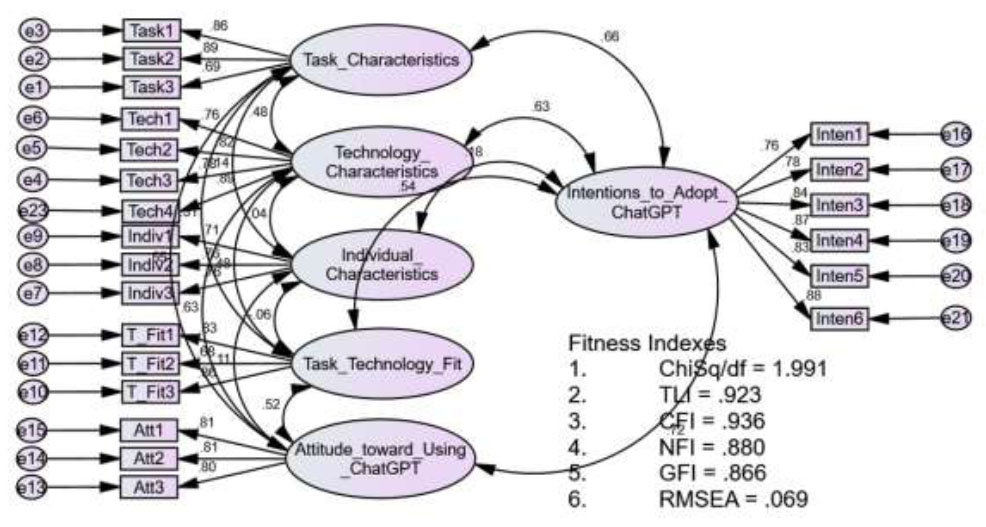
The confirmatory factor analysis (CFA) from AMOS version 24 was used to test the measurement models for each construct [32]. Awang [33] suggested that CFA should be used to assess whether the measurement items reflect the researcher's conceptualization of the construct. The measurement models were determined to satisfy the requirements suggested by Al-Mamary & Alshallaqi [34], as shown in Fig. (2).
4.3. Reliability and Validity of a Measurement Model
The study employed average variance extracted (AVE) to assess scale validity. The AVE value needed to meet or exceed 0.5, as recommended by Shrestha [35], Abdulrab et al. [36], Al-Mamary et al. [37], and Mutahar et al. [38], to ensure convergent validity. The Fornell–Larcker criterion was used to evaluate the discriminant validity of the measurement model. According to this criterion, the square root of a construct’s AVE must be greater than its correlation with all other constructs. The results are presented in Tables 3 and 4.
4.4. Structural Model
The analytical method of Structural Equation Modeling (SEM) enables researchers to study multiple variables or components effectively. Each construct must meet strict evaluation criteria for unidimensionality, validity, and reliability before being included in SEM research [34].
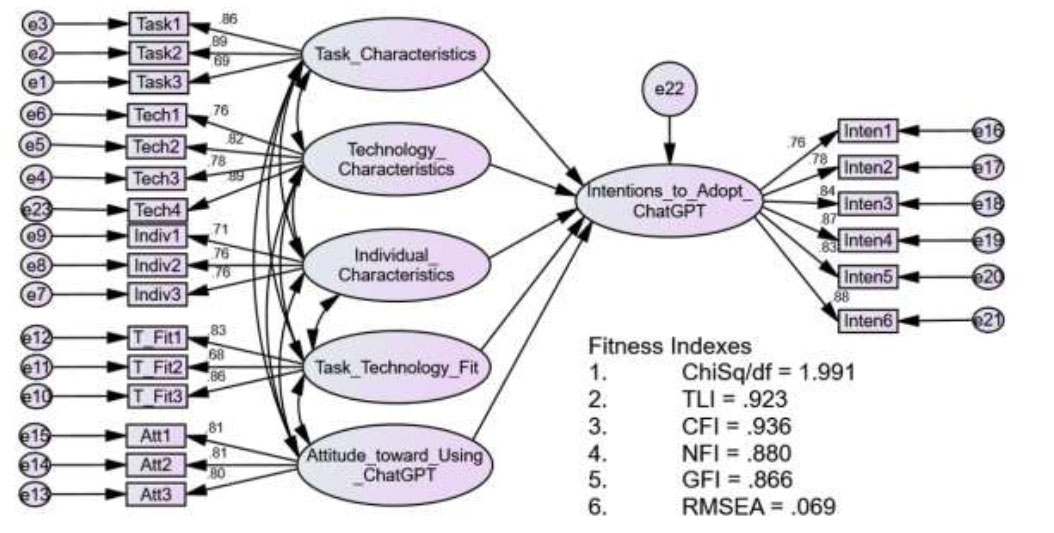
The evaluation of model fit and relationship strength relies on goodness-of-fit indices. When a model demonstrates good fit, the data supports the relationships among variables. The essential component of SEM, presented in Fig. (2), enables researchers to test specific hypotheses regarding relationships between model variables, thereby helping to validate or reject the research questions and hypotheses.
The development and interpretation of SEM require extensive knowledge of the research domain as well as advanced statistical expertise. The method provides reliable results for examining complex relationships between multiple variables, producing useful insights for both theoretical advancement and practical application.
The proposed conceptual model in Fig. (3) demonstrates strong goodness-of-fit indices, indicating its ability to explain the relationships between Task Characteristics, Technology Characteristics, Individual Characteristics, Task Technology Fit, attitude, and intention to adopt ChatGPT. The complete results from the hypothesis testing are presented in Table 5.
Validated measurement model.
Proposed structural model of the study.
| Construct | Item | Factor Loading | Cronbach alpha (> = 0.7) | CR (>= 0.7) | AVE (>= 0.5) |
|---|---|---|---|---|---|
| Task Characteristics | Task1 | 0.86 | 0.854 | 0.856 | 0.669 |
| Task 2 | 0.89 | - | - | - | |
| Task 3 | 0.69 | - | - | - | |
| Technology Characteristics | Tech1 | 0.76 | 0.883 | 0.887 | 0.663 |
| Tech2 | 0.82 | - | - | - | |
| Tech3 | 0.78 | - | - | - | |
| Tech4 | 0.89 | - | - | - | |
| Individual Characteristics | Indiv1 | 0.71 | 0.787 | 0.789 | 0.553 |
| Indiv 2 | 0.76 | - | - | - | |
| Indiv 3 | 0.76 | - | - | - | |
| Task Technology Fit | T_Fit1 | 0.83 | 0.831 | 0.835 | 0.630 |
| T_Fit2 | 0.68 | - | - | - | |
| T_Fit3 | 0.86 | - | - | - | |
| Attitude toward Using ChatGPT | Att1 | 0.81 | 0.847 | 0.850 | 0.651 |
| Att2 | 0.81 | - | - | - | |
| Att3 | 0.80 | - | - | - | |
| Intentions to adopt ChatGPT | Inten1 | 0.76 | 0.918 | 0.929 | 0.686 |
| Inten 2 | 0.78 | - | - | - | |
| Inten 3 | 0.84 | - | - | - | |
| Inten 4 | 0.87 | - | - | - | |
| Inten5 | 0.83 | - | - | - | |
| Inten6 | 0.88 | - | - | - |
| - | Task Characteristics | Technology Characteristics | Individual Characteristics | Task Technology Fit | Attitude toward Using ChatGPT | Intentions to Adopt ChatGPT |
|---|---|---|---|---|---|---|
| Task Characteristics | 0.818 | - | - | - | - | - |
| Technology Characteristics | 0.477 | 0.814 | - | - | - | - |
| Individual Characteristics | 0.143 | 0.037 | 0.744 | - | - | - |
| Task Technology Fit | 0.308 | 0.479 | 0.061 | 0.794 | - | - |
| Attitude toward Using ChatGPT | 0.549 | 0.626 | 0.114 | 0.522 | 0.807 | - |
| Intentions to adopt ChatGPT | 0.660 | 0.634 | 0.177 | 0.543 | 0.723 | 0.828 |
| Hypotheses | p | Results |
|---|---|---|
| Intentions_to_Adopt__ChatGPT <--- Task_Characteristics | *** | Supported |
| Intentions_to_Adopt__ChatGPT <--- Technology__Characteristics | 0.010 | Supported |
| Intentions_to_Adopt__ChatGPT <--- Individual__Characteristics | 0.045 | Supported |
| Intentions_to_Adopt__ChatGPT <--- T_T_Fit | 0.003 | Supported |
| Intentions_to_Adopt__ChatGPT <---Attitude_toward_Using__ChatGPT | *** | Supported |
5. DISCUSSION
The overall outcomes of this research provide strong evidence for Hypothesis 1, clearly demonstrating a positive correlation between Task Characteristics and university students' intentions to adopt ChatGPT. Hence, the results of the present study agree with those of Fang et al. [19] and Alcover & Topa [20].
The finding that Task Characteristics are positively linked to students' intentions to use ChatGPT indicates that students prefer technology that is efficient and helpful in completing their academic tasks. This correlation demonstrates that students actively choose to use modern tools that enhance their task performance and help them achieve learning objectives. Educational professionals and policymakers can use these findings to design interventions that highlight the relationship between technological capabilities and task requirements to enhance student acceptance and utilization of these tools. Understanding these linkages is essential for establishing an environment that supports ChatGPT integration and improves student learning experiences.
The results of this research also provide strong evidence for Hypothesis 2, clearly showing a positive correlation between Technology Characteristics and university students' intentions to adopt ChatGPT. This finding aligns with the work of Aziz and Wahid [21], who found that users’ perceptions of technological features such as ease of use and reliability strongly influence technology adoption. Similarly, Mohamad et al. [22] emphasized the importance of technology compatibility in shaping students’ behavioral intentions.
University students' intentions to use ChatGPT are positively correlated with Technology Characteristics. This suggests that when students perceive ChatGPT as reliable, user-friendly, and compatible with their devices and platforms, they are more likely to adopt the technology. The perception that ChatGPT possesses desirable attributes helps explain its increased acceptance and integration into academic routines. Educators and technology providers can leverage this relationship by emphasizing and improving ChatGPT’s positive features to enhance acceptance and usage among university students.
Along with this, the results of this research provide strong evidence for Hypothesis 3, which clearly shows a positive correlation between Individual Characteristics and university students' intentions to adopt ChatGPT. Therefore, the findings of the present study are in line with those of Chadegani et al. [23] and Tabak & Barr [24]. This result supports the findings of Chadegani et al. [23], who demonstrated that individual traits such as confidence and digital readiness significantly affect adoption intentions. It also reflects the observations of Tabak and Barr [24], who found that openness to innovation and personal attitudes play a key role in the acceptance of new technologies.
The role of individual characteristics in technology adoption becomes evident through the positive relationship between university students' intentions to use ChatGPT and their personal traits. Students who demonstrate characteristics such as technical aptitude, willingness to adopt new innovations, and a preference for digital educational tools are more likely to adopt ChatGPT. Understanding these attributes enables educators and policymakers to develop targeted educational strategies and pedagogical approaches that support students with different inclinations and levels of technological readiness. Educational settings can achieve better outcomes in implementing ChatGPT and related technologies by leveraging this positive relationship to provide personalized and engaging learning experiences.
This research also provides solid evidence for Hypothesis 4, which demonstrates a positive relationship between Task Technology Fit and university students' intentions to use ChatGPT. The positive relationship between task-technology fit and adoption intention is consistent with Alyoussef [25] and El Said [26], who found that students are more likely to adopt learning technologies that align with their academic needs. This supports the broader view that perceived alignment between system capabilities and task demands enhances perceived usefulness and actual usage.
The relationship between task-technology fit and university students' intentions to adopt ChatGPT is positive. This relationship indicates that students are likely to adopt and use ChatGPT when they perceive it as meeting their task demands and enhancing their productivity. Awareness of this alignment between task requirements and technological capabilities can significantly influence students’ willingness to incorporate ChatGPT into their academic work. Teachers and other stakeholders can leverage this positive link by developing instructional strategies and interventions that highlight the usefulness and relevance of the technology, thereby encouraging students to accept and use it more.
Lastly, the results of this research provide strong evidence for Hypothesis 5, which clearly shows a positive correlation between attitude and university students' intentions to adopt ChatGPT. Thus, the results of the present study are in line with those of Abdaljaleel et al. [28], Acosta-Enriquez et al. [29], and Haq et al. [30].
Students who hold positive attitudes toward ChatGPT tend to plan its usage. This positive attitude stems from users’ perceptions of the tool’s usefulness, its user-friendly design, and positive experiences with related technologies. The findings are expected because attitudes typically develop from these factors, making it logical that they would influence adoption intentions. This result confirms the findings of Abdaljaleel et al. [28] and Acosta-Enriquez et al. [29], who reported that students with favorable attitudes toward ChatGPT are more likely to use it for academic purposes. It also aligns with the Technology Acceptance Model’s assumption that positive attitudes strongly predict behavioral intention. Results from different contexts further strengthen the validity of this hypothesis.
The positive correlation shows that university students are more likely to adopt ChatGPT when educational institutions foster positive user experiences and attitudes toward the technology. For educational technology to be widely accepted, students must feel comfortable and confident when using the tool. The findings provide valuable insights for educators and developers seeking ways to enhance user interaction with AI tools. The strong and consistent correlation observed in this study leads to the acceptance of Hypothesis 5.
6. IMPLICATIONS
6.1. Practical Implications
The research results will be useful for educational staff members, government officials, and technology system developers who aim to enhance the use of AI in colleges. Identifying the factors that influence students' willingness to use ChatGPT will help universities develop appropriate strategies for integrating AI-based tools. Educational institutions should establish AI-friendly policies that encourage responsible use while addressing ethical concerns related to academic integrity and plagiarism. Educators should utilize ChatGPT to create learning experiences tailored to individual student needs, offering a more engaging and dynamic learning environment.
The research also highlights the necessity of developing digital infrastructure and training programs for both students and faculty members. Universities should implement workshops and training sessions that help students acquire the skills needed to maximize the benefits of AI-assisted learning. Developers should enhance AI tools by adding features that better serve students, making them more accessible, interactive, and supportive of different languages.
The deployment of AI educational tools requires policymakers to establish regulations that ensure transparency and reliability. As AI technologies expand, policymakers should create appropriate standards that protect academic integrity while fostering innovation. This research provides specific recommendations for developing an organized framework for AI implementation in education, which will enrich and support traditional learning approaches.
6.2. Theoretical Implications
The research contributes to the technology adoption literature by applying the Technology-to-Performance Chain (TPC) theory and the Technology Acceptance Model (TAM) within AI education settings. The study confirms the importance of task characteristics, technology characteristics, and individual characteristics in determining technology acceptance by examining their effects on students' adoption intentions.
The study further contributes to the literature by incorporating Task-Technology Fit (TTF) as an independent variable, offering a more detailed understanding of how AI technologies align with students' learning preferences. It also reinforces the role of attitudes toward AI, highlighting the significance of user perceptions in shaping behavioral intentions.
The findings demonstrate the expanding role of AI technology in education and complement previous studies on ChatGPT implementation in academic environments. This research enhances existing knowledge by integrating ChatGPT into an established theoretical framework, thus strengthening the predictive capabilities of technology adoption models. Future studies should build upon these results by examining how cultural differences, digital literacy, and institutional support influence the adoption process.
Overall, this research extends theoretical knowledge on AI adoption and provides foundational elements for future studies on AI-based educational technologies, offering a systematic framework to analyze their effects on learning outcomes.
7. LIMITATIONS AND FUTURE RESEARCH
This study provides important insights into the factors influencing university students’ adoption of ChatGPT; however, several limitations should be acknowledged. The data were collected from a single public university in Yemen, with most participants being undergraduate business students. As a result, the findings may not be generalizable to other academic disciplines, institutions, or geographic locations.
The cross-sectional research design captured student perceptions at a single point in time, which limits the ability to observe changes in attitudes or behaviors as students gain more experience with the technology. Additionally, the reliance on self-reported data introduces the possibility of bias, particularly social desirability bias and common method variance.
Future research should aim to collect more diverse and representative samples by including students from multiple universities and academic fields. Longitudinal studies could also help explore how students’ perceptions and usage of AI tools like ChatGPT evolve over time. Researchers are encouraged to investigate potential mediating and moderating variables such as perceived usefulness, digital literacy, and trust in AI to deepen the understanding of adoption behaviors. Furthermore, employing mixed-method or qualitative approaches could uncover contextual and experiential factors that may not be fully captured through surveys alone.
CONCLUSION
Through the lens of the technology-to-performance chain theory and the TAM model, this study examines university students’ adoption intentions toward ChatGPT technology. The results reveal that Task Characteristics, Individual Characteristics, Task–Technology Fit, Attitude, and Intentions to Adopt ChatGPT are positively correlated. These relationships highlight the need to align technology features with academic tasks and to consider personality factors that support technology adoption, while also encouraging active usage to strengthen adoption intentions and improve technology–task fit.
The positive relationship between Task Characteristics and adoption intentions indicates that students prefer technology that enhances task performance and efficiency. The association with Technology Characteristics demonstrates the importance of favorable perceptions of technology features in promoting adoption. The results also show that Individual Characteristics play a crucial role, as certain personal attributes are associated with a higher likelihood of adopting technology.
The associations between Task–Technology Fit and adoption intentions demonstrate that ChatGPT meets academic requirements and enhances user experience, leading to increased willingness to adopt the technology. These findings offer valuable insights for educators and policymakers in designing interventions that align technological capabilities with academic needs and leverage individual traits to support adoption, while also encouraging student engagement to improve acceptance and adoption rates.
The research provides essential information about the factors influencing college students' adoption of ChatGPT and offers guidance for enhancing technology use in educational environments. However, several limitations should be acknowledged. The primary limitation is that the findings may not be generalizable to other contexts. This restriction arises from collecting data at a single public university. Future research should include comparable studies across different universities within Gulf nations to strengthen generalizability. Expanding the research to include both public and private universities would increase the sample size and may yield different outcomes. Additionally, most participants were undergraduate students.
Including students from various types of institutions would introduce diverse perspectives that might lead to different findings. The model developed in this study did not examine mediating or moderating variables. Future studies should investigate these variables, as they may significantly impact students’ intentions to use ChatGPT. Analyzing potential mediators or moderators would provide a more comprehensive understanding of the underlying factors influencing students’ adoption behaviors.
AUTHORS’ CONTRIBUTIONS
The author confirms sole responsibility for the following: study conception and design, data collection, analysis and interpretation of results, and manuscript preparation.
LIST OF ABBREVIATIONS
| AI | = Artificial intelligence |
| TAM | = Technology Acceptance Model |
| TTF | = Task-Technology Fit |
| TPC | = Technology-to-Performance Chain |
| SEM | = Structural equation modeling |
ETHICS APPROVAL AND CONSENT TO PARTICIPATE
Ethical approval was granted by the Al-Razi University Ethics Review Committee (ERC), Yemen, under reference number ERC 103/25.
HUMAN AND ANIMAL RIGHTS
All human research procedures followed were in accordance with the ethical standards of the committee responsible for human experimentation (institutional and national), and with the Helsinki Declaration of 1975, as revised in 2013.
CONSENT FOR PUBLICATION
Informed consent was obtained from all participants before the data were collected. We informed each participant of their rights, the purpose of the study and to safeguard their personal information.
AVAILABILITY OF DATA AND MATERIALS
The data that support the findings of this study are available on request from the author.
ACKNOWLEDGEMENTS
The authors appreciate the involvement of participants in the study and thank the Leadership of Al-Razi University for constant support during the research.
Task Characteristics
Task 1: Using ChatGPT simplifies complex education tasks by providing efficient and intuitive interactions.
Task 2: ChatGPT significantly reduces the time and effort required for challenging academic and educational tasks.
Task 3: ChatGPT effectively supports a variety of academic tasks by enhancing the ability to manage and organize activities in education.
Technology Characteristics
Tech1: ChatGPT is a dependable tool that consistently meets the requirements of tasks in education.
Tech2: I frequently integrate ChatGPT with other digital tools and technologies to enhance my academic productivity in education.
Tech3: The accuracy and relevance of ChatGPT’s responses meet my expectations for solving challenges in education.
Tech4: ChatGPT represents an innovative and advanced solution for supporting academic tasks and organizing work in education.
Individual Characteristics
Indiv1: I feel confident in my ability to utilize ChatGPT effectively for tasks in education.
Indiv2: Using ChatGPT positively impacts my academic performance and ability to complete tasks in education efficiently.
Indiv3: Engaging with ChatGPT motivates me to pursue and complete tasks in education more proactively.
Task-technology Fit
T_Fit1: ChatGPT offers the necessary tools and features to help me complete my academic tasks effectively.
T_Fit2: The capabilities of ChatGPT are a good match for the demands of my academic work.
T_Fit3: I am able to integrate ChatGPT easily into my study routines and workflows.
Attitude towards Using ChatGPT
Att1: I find using ChatGPT for tasks in education beneficial for improving academic outcomes.
Att2: I prefer using ChatGPT for academic tasks because of its ability to simplify work in education.
Att3: I would recommend ChatGPT to peers for its effectiveness in supporting tasks in education.
Behavioural Intentions to use ChatGPT
Inten1: I intend to use ChatGPT consistently for tasks in education.
Inten2: I plan to rely on ChatGPT as a primary tool for support in education.
Inten3: I will encourage my peers to adopt ChatGPT for their tasks in education.
Inten4: I am enthusiastic about using ChatGPT to enhance my productivity and capabilities in education
Inten5: ChatGPT will likely become an essential tool
for me when completing assignments and projects.
Inten6: ChatGPT will play a significant role in helping me succeed academically