All published articles of this journal are available on ScienceDirect.

Evaluation of a Three-Month Cognitive Intervention in Children with Attention-Deficit/Hyperactivity Disorder
 iD
Khatuna Parkosadze3
iD
Manana Gugushvili1
Lasha Chantadze1 , 2
Nino Zhamureli2
Maia Advadze2
iD
Khatuna Parkosadze3
iD
Manana Gugushvili1
Lasha Chantadze1 , 2
Nino Zhamureli2
Maia Advadze2
Authors Info & Affiliations
Abstract
Introduction
Deficit/Hyperactivity Disorder (ADHD) is a common neurodevelopmental disorder that affects the cognitive and behavioral functioning of children. Cognitive interventions have been proposed to improve attentional functioning. The study investigated whether a three-month multi-component cognitive intervention was associated with changes in attentional functioning in children with ADHD, and whether these changes might extend to behavioral domains.
Methods
A quasi-experimental pre–post exploratory study without a control group was conducted in 55 children (aged 7–11 years) with inattentive ADHD. The intervention included twice-weekly computerized cognitive training and daily paper-based exercises. Neuropsychological performance was assessed before and after intervention using computerized tests and paper-based scales completed by parents and teachers. Nonparametric analyses were applied, and effect sizes (r) were calculated.
Results
Significant improvements were observed in attentional measures, including the Test of Attentional Vigilance (Z = –3.37, r = 0.52), Stroop task (Z = 3.46, r = 0.53), Go/No-Go task (Z = 4.13, r = 0.59). Reaction times decreased in selected tasks (visual search: Z = –6.03, r = 0.71), while other measures demonstrated non-significant trends. Behavioral assessments indicated reductions in inattention across ASEBA (Z = 4.11, r = 0.56), CBCL (Z = 3.95, r = 0.52), TRF (Z = 4.16, r = 0.59) scales.
Discussion
The findings support multi-component cognitive interventions, although intervention-specific effects cannot be confirmed due to the absence of controls.
Conclusion
Improvements were observed across multiple attentional domains, particularly divided, focused, and visuospatial attention. These improvements were partially transferred to observable behavioral changes. The findings may provide preliminary evidence for the potential benefits of cognitive interventions.
1. INTRODUCTION
Recent evidence indicates that neurodevelopmental disorders are increasing worldwide, posing significant global challenges [1, 2]. Attention-Deficit/Hyperactivity Disorder (ADHD) is among the most prevalent neurodevelopmental disorders in childhood, with an estimated global prevalence of approximately 8% [3]. About 11.3% of the children in the U.S. aged 5 to 17 have been diagnosed with ADHD [4]. The number of ADHD diagnoses is rising in both the young and middle-aged population; however, ADHD remains significantly more prevalent among children than in adults [4, 5]. Studies investigating the prevalence of ADHD in school-aged children using large population-based registries have shown that factors associated with ADHD, such as sex, social conditions, prematurity, motor functioning, inattention, and hyperactivity, are influenced by genetic and environmental risk factors. These factors significantly affect the daily functioning of children with ADHD [6, 7].
ADHD, as a neurodevelopmental disorder, is associated with a range of behavioral, neuropsychological, and psychiatric conditions [8-10]. Existing pharmacological treatments can be associated with significant side effects and may have a negative impact on the development and health of children and adolescents with ADHD [11-13]. It is evidenced that pharmacological treatments used for ADHD can lead to decreased appetite, delayed growth, headaches, nausea, tics, and mood disturbances [14, 15]. It is also important to consider the expenses associated with pharmacotherapy, which include not only the direct costs of medications and healthcare but also the indirect expenses related to reduced quality of life [16, 17]. Therefore, the investigation and implementation of non-pharmacological approaches may contribute to the formation of a valid psychophysiological/ psychological/ neuropsychological model for ADHD.
Existing neuropsychological and psychological methods enable the assessment of cognitive processes and behavioral difficulties in children [18, 19]. Different types of cognitive approaches are applied, but there is no empirical support for any of them as a standard-alone intervention for ADHD symptoms [20]. Several studies have reported that cognitive training in children with ADHD can improve working memory and certain aspects of attention and executive function without pharmacological interventions [21-23]. The variety of methods applied across studies could find application for different subtypes of ADHD and help explore potential links between ADHD and psychological and neurobiological variations [21, 24]. These approaches may represent a promising new pathway to address ADHD.
Despite the growing body of research on computerized cognitive training in ADHD, the overall effectiveness and generalizability of these interventions remain debated. Several recent meta-analyses and systematic reviews indicate that computerized cognitive training can lead to improvements in trained cognitive processes, particularly attention and executive functions, although these effects vary across studies [25-27]. However, these improvements are often modest, and evidence for transfer to broader cognitive abilities or everyday behavioral functioning remains inconsistent. Meta-analytic findings suggest that while near-transfer effects - improvements in tasks closely related to the trained cognitive processes - are frequently observed, far-transfer effects to untrained domains or clinically meaningful behavioral outcomes are substantially weaker and less reliable [25, 28, 29]. Furthermore, systematic reviews evaluating digital and computerized interventions for ADHD highlight considerable heterogeneity in training paradigms, outcome measures, and methodological quality across studies, which contributes to mixed findings and limits firm conclusions regarding clinical effectiveness [30]. Taken together, these findings underscore the need for further research examining the conditions under which cognitive training may produce measurable cognitive and behavioral benefits in children with ADHD.
Given these ongoing debates, several important gaps remain in the current literature. First, many existing interventions focus on single cognitive domains, particularly working memory, rather than targeting multiple attentional processes simultaneously [27, 28, 31, 32]. Second, meta-analyses report improvements in trained tasks or closely related tasks (near-transfer outcomes); however, evidence for transfer effects on broader neuropsychological functioning and everyday behavioral outcomes remains inconsistent, contradictory, and often modest [25, 28, 33]. Only a limited number of studies integrate objective computerized assessments with multi-informant behavioral measures, limiting comprehensive evaluation of everyday functioning [25, 30]. The present study aims to address these limitations by evaluating the utilization of a structured, multi-component cognitive intervention. Specifically, the cognitive intervention combines computerized tasks and paper-based exercises targeting multiple domains of attention. Furthermore, intervention outcomes are assessed using both objective neuropsychological tests and parent- and teacher-reported rating scales, allowing examination of intervention-related changes across different assessment modalities. Through this integrative design, the study examines whether improvements in task-specific cognitive measures are accompanied by changes in everyday behavioral functioning, as reflected in parent- and teacher-reported inattentive symptoms.
From a theoretical perspective, the cognitive intervention applied in the present study is grounded primarily in executive function theory [34, 35] and also draws on principles of neuroplasticity [36, 37]. Executive functions, including inhibitory control, working memory, and cognitive flexibility, are linked to prefrontal cortical functioning [34, 35]. Deficits in these functions play a central role in attentional and self-regulatory difficulties, particularly in neurodevelopmental conditions such as ADHD [38, 39]. Cognitive interventions that systematically engage attentional control, response inhibition, and task switching are hypothesized to strengthen core executive processes through recurrent activation of the underlying neural systems. In parallel, neuroplasticity theory proposes that repeated cognitive training may induce functional and structural changes in the brain [36, 37]. Such practice has been proposed to enhance synaptic efficiency and network connectivity within frontoparietal attention systems, thereby promoting measurable behavioral improvements [36]. Within this framework, the cognitive intervention employed in the present study was designed to simultaneously target multiple domains of attention and executive functioning through a structured, repeated cognitive training delivered over a three-month period.
The present study investigated children with ADHD exhibiting difficulties in attention and information processing and focused on enhancing psychological and neuropsychological correlates. This study investigated potential changes in attentional functions using a multi-component cognitive intervention. Neuropsychological assessments were administered twice, before and after the three-month cognitive intervention, to evaluate potential changes in performance. Cognitive Computer Tests (CCT) and Cognitive Paper Exercises (CPE) were implemented as components of cognitive intervention, which target various domains of Executive Function (EF), such as cognitive flexibility, motor inhibition, reaction time, set shifting, and selective attention. The present research explored patterns of performance on these measures by using neuropsychological assessments in children with ADHD. The study highlights the potential relevance of cognitive interventions in ADHD management, which may contribute to the difficulties experienced by children with ADHD. Such an integrated approach may support a more comprehensive evaluation of cognitive and behavioral outcomes in ADHD and contribute to the development of valid neuropsychological and psychological models [28].
Guided by the above theoretical considerations, the present study aimed to evaluate the effectiveness of a three-month, multi-component cognitive intervention targeting attentional functions in children with the predominantly inattentive subtype of ADHD. Particularly, the present study addressed the following hypotheses:
Cognitive Outcomes - grounded on executive function theory [34, 35], it is hypothesized that a three-month cognitive intervention would lead to significant improvements in objective measures across various attentional domains.
Behavioral Outcomes – it is further hypothesized that improvements in executive functioning following a three-month cognitive intervention would transfer to observable behavioral changes, reflected in reductions in parent- and teacher-reported inattentive symptoms.
The present study was designed as an exploratory, theory-driven evaluation. A quasi-experimental pre–post design was employed to examine whether the proposed intervention was associated with measurable changes in both objective and behavioral measures of attention. The findings of the presented study provide preliminary evidence that may guide future research incorporating a control group.
2. METHODS
2.1. Study Design and Sample
Sixty-one children with ADHD (15 girls and 46 boys, aged 7–11 years), predominantly of the inattentive subtype, participated in the research. The sample size calculated online with a 95% confidence level and 5% error margins was 47. Out of the 61 participants initially enrolled, 55 completed the entire study procedure; therefore, the final sample size of 55 was sufficient to address the study objectives. Participants were recruited from schools and psychological centers. Children who participated in this study had already been diagnosed with ADHD by a team consisting of a neuropsychologist, a psychiatrist, a psychologist, and a pediatrician according to the following internationally criteria: DSM-5 (The Diagnostic and Statistical Manual of Mental Disorders) [40] and ICD-10 (International Statistical Classification of Diseases and Health Problems) [41] for ADHD and its subtypes (ADHD-C, ADHD-H, ADHD-I), for ODD (Oppositional Defiant Disorder), CD (Conduct Disorder), or anxiety / depressive mood. The research team did not conduct independent diagnostic reassessments and did not have direct access to detailed individual diagnostic documentation; therefore, we could not report screening details of children with ADHD.
A homogeneous contingent of ADHD children (predominantly inattentive) was selected. None of the children with ADHD participating in this study had a history of pharmacological treatment. All comorbid factors were minimized using inclusion and exclusion criteria. Children with ODD, CD, and anxiety/depressive mood were excluded from the study. Children with normal intelligence appropriate for their age and disorder (80≤IQ <120) were included. Intelligence Quotient (IQ) was assessed by the TONI-4 Nonverbal IQ Measurement Test, which measures abstract reasoning and problem-solving skills [42]. Demographic data of participants who completed the study are presented in Table 1.
| Age Groups | - | Gender | IQ | Total | |
|---|---|---|---|---|---|
| Male | Female | Mean & SD | |||
| 7-9 Years | N | 29 | 9 | M = 100,07 | 38 |
| % | 76,3% | 23,7% | SD = 10,84 | 100% | |
| 10-11 Years | N | 13 | 4 | M = 103,23 | 17 |
| % | 76,5% | 23,5% | SD = 9,67 | 100% | |
| Total | N | 42 | 13 | M = 101,05 | 55 |
| % | 76,4% | 23,6% | SD = 11,70 | 100% | |
The study employed a quasi-experimental pre–post within-subject design. As an exploratory investigation, no control group was included. The primary aim was to examine changes in participants’ performance from baseline to post-intervention. However, the absence of a control or comparison group limits the internal validity of the study and restricts causal inference. The observed improvements may reflect influences unrelated to the intervention, such as natural developmental maturation, practice effects resulting from repeated task exposure, expectancy effects, or statistical regression to the mean. Therefore, the findings should be interpreted as preliminary associations rather than definitive evidence of intervention effectiveness. Assessments were conducted by trained research staff. Blinding of assessors and participants was not implemented.
2.2. Cognitive Intervention
The multi-component cognitive intervention was implemented over a three-month period and consisted of two components: Cognitive Computer Tests (CCT) and Cognitive Paper Exercises (CPE). CCT and CPE consisted of various types of tests. Computerized tasks were administered using the PEBL 2.1 application, which provides cognitive tests with established reliability and validity [43]. All exercises had previously been translated and adapted for the Georgian population and were used to train and develop different attentional domains and concentration skills in children with ADHD. Prior to the intervention, all participants completed a trial version of each test to ensure they fully understood the instructions.
2.2.1. Cognitive Computer Tests (CCT)
CCT sessions were conducted twice weekly for three months in school settings under the supervision of a trained specialist. Each session lasted approximately 25–30 minutes and included short breaks between tasks. Four computerized tests were administered:
- PCPT - selective and sustained attention,
- SIMON - divided and focused attention,
- PPVT - sustained attention and vigilance,
- VSEARCH – visual-spatial and selective attention.
Participants completed each test 12 times (each participant completed a total of 48 computerized tests over a three-month period). Reaction times, percentage of correct responses, and their variability were recorded and analyzed.
2.2.2. Cognitive Paper Exercises (CPE)
CPE was completed daily for approximately 5–10 minutes in home settings. Exercises targeted selective and sustained attention, concentration, and resilience, and comprised the following exercises: Test on Numbers, Test on Letters, Figure Connecting, Figure Circle, D2 & P2, Bourdon Test, and Test on 8’s. The number and complexity of symbols increased gradually in proportion to exercise performance and improvement of the skills. Consequently, each participant completed exercises of varying numbers and levels of difficulty. Because the number and complexity of symbols were progressively adjusted, the exercises were not standardized across participants and were therefore not suitable for statistical outcome analysis.
CPE was implemented as a complementary training component to support the daily practice of attentional skills. These exercises were not intended to serve as outcome measures and were therefore not analyzed as indicators of cognitive improvement or intervention effectiveness. Each participant completed approximately 180 paper exercises during the intervention period. Parents were instructed to supervise completion of the exercises, and weekly monitoring by the supervising specialist was conducted to ensure adherence to the protocol.
All participants completed the computerized and paper-based exercises following the same structured sequence, with standardized instructions, task duration, and rest breaks to ensure consistency across sessions.
2.3. Neuropsychological Assessment
Neuropsychological functioning was evaluated before and after the three-month cognitive intervention using the Neuropsychological Computer Assessment Tests (NCAT) and the Neuropsychological Paper Assessment Scales (NPAS). Neuropsychological assessments were conducted before and after the cognitive intervention to examine changes in attentional functions.
NCAT consisted of five tests that measured the following aspects of attention: selective, sustained, divided, focused attention, and alertness. The results of each test were measured by the following variables: reaction times, percentage of correct responses, and their variability were recorded and analyzed.
- TOAV (Test of Attentional Vigilance) – measures sustained attention, selective attention, and alertness.
- FLANKER – measure divided, focused, selective attention and motor inhibition.
- SHIFTING ATTENTION – measure sustained and divided attention.
- Stroop Test – measure selective attention.
- GoNogo - measure sustained and selective attention and motor inhibition skills.
Participants completed each test 2 times (each participant completed a total of 10 NCAT tests).
NPAS consisted of standardized parent- and teacher-report scales adapted for the Georgian population. NPAS assessment scales were administered to teachers and parents to evaluate children’s attention-related difficulties. The instruments had been translated and adapted for the Georgian population and have demonstrated high construct validity. NPAS included four scales: (a) National Institute for Children's Health Quality (NICHQ) Vanderbilt Parent and (b) Teacher scales [44], and (c) Achenbach System of Empirically Based Assessment (ASEBA) of Child Behavior Checklist (CBCL) completed by parent and (d) ASEBA Teacher’s Report Form (TRF) completed by teacher [45]. Each of these scales assesses different psychological and behavioral factors, but only inattention problems were analyzed during the data analysis. (a) Vanderbilt Parent and (b) Teacher Scales are standardized tools for assessing behavioral and attentional functions in children, with a focus on ADHD-related symptoms. The inattention domain included sustained attention, task completion, distractibility, listening skills, and organizational skills. (c) The Child Behavior Checklist (CBCL) and (d) the Teacher’s Report Form (TRF) both include scales to assess adaptive functioning and behavior, attentional, emotional, and social problems. The following inattention domains were included: difficulties in sustaining attention, distraction, daydreaming, difficulties completing homework, and impulsivity. Given that both scales rely on subjective evaluations by parents and teachers, both informants were included to provide assessments across home and school contexts and to enhance the reliability and validity of the assessment of children with ADHD.
2.4. Procedure
The study followed a three-phase design consisting of (1) baseline neuropsychological assessment, (2) a three-month cognitive intervention program combining computerized and paper-based exercises, and (3) post-intervention reassessment using the same neuropsychological measures.
Before the cognitive intervention, all participants completed baseline neuropsychological evaluation using NCAT and NPAS. Testing sessions were conducted at Georgian National University (SEU) under standardized conditions by a trained supervisor. To ensure methodological uniformity, supervisors ensured that identical instructions, task order, timing procedures, and environmental conditions (quiet testing room, standardized computer setup, and scheduled breaks) were maintained across participants. NCAT sessions lasted approximately 45–50 minutes, with short three-minute rest breaks between tasks to minimize fatigue. NCAT consisted of five computer tests: (a) TOAV (approximately 5 minutes), (b) Flanker (approximately 10 minutes), (c) Stroop (approximately 5 minutes), (d) Shifting Attention (approximately 8 minutes), and (e) GoNogo (approximately 14 minutes).
NPAS - Parent and teacher questionnaires were administered at baseline and after the three-month intervention period. Parents completed the questionnaires at home, and teachers completed them in the school setting. Standardized written instructions were provided, and completed questionnaires were collected by the supervising specialist to ensure consistency of administration.
Following the baseline neuropsychological assessment, participants completed a three-month cognitive intervention program consisting of CCT sessions at school and daily CPE performed at home. All computerized sessions were conducted in a controlled school environment and were administered under the supervision of a trained teacher or psychologist. Weekly monitoring by the supervising specialist was carried out to ensure consistent implementation of the intervention protocol.
To avoid cognitive overload, the four computerized tests were divided across two days each week (on Mondays and on Thursdays). On Day 1, participants completed two tests: the PCPT (approximately 14 minutes) and VSEARCH (approximately 10–12 minutes). On Day 2, participants completed the PPVT (approximately 15 minutes) and the SIMON (approximately 10–12 minutes). The order of the tests, instructions, and testing conditions was identical for all participants. Short three-minute rest breaks have been used between tests to minimize fatigue.
Daily CPE was conducted in home settings and required approximately 5–10 minutes to complete. Participants were given two different paper exercises per day. To monitor adherence to the intervention protocol, parents maintained simple completion logs, and weekly monitoring was conducted by the supervising specialist through communication with families and review of the completed exercises. This procedure was implemented to ensure consistent participation throughout the intervention period.
Upon completion of the three-month cognitive intervention, participants were reassessed using the same NCAT and NPAS procedures administered at baseline.
2.5. Statistical analysis
Statistical analysis was performed using IBM SPSS Statistics version 26. Inferential statistical analyses were conducted to examine whether significant differences emerged between the baseline and post-intervention measurements. Given that the majority of outcome variables significantly deviated from normal distribution (Shapiro–Wilk test, p < 0.05), nonparametric statistical methods were applied.
The Wilcoxon signed-rank test was used to compare paired measurements (baseline vs. post-intervention and monthly comparisons within the intervention period). The Mann–Whitney U test was used for comparisons between independent groups (e.g., age group comparisons), and the Kruskal–Wallis test was used to compare more than two independent groups.
Effect sizes for nonparametric tests were calculated using the correlation coefficient (r), derived from the standardized test statistic (Z) divided by the square root of the total number of observations (N) (r = Z / √N). Effect sizes were interpreted according to Cohen’s criteria (Cohen, 1988), where r = 0.10 represents a small effect, r = 0.30 a medium effect, and r = 0.50 a large effect.
The data analysis process began with data cleaning and descriptive statistics to summarize the primary outcomes of the participants. Extreme values were identified based on a ±3 standard deviation criterion threshold. Participants whose performance measures exceeded three standard deviations above or below the sample mean were classified as outliers and excluded from further analyses.
The main outcome measures included the mean percentage of correct responses, mean reaction times, and standard deviations. Changes in participants’ performance across the three-month cognitive intervention period were examined using pairwise comparisons between time points. These comparisons were conducted with the Wilcoxon signed-rank test, specifically comparing performance between the first and second months and between the second and third months.
To reduce the risk of Type I error inflation resulting from multiple comparisons, Bonferroni adjustments were applied when multiple pairwise tests were conducted within the same outcome domain. Because multiple outcome variables were tested, a Bonferroni correction was applied across 10 comparisons, resulting in an adjusted significance threshold of p ≤ 0.005. All reported statistically significant findings remained significant after this correction.
3. RESULTS
3.1. Cognitive Computer Tests (CCT)
Fifty-five children with ADHD (13 girls and 42 boys) completed all tasks of CCT. For these tasks, reaction times (in milliseconds) and performance (percent of correct responses) were analyzed.
(a) PCPT (selective and sustained attention): No statistically significant improvement in performance and reaction times. However, a tendency toward improvement was observed from the first to the second month (Fig. 1A).
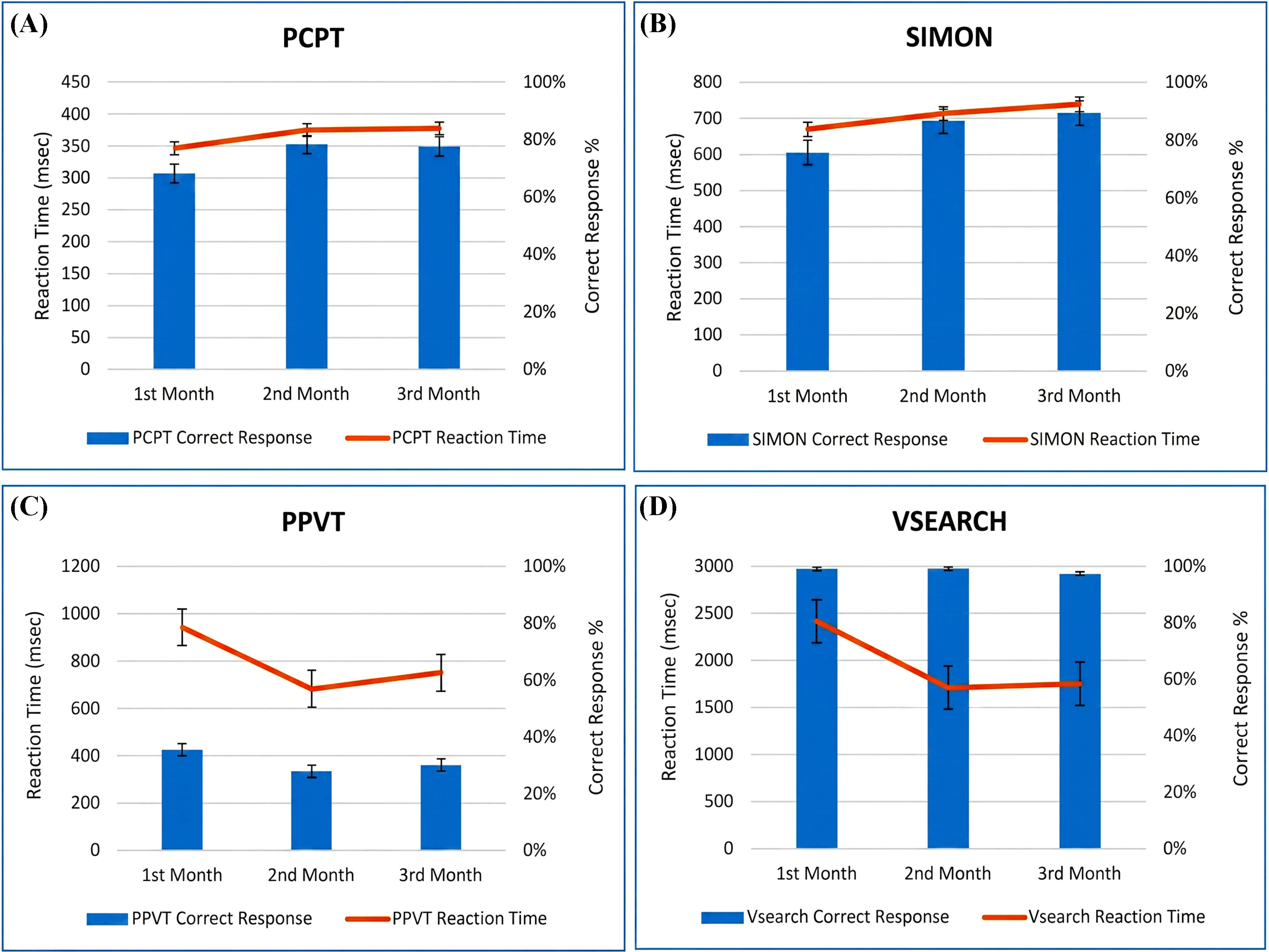
Results of cognitive computer tests (CCT).
A - PCPT. There were no significant differences in task performance and reaction times (p < 0.05); however, both measures showed a tendency to improve from the first to the second month.
B –SIMON. Here, correct responses significantly increased from the first to the second and third months (p < 0.05), but reaction times did not show any significant differences, only a tendency for improvement.
C –PPVT. There is a significant reduction of timely correct responses from the first to the second and the first to the third months (p < 0.05). Reaction times show a tendency to decrease.
D –VSEARCH. The rates of correct responses did not reveal statistically significant differences because of high performance (almost 100%). The average reaction times decreased significantly from the first to the second and from the first to the third months (p < 0.05).
(b) SIMON (divided and focused attention): Significant improvement in performance from the first to the second month (Z = -3.80, r = -0.59, p < 0.001) with a large effect size. Reaction times tended to decrease from month 2 to 3 (Fig. 1B).
(c) PPVT (sustained attention and vigilance): Statistically significant decrease in correct responses (Z = –4.17, r = -0.62, p < 0.001) with a large effect size and indicating reduced task performance during the intervention period (Fig. 1C). Notably, this outcome contrasts with the improvements observed in several other attentional measures. Reaction times revealed a tendency to decrease from the second to the third months.
(d) VSEARCH (visuospatial and selective attention): Performance remained near ceiling across all months (within a 100% range). Reaction times showed significant reductions from first to second and from first to third months (Z = –6.03, r = -0.71, p < 0.001), with a large effect size (Fig. 1D).
3.2. Cognitive Paper Exercises (CPE)
Fifty-five children with ADHD performed CPE daily for three months. The results of CPE showed that the overall percentage of correct responses was high (over 90%) and completion times varied significantly across participants. As exercises were individualized and progressively adjusted based on each child’s performance, making them unsuitable as standardized outcome measures, CPE data were not statistically analyzed. These exercises primarily served to reinforce attentional engagement and concentration, while CCT and neuropsychological and behavioral assessments (NCAT and NPAS) have been used to evaluate participants’ performance before and after the intervention.
3.3. Neuropsychological Assessment
Neuropsychological assessment included NCAT and NPAS administered before and after a three-month cognitive intervention. Fifty-five participants completed the NCAT, and parents and teachers of these children with ADHD completed NPAS, providing comprehensive behavioral and cognitive outcome data.
3.3.1. Computer Assessment Tests (NCAT)
Participants performed five tests before and after a three-month cognitive intervention. The reaction times (in milliseconds) and performance (percent of correct responses) were analyzed.
(a) The TOAV (sustained and selective attention): Significant improvement in performance after the cognitive intervention. The average correct response rate increased significantly by 2.49% (Z = –3.37, r = -0.52, p < 0.001) with a large effect size. Reaction time remained unchanged on follow-up visit (Fig. 2A).

Results of neuropsychological computer assessment tests (NCAT).
A - Comparison of the results of TOAV before (first visit) and after (second visit) the cognitive intervention. Correct responses increased significantly (p < 0.05), but the average reaction times remained unchanged.
B - Comparison of results of FLANKER before (first visit) and after (second visit) the cognitive intervention. No significant differences were found (p > 0.05).
C - Comparison of results of SHIFTING ATTENTION before (first visit) and after (second visit) the cognitive intervention. No statistically significant differences were found (p > 0.05).
D - Comparison of the results of Stroop before (first visit) and after (second visit) the cognitive intervention. Performance improved significantly for the second visit (p < 0.05).
E - Comparison of results of GoNogo before (first visit) and after (second visit) the cognitive intervention. Correct responses and average reaction times increased significantly (p < 0.05).
(b) FLANKER (divided, focused, and selective attention): No significant differences in performance before and after cognitive intervention (p > 0.005), but displayed the tendency of increasing correct responses (2.60%) after the cognitive intervention. Reaction times remained unchanged (Fig. 2B).
(c) SHIFTING ATTENTION (sustained and divided attention): No significant differences in performance before and after cognitive intervention (p > 0.005), but displayed the tendency of increasing correct responses (2.64%) after the cognitive intervention. Reaction times remained unchanged (Fig. 2C).
(d) Stroop test (selective attention): Significant increase of correct responses by 5.20% after the cognitive intervention (Z = 3.46, r= -0.53, p < 0.001) with a large effect size (Fig. 2D). For this test, reaction times were not registered and analyzed.
(e) GoNogo (sustained and selective attention): Significant increase of correct responses by 2.79% (Z = 4.13, r = -0.59, p = 0.001) after the cognitive intervention with a large effect size. During the follow-up visit, reaction time increased by 141 ms (Z = 3.14, p < 0.001) (Fig. 2E). The increase in reaction time should be interpreted cautiously: it may reflect a more deliberate response strategy and enhanced inhibitory control, but it could also indicate reduced response efficiency. These findings highlight the need for nuanced interpretation rather than framing all changes as improvements.
When analyzing GoNogo test results, extreme values of reaction times were identified using a ±3 standard deviation criterion. Participants whose reaction times measured exceeded three standard deviations above or below the sample mean were identified as outliers and excluded from further analyses (n = 4); accordingly, the statistical analysis of GoNogo results includes the data of 51 participants.
3.3.2. Neuropsychological Paper Assessment Scales (NPAS)
Comparison of results of NPAS before and after the cognitive intervention showed a decrease in inattention in all four assessment scales. In particular, three of them showed a significant decrease in inattention problems (p < 0.005). ASEBA (Z = 4.11, r = -0.56, p < 0.001); CBCL (Z = 3.95, r = -0.52, p < 0.001); TRF (Z = 4.16, r = -0.59, p < 0.001), and one (Vanderbilt teacher scale) showed a tendency of reduction of inattention (p > 0.005). (Fig. 3).
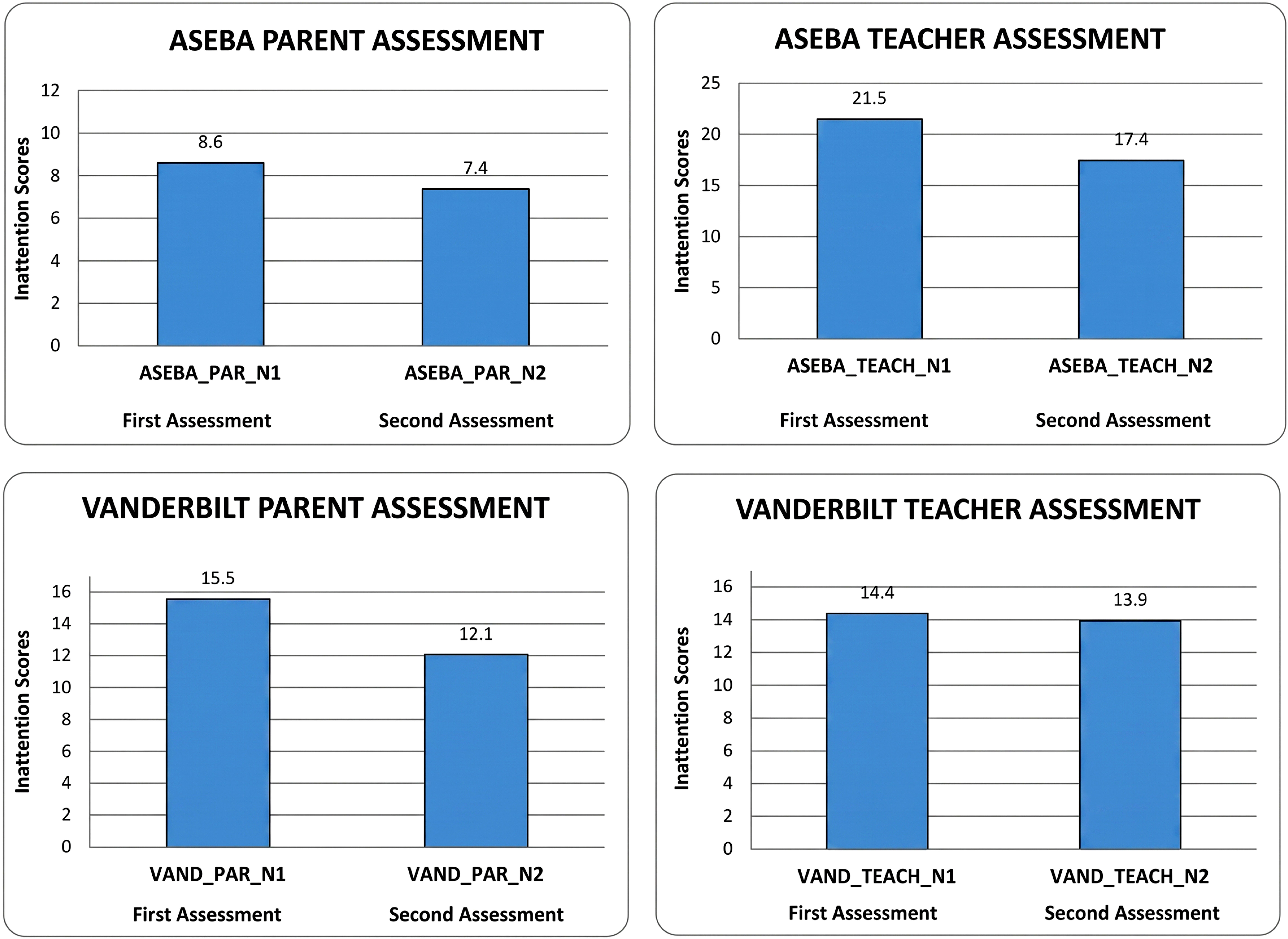
Results of the neuropsychological paper assessment scales (NPAS) before (first assessment) and after (second assessment) the cognitive intervention.
Analysis of average inattention scores for Achenbach parent and teacher, and Vanderbilt parent scales revealed a significant decrease in children's attention problems (p < 0.05), and the Vanderbilt teacher scale showed a tendency to reduction.
3.4. Age Comparison
Participants were divided into two age groups (7–9 years old children, n = 38, and 10–11 years old children, n = 17) to explore potential developmental differences in response to the cognitive intervention. Comparison of CCT results showed that older children (10-11 years old) exhibit faster reaction times on the PPVT (U = 77.00, Z = -2.85, r = -0.45, p = 0.004) and VSEARCH (U = 82.00, Z = -3.53, r = -0.48, p = 0.002) compared with younger children (7-9 years old) (Fig. 4). Difference scores between baseline and post-intervention assessments did not differ significantly between the two age groups (U = 11.00, p > 0.05), suggesting that, within the limitations of the current sample and without formal interaction analyses, intervention-related changes were broadly similar across ages, though firm conclusions about equivalence cannot be drawn.
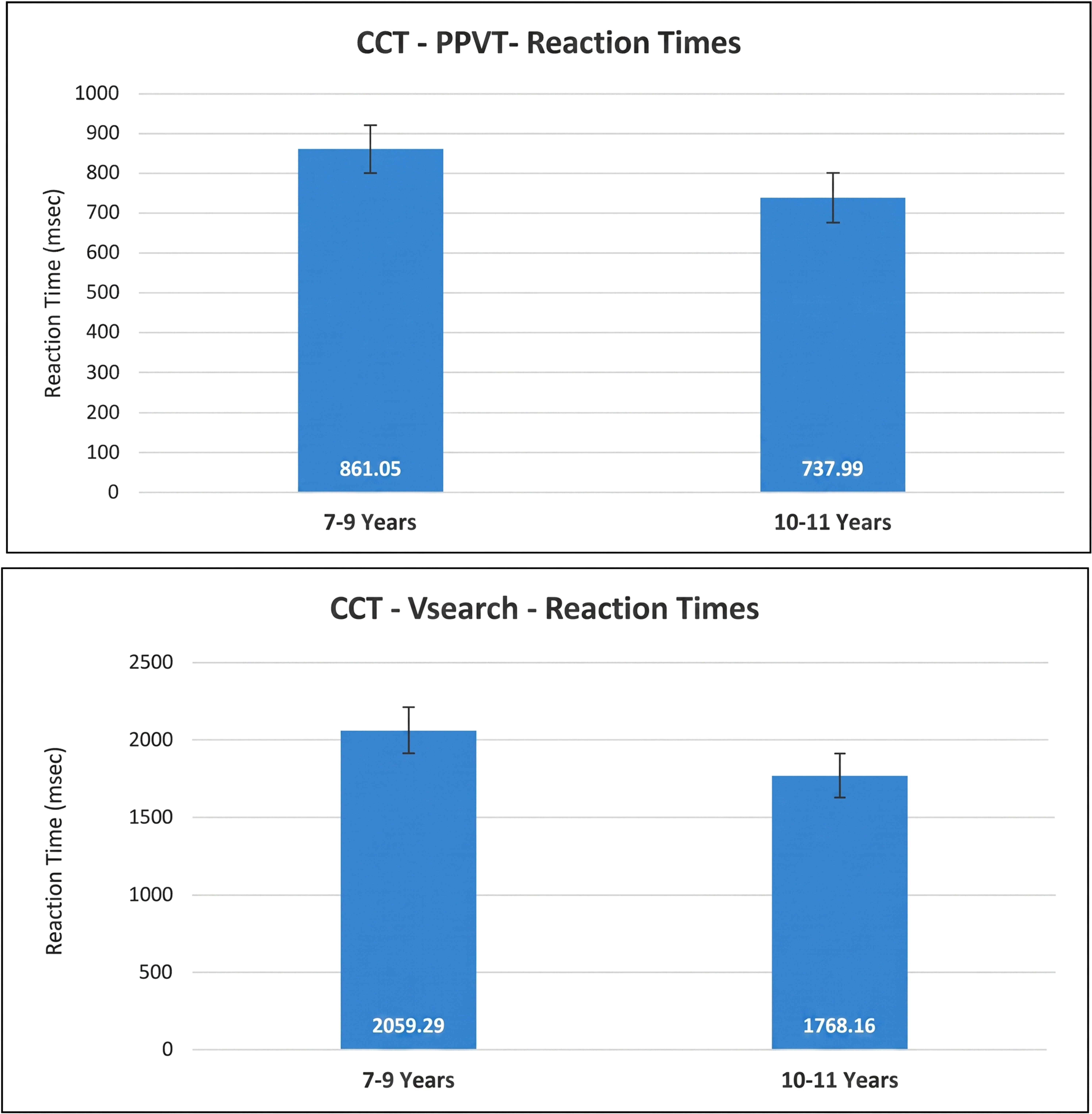
Results of comparison between two age groups.
Older children (10-11 years old) had faster reaction times on the PPVT and VSEARCH than younger ones (7-9 years old) (p < 0.05).
4. DISCUSSION
The present study investigated children with ADHD and focused on enhancing psychological and neuropsychological correlates. Particularly, this research examined whether a three-month multi-component cognitive intervention was associated with changes in attentional functioning in children with the predominantly inattentive subtype of ADHD. Guided by executive function theory [35], the cognitive intervention combined computerized and paper-based exercises targeting multiple domains of attention and was evaluated using a quasi-experimental pre–post design. Objective neuropsychological tests and parent- and teacher-reported inattention measures were administered before and after the cognitive intervention to explore potential cognitive and behavioral changes. It should be noted that, as an exploratory pre–post study without a control group, observed changes cannot be conclusively attributed to the intervention and may reflect factors such as maturation, practice effects, expectancy, or regression to the mean. Nonetheless, the pre–post comparisons provide a preliminary assessment of potential changes over the intervention period and can inform hypotheses for future controlled studies. Future research employing randomized controlled designs is necessary to establish causal effects and evaluate the generalizability of multi-component cognitive interventions for children with ADHD.
Several studies have reported that computerized cognitive training improves executive functions in children with ADHD, particularly attentional domains and visuospatial skills [21-23, 25]. However, systematic reviews and meta-analyses caution that these effects are often small, short-term, and inconsistent across studies [25, 27]. The study’s results showed improvements in divided, focused, and visuospatial attention and a tendency toward improvement in selective and sustained attention, which partially align with existing evidence [25]. Overall, performance improvements were observed in the neuropsychological evaluation across several attentional domains following the cognitive intervention, which is consistent with the cognitive outcome hypothesis. However, the causal relationship between the cognitive intervention and the observed improvements cannot be conclusively established. Overall, certain attentional domains showed improvement during the intervention period, but not all measures demonstrated consistent positive changes. Several tasks (SIMON, TOAV, Stroop, VSEARCH) showed improvements or faster performance, whereas PPVT demonstrated a significant decrease in correct responses, highlighting that gains were task-specific and not universal. While GoNogo performance improved in accuracy, reaction times increased, suggesting that participants may have adopted a more cautious, deliberate response strategy indicative of enhanced inhibitory control rather than reduced efficiency. These mixed patterns are consistent with previous evidence indicating that computerized cognitive training often produces near-transfer effects but limited far-transfer to other domains [28, 29, 46]. However, given the quasi-experimental design without a control group, these improvements cannot be attributed solely to the intervention.
From a theoretical perspective, the pattern of findings may be interpreted within the executive function theory of ADHD [35], which conceptualizes attentional and self-regulatory difficulties as reflecting impairments in inhibitory control, working memory, and cognitive flexibility. According to this framework, repeated engagement of attentional control processes through cognitive exercises may support adaptive modulation of executive systems [35] and enhance neuronal connectivity in line with neuroplasticity theory [36, 37]. The observed improvements in selective, divided, and sustained attention are theoretically consistent with these models that emphasize executive dysfunction as a core component of ADHD symptoms [38, 39].
Greater improvements in performance were observed between the first and second months compared to the period between the second and third months. The existing literature suggests that several factors may contribute to pronounced early gains in cognitive training studies [33, 47-50]. Among these, motivational processes and practice effects are considered particularly influential [47]. The significant early improvement in the study’s findings probably reflects high initial motivation and the novelty effect of the training from the beginning [33]. Motivational factors may include general task engagement, engagement in repeated testing sessions, and reinforcement mechanisms. Contextual reinforcement effects have been found to significantly influence cognitive task performance in youth with ADHD [48]. This factor is particularly relevant for our study, as reward-based incentives were incorporated into the cognitive intervention process. Practice effects may also have contributed to the early performance gains. Practice factors can involve strategy acquisition, habituation, reduced anxiety during repeated administrations compared to the initial assessment, and increased familiarity with testing procedures. It is known that repeated cognitive testing may result in measurable performance improvements even in the absence of objective cognitive change [49, 50]. Practice effects may also be applicable to the present study, as participants completed the same tasks repeatedly, which made them more familiar with the tests. The slower progress at a later phase may be explained by decreased engagement, task habituation, or cognitive fatigue - factors frequently reported in cognitive interventions in children with ADHD [51].
In the present study, Neuropsychological Computer Tests, which assessed divided and focused attention, were sensitive to changes in attentional performance in children with ADHD. Evidence suggests that computerized outcome measures are more sensitive to intervention-related change than paper-based assessments, particularly because of their alignment with training tasks [25]. However, some studies report improvements in computerized measurements that are not always applicable to everyday behaviors [30] or teacher/parent reports, suggesting that these instruments may overestimate clinical relevance [52]. In this study, the results of the Neuropsychological Paper Assessment Scales showed improvement of attention skills both at school and at home. These findings are consistent with the behavioral outcome hypothesis, suggesting that improvements in cognitive functioning may be reflected in observable behavioral changes, as indicated by reductions in parent- and teacher-reported inattentive symptoms. However, progress appeared more evident in the home setting. This aligns with reports that parents often detect larger behavioral changes than teachers do, possibly because they observe children in individualized contexts with greater monitoring opportunities, consistent with previous evidence that individualized observation may capture subtle improvements more effectively [25].
The interpretation of improvements observed in computerized neuropsychological tests should also consider the distinction between near-transfer and far-transfer effects in cognitive training research. Near-transfer effects refer to improvements in tasks that are closely related to the trained cognitive processes, whereas far-transfer effects involve broader improvements in untrained cognitive domains or everyday behavioral functioning. Previous meta-analyses have consistently shown that cognitive training programs frequently produce improvements in trained or closely related tasks, while evidence for far-transfer effects remains more limited and inconsistent [25, 28]. In the present study, improvements in computerized attention measures may therefore primarily reflect enhanced performance in task-specific attentional processes. Although improvements were also observed in parent- and teacher-reported inattentive symptoms, the extent to which these changes represent clinically meaningful improvements in everyday functioning should be interpreted cautiously. Concerns regarding the ecological validity of computerized cognitive training tasks have been widely discussed in the literature, as performance gains in structured testing environments do not necessarily translate into generalized functional improvements in real-world contexts [28]. In addition, detailed clinical information regarding participants’ ADHD profiles was not available for the present sample. This limitation restricts the ability to determine whether the observed neuropsychological improvements correspond to clinically meaningful changes in everyday functioning.
During the three-month cognitive intervention, older children (10–11 years) performed CCT better than younger participants (7–9 years), but these differences were not reflected in their progress on the NCAT. While older children exhibited faster baseline performance on PPVT and VSEARCH tasks compared with younger children, pre- to post-intervention difference scores did not significantly differ between age groups. These findings suggest that the intervention may benefit children across this developmental range; however, conclusions about equivalence should be drawn cautiously, given the small and unequal group sizes and the absence of formal interaction analyses. Future research with larger, balanced samples is needed to clarify potential age-related differences in responsiveness to cognitive training.
Several studies have reported that non-pharmacological interventions such as computerized cognitive training and cognitive paper exercises can yield small-to-moderate improvements in attention skills and executive functions in children with ADHD [22, 23, 53]. However, meta-analyses also indicate that these effects are inconsistent in different studies, vary depending on outcome measures, and often lack long-term durability [25]. The study’s findings suggest that a three-month multi-component cognitive intervention including both CCT and CPE, without pharmacological treatment, may be associated with improvements in attention performance and ADHD-related symptoms [54, 55]. A multimodal assessment approach (combination of NCAT and NPAS) may provide a comprehensive framework for evaluating changes across cognitive and behavioral domains. A separate publication originating from the same broader research project Examined Electrophysiological (EEG) outcomes associated with the cognitive intervention [56].
The obtained results are consistent with a growing body of research exploring the implementation of non-pharmacological interventions for children with ADHD. Such approaches are particularly important given that existing pharmacological treatments, while effective, can be associated with undesirable side effects [12-15]. Moreover, there are concerns that individuals may be driven to substances that make them feel calm. Their brains might be more sensitive to drugs, misuse, and heightened sensitivity to addictive substances in some children and adolescents with ADHD [57]. Our research attempts to define whether a multi-component cognitive intervention can improve attention and concentration skills in children with ADHD without pharmacotherapy. Developing effective methods of cognitive intervention may reduce the persistence of symptoms into adulthood, thereby alleviating the long-term personal and financial burden on families and society [58].
Overall, the findings support the feasibility of multi-component cognitive interventions, though improvements cannot be definitively attributed to the intervention due to the absence of a control group. Future studies employing randomized controlled trials, larger samples, and extended follow-up are necessary to confirm efficacy, assess transfer to real-life behavior, and evaluate the sustainability of effects.
5. LIMITATION OF THE STUDY
The present study is subject to several limitations that should be considered when interpreting the findings, which are as follows:
1) Not all the participants who were initially enrolled completed the study; some of them quit the study during the second month of cognitive intervention.
2) The number of participants differed between the two age groups: younger (n = 38, 7–9 years) and older (n = 17, 10–11 years). More balanced group sizes (at least 38 participants in the older children group) would provide more reliable comparisons.
3) The sample included an unequal number of male and female participants (female n=13 and male n=42), which may limit the ability to examine potential sex-related differences.
4) The study employed a quasi-experimental pre–post design without a control group, which restricts causal interpretation and internal validity. Additionally, the use of non-random sampling may limit the generalizability of the findings.
5) Repeated administration of computerized cognitive tasks may have contributed to performance improvements due to increased familiarity with test procedures, strategy acquisition, or reduced test-related anxiety. Although such effects are common in cognitive training research, they cannot be fully disentangled from potential intervention-related changes in the present design.
6) The absence of blinding represents a methodological limitation. Blinding procedures were not implemented, which may have introduced potential assessment bias. Additionally, parental and teacher awareness of the child’s participation in the intervention may have influenced behavioral ratings through expectancy effects.
7) The study did not include follow-up assessments beyond the three-month intervention period; therefore, the long-term sustainability of the observed changes cannot be determined. Furthermore, the use of non-random sampling may limit the generalizability of the findings. Future research employing randomized controlled designs, blinded assessment procedures, and extended follow-up periods is warranted to address these methodological limitations.
CONCLUSION
The present study investigated whether a three-month multi-component cognitive intervention was associated with changes in attentional functioning in children with ADHD, and whether these changes might extend to behavioral domains. Observed changes were evident across multiple attentional domains, particularly in divided, focused, and visuospatial attention, with trends toward change in selective and sustained attention. These improvements in cognitive functions may be associated with observable reductions in inattention in children with ADHD.
Obtained data from exploratory quasi-experimental research, examining differences between pre- and post-cognitive intervention assessments, cannot be interpreted as definitive evidence of the intervention’s efficacy. Nevertheless, the findings may provide preliminary evidence for the potential benefits of cognitive interventions and contribute to the development of more adaptive intervention approaches that may serve as alternatives or complements to pharmacological treatment.
Further study employing randomized controlled designs, larger samples, and extended follow-up periods might clarify the specificity, magnitude, and sustainability of cognitive intervention–related changes in children with ADHD.
AUTHORS’ CONTRIBUTIONS
The authors confirm contribution to the paper as follows: I.K., K.P.: Study conception and design; L.C., N.Z., M.G., M.A.: Data collection: L.C., I.K., K.P.: Analysis and interpretation of results:: I.K., K.P., M.A.: Draft manuscript. All authors reviewed the results and approved the final version of the manuscript.
LIST OF ABBREVIATIONS
| ADHD | = Attention-Deficit/Hyperactivity Disorder |
| CCT | = Cognitive Computer Tests |
| CPE | = Cognitive Paper Exercises |
| EF | = Executive Function |
| EEG | = Electroencephalographic |
| DSM-5 | = The Diagnostic and Statistical Manual of Mental Disorders |
| ICD-10 | = International Statistical Classification of Diseases and Health Problems |
| ADHD-C | = Subtype of ADHD that is a combined subtype and that involves both inattention and hyperactivity-impulsivity symptoms |
| ADHD-H | = A subtype of ADHD that involves predominantly hyperactive-impulsive symptoms |
| ADHD-I | = Subtype of ADHD that involves predominantly inattentive symptoms |
| ODD | = Oppositional Defiant Disorder |
| CD | = Conduct Disorder |
| IQ | = Intelligence Quotient |
| NCAT | = Neuropsychological Computer Assessment Test |
| NPAS | = Neuropsychological Paper Assessment Scales |
| TOAV | = Test of Attentional Vigilance |
| NICHQ | = National Institute for Children's Health Quality |
| ASEBA | = Achenbach System of Empirically Based Assessment |
| CBCL | = Child Behavior Checklist |
| TRF | = Teacher Report Form |
ETHICS APPROVAL AND CONSENT TO PARTICIPATE
The study was approved by the Bioethics Committee of Ivane Beritashvili Centre of Experimental Biomedicine, Georgia under approval number 02/06.04.2023.
HUMAN AND ANIMAL RIGHTS
All human research procedures followed were in accordance with the ethical standards of the committee responsible for human experimentation (institutional and national), and with the Helsinki Declaration of 1975, as revised in 2013.
CONSENT FOR PUBLICATION
Written informed consent was obtained from the parents/legal guardians of all participants, and assent was obtained from the children with ADHD prior to participation in the study.
AVAILABILITY OF DATA AND MATERIALS
The data supporting the findings of this study are available from the corresponding author [I.K] upon reasonable request. The dataset has not been deposited in a public repository because it contains information derived from children with ADHD, and data sharing is subject to ethical and confidentiality considerations.
FUNDING
Research was supported by Shota Rustaveli National Science Foundation of Georgia, Grant No. FR-22-1991.
ACKNOWLEDGEMENTS
The authors would like to express their sincere appreciation to the administrations of the participating schools for their cooperation, as well as to the teachers and parents who generously agreed to participate in the study. The authors also gratefully acknowledge Georgian National University (SEU) for providing the facilities where the neuropsychological evaluations were conducted.