All published articles of this journal are available on ScienceDirect.

The Adaptive Capital Scale (AdCap): Construct Development and Psychometric Evaluation among Indonesian Generation Z
 iD
Dewi Ilma Antawati1
iD
Andini Dwi Arumsari1
iD
Fety Khosianah1
iD
Ghozali Rusyid Affandi2
iD
Ika Puspitasari3
iD
Endah Hendarwati4
iD
Sujinah4
iD
iD
Dewi Ilma Antawati1
iD
Andini Dwi Arumsari1
iD
Fety Khosianah1
iD
Ghozali Rusyid Affandi2
iD
Ika Puspitasari3
iD
Endah Hendarwati4
iD
Sujinah4
iD
Authors Info & Affiliations
Abstract
Introduction
The rapid technological and social transformations of the 21st century have created volatile, uncertain, complex, and ambiguous (VUCA) conditions, further intensified by the brittle, anxious, nonlinear, and incomprehensible (BANI) context. While numerous theoretical frameworks have outlined the dispositions and competencies required to navigate such environments, empirically psychological instruments capable of assessing the adaptive psychological capital of Generation Z in Indonesia remain limited.
This study aims to develop and validate the adaptive capital (AdCap) Scale, a multidimensional construct designed to measure the personal resources that enable individuals to respond effectively to change and uncertainty.
Methods
This research employed a cross-sectional observational design that integrated expert judgment through the Delphi method with subsequent psychometric testing using Confirmatory Factor Analysis (CFA). Nine psychology experts defined four dimensions of adaptive capital: toughness, innovativeness, independence, and wisdom. An initial pool of 60 items was assessed for content validity by six psychologists and psychometricians. The instrument was then subjected to CFA based on responses from 1,010 undergraduate students. Reliability was examined using Composite Reliability (CR) and Average Variance Extracted (AVE).
Results
The Delphi procedure yielded an adaptive capital scale for Generation Z, consisting of four dimensions: toughness, innovativeness, independence, and wisdom. The PLS-SEM analysis showed that the toughness dimension retained 14 statistically significant items, innovativeness retained 11 items, independence retained 10 items, and wisdom retained 12 items. All retained items met the loading threshold of p > 0.50. The four dimensions demonstrated significant correlations with the AdCap construct (r = 0.695–0.879, p < 0.01). Although several AVE values fell below 0.50, the CR values ranged from 0.700 to 0.814, suggesting acceptable internal consistency.
Discussion
The study developed and validated the AdCap Scale, delineating four key dimensions, toughness, innovativeness, independence, and wisdom, as salient psychological resources for Generation Z in the VUCA–BANI context. Confirmatory factor analyses supported the construct’s reliability and theoretical grounding within COR Theory and Positive Organizational Behavior. Findings highlighted toughness as the strongest contributor, while innovativeness, independence, and wisdom enhanced adaptive functioning through creativity, autonomy, and ethical reflection. The framework offers a culturally sensitive model relevant to Indonesian youth, foregrounding both resilience and moral agency.
Conclusion
The AdCap Scale demonstrates adequate psychometric properties and provides a theoretically grounded measure of adaptive psychological resources. Interpreted through the lenses of Conservation of Resources Theory, Psychological Capital, and Positive Organizational Behavior frameworks, AdCap reflects the integrative interplay of endurance, creativity, autonomy, and moral reflection. It offers a culturally relevant and practical tool for strengthening Generation Z’s adaptability in the complex realities of the BANI era.
1. INTRODUCTION
Indonesia has articulated the Golden Indonesia 2045 vision, which aims to establish the nation as sovereign, advanced, independent, and inclusive. Data from the Central Statistics Agency of Indonesia indicates that the national population was projected to reach 281.64 million in 2024. Individuals aged 12–27 years in 2024, those currently enrolled in secondary or higher education, are categorized as Generation Z. This generation comprises approximately 75.49 million individuals, accounting for 27.94% of Indonesia’s total population [1]. This group also holds a strategic position in achieving the Golden Indonesia 2045 agenda and in shaping the nation’s future developmental trajectory. For that reason, understanding the psychological resources that support their capacity to thrive amid rapid societal change is of strategic importance.
Contemporary global conditions are characterized by rapid technological advancement, cultural shifts, and social transformation, which have intensified exposure to volatile and uncertain environments. These dynamics are commonly described through the VUCA (Volatility, Uncertainty, Complexity, Ambiguity) and BANI (Brittle, Anxious, Nonlinear, Incomprehensible) frameworks. Although recent scholarship has increasingly emphasized psychological strengths and resilience as protective factors, there remains a paucity of empirically validated instruments that capture the specific adaptive resources of Indonesian Generation Z. This limitation highlights an important theoretical and methodological gap, underscoring the need to conceptualize and validate Adaptive Capital as a distinct psychological construct.
During the early decades of the 21st century, the VUCA framework shaped prevailing interpretations of global change, portraying the world as volatile, uncertain, complex, and ambiguous [2]. However, the accelerating pace and increasing complexity of contemporary change have rendered the VUCA framework increasingly insufficient for explaining present-day realities [3]. Emerging global conditions demand a new conceptual language capable of capturing deeper systemic fragility and unpredictability. In response, the BANI framework has been introduced as a more nuanced lens for understanding modern complexity, particularly within the domains of business, technology, and societal transformation.
The BANI framework comprises four interrelated characteristics. Brittleness (or fragility) refers to the vulnerability of modern systems that rely heavily on interconnected technologies and tightly coupled structures, making them prone to sudden breakdowns [4]. Anxiety reflects pervasive uncertainty and heightened psychological strain associated with unpredictable futures, including concerns related to employment and social stability. Nonlinearity emphasizes the breakdown of linear cause– effect relationships, as contemporary challenges are increasingly interconnected and dynamic. Finally, incomprehensibility denotes the growing difficulty of fully understanding and anticipating outcomes within complex systems, exacerbated by information overload and systemic opacity. Under such BANI conditions, Generation Z must cultivate high levels of adaptability not only to survive but also to contribute meaningfully to national development. Adaptive strategies are essential for navigating the complexities inherent in both VUCA and BANI environments [5], particularly in maintaining psychological well-being and optimal functioning [6].
Adaptability has been defined as the capacity to regulate psychological and behavioral functioning in constructive ways when encountering new, changing, and uncertain situations [7]. In VUCA contexts, adaptability primarily involves rapid and flexible responses to change. Conversely, the BANI era requires a more advanced form of adaptability, one that extends beyond adjustment and coping toward proactive engagement, innovation, and leadership in the face of nonlinearity and incomprehensibility. Individuals equipped with robust psychological resources, or forms of capital, are therefore more likely to adapt effectively across both VUCA and BANI conditions.
The concept of capital broadly refers to resources that provide value and support individuals in achieving goals and sustaining well-being. The Conservation of Resources (COR) theory categorizes resources into material assets, contextual conditions, psychological energies, and personal characteristics that can be developed, such as self-efficacy and optimism [8]. Subsequent perspectives have expanded this definition to include any resource perceived by individuals as instrumental in goal attainment [9]. From a sociological perspective, capital has been conceptualized as comprising economic, cultural, and social forms [10]. Within psychology, these perspectives converge in the construct of psychological capital.
Psychological capital (PsyCap) is a core construct within positive psychology and was developed within the Positive Organizational Behavior (POB) framework [11]. PsyCap represents an individual’s measurable, developable, and manageable psychological capacities that contribute to improved performance and well-being. Empirical research has consistently disclosed four key components, hope, self- efficacy, resilience, and optimism, as meeting the scientific criteria for inclusion within the POB framework. While PsyCap has demonstrated substantial explanatory power, emerging global conditions suggest the need for a broader and more context-sensitive resource framework. In this regard, adaptive capital is proposed as an integrative construct that captures the dynamic psychological resources required by Generation Z to navigate the demands of VUCA and BANI environments.
A substantial body of empirical studies have examined Psychological Capital (PsyCap), consistently demonstrating its capacity to predict a wide range of work-related outcomes, including performance, engagement, and well-being. Despite this growing body of evidence, limited attention has been directed toward identifying the psychological resources specifically required for adaptation in the increasingly complex VUCA and BANI environments. Existing studies tend to emphasize general psychological strengths without adequately addressing the contextualized and dynamic nature of the adaptive capacities required in contemporary settings.
Several conceptual frameworks have been proposed to describe the competencies needed to navigate VUCA and BANI conditions. The ability to adapt and perform effectively in the VUCA era is supported by essential personal attributes such as self-discipline, self-belief, courage, moral integrity, national commitment, patience, service orientation, and dedication [12]. In the context of BANI, the capacity to respond effectively to complex and evolving challenges is supported by a broad range of competencies, including creativity, emotional intelligence, resilience, adaptability, collaboration, continuous learning, systems thinking, critical thinking, and empathy [13]. As a response to the challenges associated with the BANI environment, the RAAT framework emphasizes resilience, attentiveness, adaptation, and transparency. Nevertheless, the framework has not yet received substantial empirical validation. Adaptive capacity is supported by key competencies such as agility, adaptability, and strategic foresight, which enable individuals to anticipate and respond effectively to emerging challenges. The ability to navigate BANI-related challenges is supported by strengths in identity, communication, and alignment, which are integrated within the ICA framework [14]. Notwithstanding their conceptual relevance, these frameworks remain largely theoretical and lack systematic empirical validation, limiting their applicability within psychological measurement and intervention research. Taken together, this body of literature suggests that adaptability constitutes a central psychological requirement for functioning effectively in both VUCA and BANI contexts. For this reason, the present study focuses on the identification and conceptualization of psychological capital for adaptability, hereafter referred to as Adaptive Capital (AdCap). Drawing on the resource-based perspective, Adaptive Capital is conceptualized as a set of personal resources that enable individuals to navigate change, pursue goals, and maintain psychological well-being. These resources are operationalized through four interrelated personal attributes: toughness, innovativeness, independence, and wisdom.
Prior research has frequently emphasized resilience as a principal resource for coping with environmental uncertainty, particularly in the BANI era. In the present study, however, the construct of toughness is proposed as a more encompassing resource for navigating both VUCA and BANI contexts. Toughness is conceptualized as a broader psychological capacity that integrates elements of hardiness [15], grit [16], and resilience [17]. It reflects an individual’s ability to recover from adversity, endure prolonged stressors, and persist under sustained pressure, thereby providing the psychological endurance required in highly unstable and demanding environments.
Innovativeness constitutes the second dimension of adaptive capital. It is defined as deliberate behavior aimed at initiating and implementing novel and valuable ideas, processes, or solutions within a given context [18-20]. This resource is particularly salient in BANI conditions, where nonlinearity and incomprehensibility demand improvisation and creative problem-solving. Menaria has underscored the role of agility in responding to such environments, while Sommer argued that BANI- related disruptions simultaneously generate opportunities for innovation [21]. Cascio further noted that complex and nonlinear situations inherently require adaptive improvisation. Accordingly, innovativeness is conceptualized as a critical psychological resource that supports adaptive functioning across both VUCA and BANI contexts.
The third dimension of adaptive capital is wisdom. The accelerating complexity of change and the pervasive role of technology in contemporary life necessitate not only cognitive competence but also reflective judgment and ethical sensitivity. Wisdom is therefore conceptualized as a psychological capacity that integrates virtue and intelligence, enabling individuals to navigate complex social and moral landscapes [22, 23]. Wise individuals demonstrate deep insight into themselves and others, approach life with openness and goodwill, and apply their knowledge to resolve complex problems through thoughtful, ethical, and innovative means [24]. One of the most widely accepted conceptualizations of wisdom is the Three-Dimensional Model, which comprises cognitive, reflective, and compassionate components. These dimensions foster sound decision-making, interpersonal effectiveness, and subjective well-being, underscoring wisdom as a vital resource for adaptive functioning under uncertain environments.
The fourth dimension of adaptive capital is independence, conceptualized in terms of autonomy. Drawing on self-determination theory, independence is defined as the experience of choice, agency, and self-endorsement in one’s actions, guided by deeply held values [25]. Independence reflects a sense of personal agency and freedom that underpins self-reliant behavior. In the context of VUCA and BANI environments, autonomy enables individuals not only to cope with uncertainty but also to actively shape their responses, thereby supporting both survival and growth.
Adaptive capital (AdCap) is conceptualized as a higher- order psychological construct that facilitates effective adjustment to changing environmental conditions. From a resource-based perspective [8, 26], AdCap represents a constellation of personal resources mobilized to navigate change, achieve goals, and maintain well-being. At the antecedent level, volatile and demanding environmental conditions, such as accelerated change, heightened role pressures, decisional ambiguity, and persistent disruption, create the need for adaptive psychological resources. Structurally, adaptive capital is specified as a formative construct composed of four non-interchangeable yet interrelated dimensions: toughness, innovativeness, independence, and wisdom. At the process level, AdCap functions as an intermediary mechanism linking environmental challenges to individual outcomes by fostering adaptive appraisals, flexible coping strategies, and the capacity to capitalize on opportunities embedded in uncertainty and disruption.
Overall, this configuration positions Adaptive Capital as an emergent and integrative construct that links VUCA– BANI environmental demands with individuals’ capacity to endure, adjust, and ultimately flourish. By foregrounding adaptability as a core psychological resource, this conceptualization extends the psychological capital literature and highlights its critical role in supporting human functioning under conditions of profound and persistent uncertainty.
At the outcome level, higher levels of adaptive capital are expected to be positively associated with key indicators of adaptive functioning, including adaptive performance, psychological well-being, stress resilience, lifelong learning orientation, and thriving across both work and broader life domains. Conversely, insufficient adaptive capital is likely to be related to maladaptive responses, psychological depletion, and reduced effectiveness in managing ongoing change and disruption.
In the present study, adaptive capital is conceptualized as a formative composite construct, wherein four psychological capacities, toughness, innovativeness, independence, and wisdom, function as causal components that jointly constitute the higher-order construct. This specification is theoretically and methodologically justified, as the four dimensions represent heterogeneous, non-interchangeable resources that collectively define adaptive capital rather than reflect a single underlying latent trait. Contemporary methodological literature increasingly emphasizes that such constructs should be modeled formatively rather than reflectively.
Recent methodological developments in composite-based structural equation modeling (SEM) further support this approach. Advances in SEM methodology have provided robust approaches for modeling formative composites, including the Henseler–Ogasawara specification [27]. Furthermore, SVD-SEM offers a formal framework that accommodates both latent factors and composite constructs, enhancing the methodological basis for investigating emergent constructs such as adaptive capital [28]. Evidence from simulation studies further demonstrates that treating formative constructs as reflective may result in biased parameter estimates, distorted model fit indices, and misleading substantive conclusions [29]. Consistent with this perspective, recent discussions in the PLS-SEM literature emphasize the importance of appropriate specification and evaluation criteria for formative constructs, including the assessment of multicollinearity, the significance and relevance of indicator weights, and convergent validity through redundancy analysis [30, 31]. Collectively, these developments provide strong methodological justification for conceptualizing adaptive capital as a formative composite in which each dimension contributes unique explanatory value, and the omission or alteration of any component fundamentally changes the nature of the construct.
Accordingly, the present study aims to develop and validate the adaptive capital (AdCap) Scale as a psychological measurement instrument designed to assess the adaptive resources of Indonesian Generation Z in navigating the challenges of the BANI era. These resources are conceptualized as enabling individuals not only to survive amid pervasive uncertainty but also to maintain psychological well-being and functional effectiveness. Given the novelty of the construct, this study represents an initial empirical exploration. It therefore begins with the conceptual delineation of adaptive capital as a form of psychological capital for adaptability, followed by the systematic development and validation of a measurement instrument intended to operationalize this construct.
2. MATERIALS AND METHODS
2.1. Design Study
The development of the adaptive capital (AdCap) measurement instrument employed a quantitative research design and continued through three sequential phases of instrument construction and psychometric evaluation.
The first phased involved conceptual delineation, with the objective of specifying the dimensions and indicators of adaptive capital in accordance with its theoretical framework. During this stage, expert judgment was solicited to assess the relevance, conceptual coherence, and clarity of the proposed dimensions and indicators. All experts who agreed to participate completed both rounds of the evaluation process, resulting in no participant attrition.
The second stage involved item and scale construction. Dimensions and indicators that achieved a high level of expert agreement were operationalized into item statements. These items were formulated to represent each dimension of adaptive capital in a clear and theoretically consistent manner.
The third stage consisted of psychometric analysis, which included content validity assessment using Aiken’s V coefficient, followed by construct validity and reliability testing. Confirmatory Factor Analysis (CFA) was employed to examine the factor structure and measurement properties of the AdCap instrument. This stage involved participants from Generation Z, specifically undergraduate university students.
2.2. Participants and Setting
The study involved two distinct participant groups corresponding to different phases of the research process: an expert panel for the Delphi procedure and a sample of undergraduate students for psychometric validation.
The expert panel consisted of eight psychologists representing diverse subdisciplines, including two industrial– organizational psychologists, two educational psychologists, two social psychologists, one psychometrician, and one developmental psychologist. Experts were invited to participate based on a minimum of five years of professional experience in their respective fields. This disciplinary diversity was intended to ensure balanced and comprehensive evaluations of the conceptual and structural components of the adaptive capital construct. Participation was voluntary, and all invited experts who agreed to take part completed both rounds of the Delphi evaluation, resulting in no attrition. For the quantitative validation phase, undergraduate students were recruited using a convenience sampling strategy. Eligibility criteria included current enrollment in an undergraduate program at an Indonesian university, age between 18 and 25 years, the ability to provide informed consent, and the capacity to complete an online questionnaire independently. Data were collected via an online survey distributed through academic networks, faculty communication channels, and student organizations, thereby facilitating broad and voluntary participation. To preserve sample heterogeneity and reflect the diversity of Indonesian Generation Z, no demographic variables beyond age and enrollment status were imposed as inclusion criteria.
The determination of the sample size in this study was calculated based on Cochran’s formula as follows (1) [32]:
n. = Z2pq / e2
where Z is the critical value corresponding to the desired confidence level, p is the estimated proportion of the attribute present in the population, q = (1 – p), and e is the desired level of precision.
For the student sample, the final dataset included 1010 undergraduate participants comprising 237 males (23.47%) and 793 females (78.51%). Participants ranged in age from 18 to 25 years, with a mean age of 20.4 years (SD = 1.6). The sample also represented a wide range of academic programs, including psychology, education, engineering, health sciences, and social sciences, providing substantial diversity relevant to the construct under investigation.
Participation in both phases of the study was voluntary. Because the online recruitment process did not record the number or characteristics of individuals who viewed but did not complete the survey, reasons for non-participation could not be determined.
2.3. Instrument Development
The instrument development process to develop a measurement instrument for adaptive capital passed several systematic stages. Cohen and Swerdlik have outlined five essential steps in scale development: (1) conceptualization, (2) item and scale construction, (3) testing, (4) item analysis, including validity and reliability assessment, and (5) final revision and formatting [33, 34]. Complementing this framework, other scholars have proposed a three-stage model comprising the conceptualization stage, the operational construct stage, and the confirmatory construct stage [35]. Grounded in these perspectives, the present study adopted a multi-stage approach encompassing conceptualization, operationalization, and construct confirmation (Fig. 1).
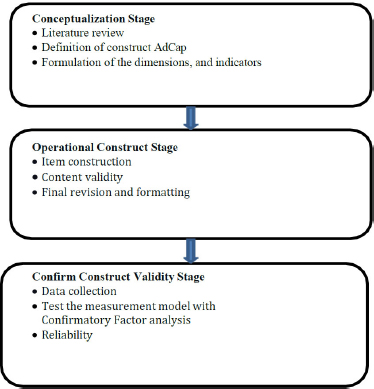
The scale development stage.
2.3.1. Conceptualization Stage
The scale development process began with an extensive theoretical review followed by a focus group discussion (FGD) involving experts in psychology. The purpose of this stage was to formulate the dimensions of Adaptive Capital in alignment with Indonesian cultural and contextual characteristics. The FGD resulted in the identification of four core dimensions (toughness, innovativeness, independence, and wisdom) as key forms of psychological capital required for effective adaptation to rapid and flexible change. These dimensions collectively reflect the capacity for self-reliance and innovation, the maintenance of psychological and spiritual well-being, and the ability to demonstrate resilience and wise judgment across diverse and uncertain conditions.
Subsequently, a theory-driven review was conducted to identify indicators for each dimension. For toughness, the indicators included resilience, self-determination, perseverance, commitment, challenge orientation, adaptability, and conscientiousness. Innovativeness was operationalized through indicators such as unattached exploration, interaction between abstract and concrete thinking, action orientation, courage, sensitivity to uncertainty, designing valuable experiments, opportunity orientation, extracting learning, applying learning, and adapting ideas. Independence comprised self- reliance, sense of choice, non-dependence, risk-taking, realism, and independence of belief [36]. Finally, wisdom included thinking beyond the present moment and social decision-making, reflection and self-understanding, socio-emotional awareness, openness, emotional regulation, spirituality, and tolerance [37, 38].
Data analysis at this stage drew on evaluations from nine experts who assessed the alignment between indicators and the four adaptive capital dimensions. Quantitative analysis of the Delphi data followed established procedures for determining expert consensus. Consensus is reflected in the convergence of judgments toward a central tendency and can be evaluated through aggregated responses [39]. Stability of responses was examined using measures such as the interquartile range (IQR), variation coefficients, and agreement indices [40]. Consistent with Greatorex and Dexter [41], movement toward convergence across Delphi rounds was evaluated using means and standard deviations. Overall, measures of central tendency (mean, median, mode) and dispersion (standard deviation and IQR) were employed to capture collective expert judgments [42, 43].
Based on mean scores, the most strongly endorsed indicators were identified for each dimension. For toughness, these were resilience, self-determination, and perseverance. For innovativeness, unattached exploration, action orientation, and courage emerged as core indicators. Wisdom was represented by thinking beyond the moment and social decision-making, socio-emotional awareness, and reflection and self-understanding. For independence, the retained indicators were self-reliance, sense of choice, and non- dependence.
2.3.2. Operational Construct Stage: Item Construction and Content Validity
Drawing on the results of the expert evaluations, a blueprint was developed as the foundation for item construction. A total of 60 Likert-type items were generated to represent the agreed-upon indicators across the four dimensions. The response scale ranged from 1 (Strongly Irrelevant) to 5 (Highly Relevant). Table 1 presents the indicator-to-item mapping for the adaptive capital (AdCap) instrument.
| Dimensions | Indicators | Descriptions | Item Numbers |
|---|---|---|---|
| Toughness | Resilience | Persistent and determined in completing tasks or facing difficulties. | 1, 8, 12, 16, 60 |
| Self-Determination | Having strength and determination in setting and achieving goals. | 24, 32, 28, 36, 51 | |
| Steadfastness | Having a high tolerance for hardship or suffering. | 40, 44, 48, 56, 52 | |
| Innovative | Unattached Exploration | Open to exploring different ideas or possibilities before making a decision. | 2, 5, 9, 13, 17 |
| Action Orientation | Generating practical ideas that can be easily implemented into real actions. | 21, 25, 29, 33, 37 | |
| Courage | Willing to face the risk of rejection and failure. | 41, 45, 49, 53, 57 | |
| Independent | Self-Reliance | Able to fulfill responsibilities, solve problems independently, and confidently express ideas and concepts. | 10, 14, 18, 22, 55, 59 |
| Sense of Choice | Feeling in control of one’s own decisions and actions; not easily influenced in situations that demand conformity. | 26, 30, 34, 38, 42 | |
| Non-Dependency | Relying on one’s own abilities without expecting help from others. | 46, 50, 54, 58 | |
| Wisdom | Thinking Beyond the Moment and Social Decision-Making | Understanding the human condition and viewing situations holistically; able to make decisions for the greater good or long-term consequences. | 4, 7, 11,15, 19 |
| Social-Emotional Awareness | Showing deep concern for the welfare of others, going beyond self-interest. | 23, 27, 31, 35, 39 | |
| Reflection and Self-Understanding | Evaluating events from multiple perspectives by suspending one’s own biases and gaining broader insight. | 3, 6, 20, 43, 47 |
Content validity was subsequently assessed. Expert review is widely recognized as a core procedure in establishing content validity during scale development [44, 45]. In this study, five psychology experts evaluated the relevance and clarity of each item with respect to its designated indicator and dimension. Content validity was quantified using Aiken’s V coefficient, a commonly employed index for expert-based content validation [46, 47]. The results indicated that 49 items demonstrated high content validity (Aiken’s V > 0.83), while the remaining 11 items showed acceptable validity (Aiken’s V between 0.62 and 0.83). Collectively, all 60 items met established criteria for content validity and were retained for subsequent analysis.
2.3.3. Confirmatory Construct Stage
At this stage, empirical data were collected using an online survey administered via Google Forms. The final dataset comprised responses from 1,010 participants. Data screening procedures were applied prior to analysis; cases with more than 10% missing responses were automatically excluded during data collection. As a result, the analytic sample contained no missing data, ensuring completeness and suitability for factor analytic procedures.
The subsequent phase involved psychometric evaluation, including Confirmatory Factor Analysis and reliability assessment. CFA was conducted to examine the underlying factor structure of the adaptive capital instrument and to evaluate the alignment between empirical data and the theoretically proposed dimensions. Items with inadequate factor loadings or cross-loadings were systematically reviewed and removed.
The results of the analysis indicated that 45 items were retained across four dimensions of adaptive capital. All retained items demonstrated satisfactory factor loadings, while the constructs exhibited adequate internal consistency and convergent validity, as evidenced by Composite Reliability (CR) and Average Variance Extracted (AVE) values exceeding the recommended thresholds. These findings confirm that the final AdCap instrument meets established criteria for psychometric adequacy and supports its use as a reliable and valid measure of adaptive capital.
3. RESULTS
3.1. Confirmatory Factor Analysis and Reliability Analysis
Data analysis was conducted using Structural Equation Modeling (SEM) with a Partial Least Squares (PLS) approach, implemented through SmartPLS software. PLS-SEM is a variance-based structural equation modeling technique that is particularly suitable for predictive research, complex models, and data that do not meet multivariate normality assumptions. Compared with covariance-based SEM, PLS-SEM requires fewer distributional assumptions, making it a robust approach for analyzing complex models [48].
The use of Partial Least Squares Structural Equation Modeling (PLS-SEM) in this study is methodologically justified given the exploratory nature of the research and its focus on scale development. PLS-SEM is particularly suitable for early-stage research where theoretical foundations are still evolving, and the primary objective is to develop and refine measurement instruments rather than to confirm well-established models [49]. Unlike covariance-based SEM, PLS-SEM is variance-based and prediction-oriented, allowing for greater flexibility in handling complex models and constructs that are not yet fully established.
Furthermore, PLS-SEM does not require strict assumptions of multivariate normality and performs well with relatively small sample sizes, which are common in initial scale validation studies [50]. Additionally, PLS-SEM offers substantial flexibility in modeling both reflective and formative constructs, which is advantageous in scale development where the nature of indicators may vary [50]. Given these strengths, PLS-SEM is widely recognized as an appropriate and robust analytical technique for exploratory research and instrument development. Therefore, its use in the present study is both theoretically and methodologically appropriate.
The Kolmogorov–Smirnov test indicated non-normal data distribution across all adaptive capital dimensions (p < 0.05). Accordingly, PLS-SEM was considered an appropriate method for assessing the validity and reliability of the Adaptive Capital (AdCap) measurement instrument. The results of the normality assessment are presented in Table 2.
| Dimension | K-S Test | p (Sig.) | Interpretation |
|---|---|---|---|
| Toughness | 0.066 | <0.001 | Not normally |
| Innovativeness | 0.089 | <0.001 | Not normally |
| Wisdom | 0.084 | <0.001 | Not normally |
| Independence | 0.071 | <0.001 | Not normally |
| AdCap | 0.059 | <0.002 | Not normally |
Confirmatory Factor Analysis (CFA) was conducted to evaluate the measurement model based on four criteria: indicator reliability, construct reliability, convergent validity, and discriminant validity. Indicator reliability was first assessed using standardized factor loadings of the observed indicators on their respective latent variables. Factor loadings above 0.70 were considered indicative of satisfactory indicator reliability, while loadings between 0.50 and 0.60 were retained when theoretically justified, given that the instrument was in the developmental stage [51].
The results of the CFA indicated that several items across the four dimensions exhibited factor loadings below 0.50 and were therefore removed from the model to improve measurement quality. Construct reliability was subsequently evaluated using Composite Reliability (CR), with values exceeding 0.70 indicating acceptable reliability. All latent constructs met this criterion, confirming adequate internal consistency.
Convergent validity was assessed by examining both standardized factor loadings and the Average Variance Extracted (AVE). Convergent validity was considered satisfactory when AVE values exceeded 0.50, indicating that the latent constructs accounted for more than half of the variance in their respective indicators [52]. All retained constructs met the recommended AVE threshold, supporting the convergent validity of the adaptive capital measurement model.
3.2. First-order Analysis of the Toughness Dimension
In the outer model (measurement model) evaluation of the Toughness dimension, one indicator (RES1) exhibited a standardized factor loading below the acceptable threshold (λ < 0.50) and was therefore removed from the model to improve indicator reliability. Subsequent reliability assessment showed that the toughness construct achieved satisfactory internal consistency, as indicated by a Composite Reliability (CR) value exceeding the recommended cutoff of 0.70.
Although the Average Variance Extracted (AVE) value for the toughness dimension did not reach the conventional criterion of 0.50, the construct was retained based on its adequate Composite Reliability. This decision is consistent with methodological recommendations suggesting that constructs may still be considered reliable when CR exceeds 0.70, even if AVE is slightly below the threshold, particularly in the context of scale development.
Discriminant validity of the toughness dimension was further supported by cross-loading analysis, which demonstrated that each indicator loaded more strongly on its intended construct than on other constructs in the model. The complete results of the outer model evaluation are presented in Table 3 and Fig. (2).
| Construct | Loading Factor | Indicator | CR | AVE |
|---|---|---|---|---|
| DET1 | 0.633 | Self Determination | 0.730 | 0.356 |
| DET2 | 0.724 | |||
| DET3 | 0.504 | |||
| DET4 | 0.502 | |||
| DET5 | 0.589 | |||
| RES1 | 0.451* | Resilient | 0.747 | 0.428 |
| RES2 | 0.556 | |||
| RES3 | 0.744 | |||
| RES4 | 0.601 | |||
| RES5 | 0.639 | |||
| TEG1 | 0.640 | Steadfastness | 0.745 | 0.371 |
| TEG2 | 0.669 | |||
| TEG3 | 0.645 | |||
| TEG4 | 0.523 | |||
| TEG5 | 0.554 |
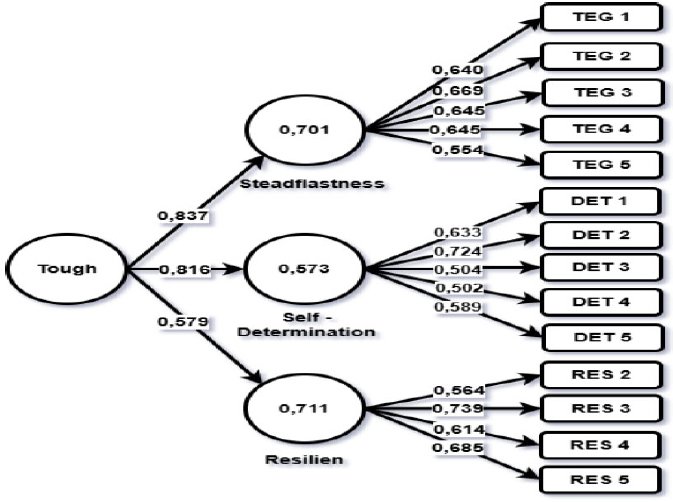
CFA toughness model analysis result.
3.3. First-order Analysis of the Innovative Dimension
In the outer model (measurement model) evaluation of the Innovativeness dimension, several indicators, AO2, AO3, COU4, COU5, UE4, and UE5, exhibited standardized factor loadings below the acceptable threshold (λ < 0.50) and were therefore removed from the model to improve measurement quality.
The reliability assessment indicated that the innovativeness construct demonstrated satisfactory internal consistency, as reflected by Composite Reliability (CR) values exceeding the recommended cutoff of 0.70. Although the Average Variance Extracted (AVE) for the action-oriented indicator fell below the conventional criterion of 0.50, the construct was retained based on its adequate composite reliability. This approach aligns with established methodological guidance, suggesting that constructs may remain acceptable when CR exceeds 0.70, even if AVE values are marginally below threshold during instrument development. Table 4 and Fig. (3) present the results of the CFA/outer model analysis for the innovativeness dimension, including standardized factor loadings, Composite Reliability, and Average Variance Extracted values.
| Item Code | Loading Factor | Indicator | CR | AVE |
|---|---|---|---|---|
| AO1 | 0.651 | Act-Orient | 0.733 | 0.479 |
| AO2 | 0.439* | |||
| AO3 | 0.388* | |||
| AO4 | 0.766 | |||
| AO5 | 0.653 | |||
| COU1 | 0.711 | Courage | 0.814 | 0.593 |
| COU2 | 0.712 | |||
| COU3 | 0.751 | |||
| COU4 | 0.496* | |||
| COU5 | 0.092* | |||
| UE1 | 0.797 | Unatt-Explore | 0.796 | 0.567 |
| UE2 | 0.673 | |||
| UE3 | 0.783 | |||
| UE4 | 0.361* | |||
| UE5 | 0.380* |
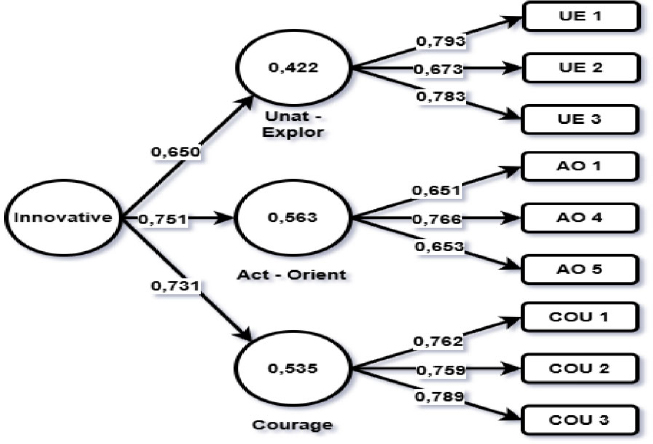
CFA innovative model analysis result.
3.4. First-order Analysis of the Wisdom Dimension
In the confirmatory factor analysis (CFA) of the wisdom dimension, three indicators (TBM2, TBM3, and TBM4) exhibited standardized factor loadings below the acceptable threshold (λ < 0.50) and were therefore removed from the model. These indicators were excluded from subsequent CFA analyses to improve the measurement quality of the wisdom construct.
As presented in Table 5 and Fig. (4), the wisdom dimension also demonstrated satisfactory discriminant validity. Cross-loading analysis indicated that each indicator loaded more strongly on its intended construct than on other constructs in the model, supporting the distinctiveness of the wisdom dimension.
| Item Code | Loading Factor | Indicator | CR | AVE |
|---|---|---|---|---|
| TBM1 | 0.582 | Thinking Beyond the Moment and Social Decision Making | 0.708 | 0.548 |
| TBM2 | 0.483* | |||
| TBM3 | 0.394* | |||
| TBM4 | 0.271* | |||
| TBM5 | 0.634 | |||
| SEA1 | 0.524 | Social-Emotional Awareness | 0.746 | 0.374 |
| SEA2 | 0.691 | |||
| SEA3 | 0.675 | |||
| SEA4 | 0.632 | |||
| SEA5 | 0.513 | |||
| RSU1 | 0.731 | Reflection and Self-Understanding | 0.808 | 0.458 |
| RSU2 | 0.654 | |||
| RSU3 | 0.645 | |||
| RSU4 | 0.677 | |||
| RSU5 | 0.674 |
Note: *invalid item and was removed from the model.
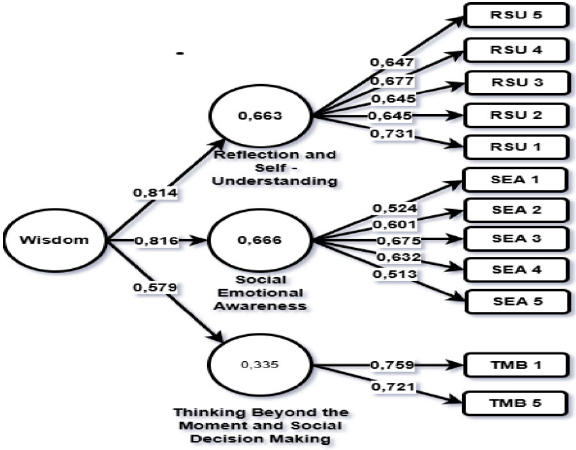
CFA wisdom model analysis results.
Reliability assessment indicated that the wisdom dimension demonstrated satisfactory internal consistency, as evidenced by Composite Reliability (CR) values exceeding the recommended threshold of 0.70. Although the Average Variance Extracted (AVE) values for the social–emotional awareness and reflection and self-understanding indicators did not meet the conventional criterion of 0.50, the wisdom construct was retained based on its adequate Composite Reliability. This decision is consistent with methodological recommendations, allowing constructs with CR values above 0.70 to be considered acceptable during scale development, even when AVE values are marginally below the threshold.
3.5. First-order Analysis of the Independent Dimension
In the confirmatory factor analysis (CFA) of the Independence dimension, several indicators, SR1, SR2, SR4, SC1, and SC2, exhibited standardized factor loadings below the acceptable threshold (λ < 0.50) and were therefore removed from the measurement model. These indicators were excluded from subsequent CFA analyses to enhance construct validity, as presented in Table 6 and Fig. (5).
| Item Code | Loading Factor | Indicator | CR | AVE |
|---|---|---|---|---|
| SR1 | 0.372* | Self-Reliance | 0.700 | 0.425 |
| SR2 | 0.441* | |||
| SR3 | 0.564 | |||
| SR4 | 0.424* | |||
| SR5 | 0.598 | |||
| SR6 | 0.706 | |||
| ND1 | 0.636 | Non-Dependent | 0.734 | 0.411 |
| ND2 | 0.718 | |||
| ND3 | 0.656 | |||
| ND4 | 0.543 | |||
| SC1 | 0.318* | Sense of Choice | 0.796 | 0.566 |
| SC2 | 0.115* | |||
| SC3 | 0.667 | |||
| SC4 | 0.812 | |||
| SC5 | 0.678 |
Note: *invalid item and was removed from the model.
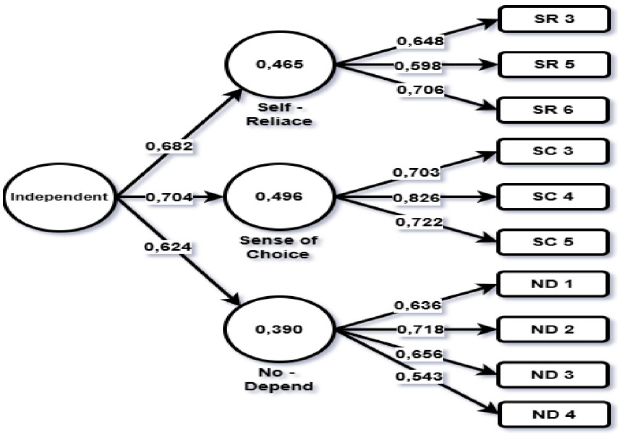
CFA independent model analysis results.
Reliability assessment indicated that the independence dimension demonstrated satisfactory internal consistency, as evidenced by Composite Reliability (CR) values exceeding the recommended cutoff of 0.70. Although the Average Variance Extracted (AVE) values for the self-reliance and non-dependency indicators did not reach the conventional criterion of 0.50, the construct was retained based on its adequate Composite Reliability.
This approach is consistent with methodological recommendations allowing constructs to be considered acceptable when CR values exceed 0.70, particularly in the context of scale development. As shown in Table 6, the independence dimension also demonstrated adequate discriminant validity. Cross-loading analysis indicated that each indicator loaded more strongly on its intended construct than on other constructs, supporting the distinctiveness of the Independence dimension.
3.6. Second-order CFA Analysis
A second-order construct analysis was conducted to examine the relationships between the first-order indicators and their respective higher-order dimensions of Adaptive Capital: toughness, innovativeness, wisdom, and independence.
The results indicated that all indicators demonstrated statistically significant correlations with their corresponding dimensions, with correlation coefficients exceeding acceptable thresholds and significance levels of p < 0.01. These findings provide empirical support for the hierarchical structure of the adaptive capital construct, confirming that the retained indicators meaningfully represent their intended dimensions. Detailed correlation coefficients and significance values are presented in Table 7.
| Dimension | Indicator | Corr. Coeff. | p-value | Conclusion |
|---|---|---|---|---|
| Toughness | Resilience | 0.843 | < 0.01 | Sign |
| Self Determination | 0.757 | < 0.01 | Signt | |
| Steadfastness | 0.837 | < 0.01 | Signt | |
| Innovative | Unattached Exploration | 0.650 | < 0.01 | Signt |
| Action Oriented | 0.750 | < 0.01 | Sign | |
| Courage | 0.731 | < 0.01 | Sign | |
| Wisdom | Thinking Beyond the Moment and Social Decision Making | 0.579 | < 0.01 | Sign |
| Social emotional awareness | 0.816 | < 0.01 | Sign | |
| Reflection & self-understanding | 0.810 | < 0.01 | Sign | |
| Independent | Self Reliance | 0.682 | < 0.01 | Sign |
| Sense of Choice | 0.704 | < 0.01 | Sign | |
| Non-Dependency | 0.624 | < 0.01 | Sign |
3.7. Third-order CFA Analysis
This analysis examined the relationships between the four dimensions, toughness, innovativeness, independence, and wisdom, and the higher-order construct of adaptive capital. Establishing these relationships is essential to confirm whether each dimension meaningfully contributes to the overall construct and functions as part of a coherent system of adaptive personal resources [29, 53]. Statistically significant correlations between each dimension and adaptive capital indicate that the dimensions are not isolated traits but interrelated components that collectively shape individuals’ adaptive capacity in responding to the pressures, uncertainties, and complexities characteristic of BANI and VUCA contexts. Accordingly, this stage of analysis is critical for validating the structural integrity of the adaptive capital model. The results of this analysis are presented in Table 8.
| Construct | Dimension | Correlation Coefficient | p-value | Conclusion |
|---|---|---|---|---|
| Adaptive Capital | Tought | 0.879 | < 0.01 | Significant |
| Inovatif | 0.762 | < 0.01 | Significant | |
| Wisdom | 0.695 | < 0.01 | Significant | |
| Independent | 0.720 | < 0.01 | Significant |
Based on the results of the analysis, it was found that the correlation values of all dimensions with the adaptive capital construct were greater than 0.5 and significant at p < 0.01. This indicates that each dimension has a significant correlation with the adaptive capital construct, so it can be concluded that toughness, innovativeness, wisdom, and independence are indicators of AdCap.
The analysis results of the adaptive capital instrument above indicate that there are 15 items from 4 dimensions, toughness, innovativeness, independence, and wisdom, with loading factors < 0.5, which must be dropped from the model, leaving 45 items that meet validity criteria. The analysis of relationships between the four dimensions, toughness, innovativeness, independence, and wisdom, and the higher-order construct of adaptive capital yielded correlation values greater than 0.5 and significant at p < 0.01. This demonstrates that innovativeness, toughness, wisdom, and independence are dimensions of AdCap. The final model from the analysis is presented in the Fig. (6).
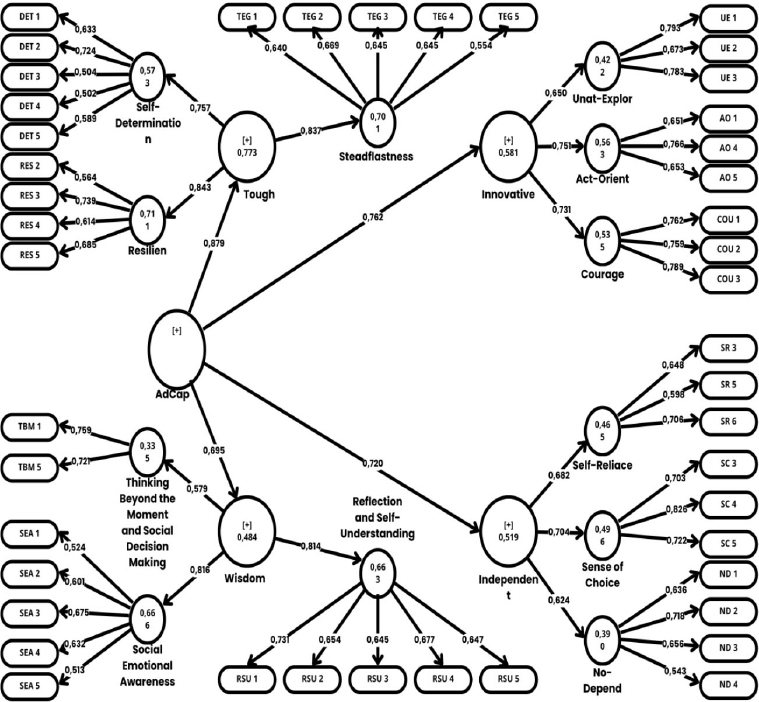
Final adaptive capital model.
4. DISCUSSION
The present study aimed to develop and validate the Adaptive Capital (AdCap) Scale as a multidimensional construct, representing the psychological resources required by Generation Z to navigate the challenges of VUCA and BANI environments. The findings indicate that Adaptive Capital comprises four interrelated dimensions, toughness, innovativeness, independence, and wisdom, which together reflect a form of psychological capital essential for effective adaptation in dynamic and uncertain contexts. Although the study was exploratory in nature, the results provide robust preliminary evidence supporting the construct validity and reliability of the AdCap Scale.
4.1. Overview of Findings
The results of the exploratory and confirmatory analyses confirmed that the four dimensions meaningfully contribute to the overarching construct of adaptive capital. All subdimensions showed statistically significant correlations with the total construct, indicating their synergistic interaction rather than isolated functioning. Among the four, toughness displayed the strongest correlation, followed by innovativeness, independence, and wisdom, suggesting that endurance and resilience are fundamental to adaptive capacity, while creativity, autonomy, and reflective wisdom complement and sustain adaptive behaviors. The composite reliability (CR) of all dimensions exceeded 0.70, confirming internal consistency despite some Average Variance Extracted (AVE) coefficients falling below 0.50, an acceptable result for an early-stage scale development study.
4.2. Theoretical Interpretation
The results of the exploratory and confirmatory analyses in this study confirm that the four dimensions, toughness, innovativeness, independence, and wisdom, significantly contribute to the overarching construct of adaptive capital. These findings are consistent with the growing body of literature in Positive Psychology and Organizational Psychology, which emphasizes the importance of multidimensional psychological resources in coping with uncertainty and environmental changes [54]. In this context, adaptive capital can be understood as an integration of self-regulation capacity, cognitive flexibility, and emotional resilience that enables individuals to adapt effectively.
From a theoretical perspective, the significant contribution of all subdimensions to the overall construct indicates that adaptive capital operates synergistically rather than as a mere aggregation of independent components. This is consistent with the framework of Psychological Capital, which posits that the combination of self-efficacy, hope, optimism, and resilience produces a stronger effect than each element alone [55, 56]. Therefore, adaptive capital can be positioned as a conceptual extension that integrates new dimensions relevant to the contemporary generational context.
The toughness dimension, which exhibited the strongest correlation, suggests that psychological endurance and resilience serve as the fundamental basis of adaptive capacity. This finding reinforces the resilience literature, which identifies the ability to withstand pressure as a key predictor of successful adaptation in rapidly changing environments [57, 58]. In the context of Generation Z, who face global uncertainties such as digital disruption and social crises, toughness becomes a foundational resource that enables individuals to maintain optimal functioning.
Furthermore, the innovativeness dimension, ranked second, highlights the importance of creativity and flexible thinking. This aligns with cognitive flexibility theory, which emphasizes that the ability to generate novel solutions is crucial in complex and ambiguous situations [59, 60]. Innovativeness functions not only as a reactive mechanism to change but also as a driver of proactive adaptation.
The independence dimension reflects autonomy and self-directed decision-making, consistent with Self-Determination Theory [61]. Within this framework, the need for autonomy is a critical factor that supports intrinsic motivation and adaptive success. Individuals with high levels of independence tend to possess strong internal control, enabling them to navigate change without excessive reliance on external conditions.
Meanwhile, the wisdom dimension serves as a reflective component that integrates experience and moral judgment in the adaptation process. This concept is in line with contemporary theories of wisdom, which conceptualize it as a combination of knowledge, reflection, and emotional regulation [62]. Although its correlation is lower than that of other dimensions, wisdom serves as a balancing mechanism that sustains adaptive behavior over the long term.
From a psychometric perspective, the Composite Reliability (CR) values exceeding 0.70 across all dimensions indicate good internal consistency, thereby supporting the construct validity of Adaptive Capital. Although some Average Variance Extracted (AVE) values fall below 0.50, this condition is still acceptable in the early stages of scale development, particularly when composite reliability is high [51, 63]. This suggests that the instrument demonstrates strong potential, although further refinement is needed in future research.
Overall, these findings contribute to the literature by proposing adaptive capital as an integrative construct that is relevant for understanding the adaptive capacity of Generation Z. The integration of toughness, innovativeness, independence, and wisdom indicates that adaptation is not merely about survival but also about the capacity to grow dynamically in response to complex and evolving challenges.
4.3. Implications for Generation Z in the BANI Context
The BANI framework, marked by brittleness, anxiety, nonlinearity, and incomprehensibility, demands that individuals cultivate adaptability not only as a coping mechanism but as a proactive strategy for growth. For Generation Z, whose formative years coincide with rapid technological disruption and social uncertainty, adaptive capital becomes a critical asset. The finding that toughness most strongly correlates with AdCap indicates that perseverance and resilience remain core capacities for stability under volatility. At the same time, innovativeness and independence demonstrate that adaptation involves creative problem-solving and self-regulation, while wisdom contributes the moral and reflective depth required for sustainable adjustment.
These findings are consistent with the view that adaptability reflects the capacity to regulate psychological and behavioral responses to uncertainty. Furthermore, wisdom is regarded as the integration of intelligence and virtue, enabling individuals to make ethically grounded decisions in complex situations. These perspectives suggest that adaptive capital extends beyond a set of coping mechanisms, representing a framework of proactive competencies that supports long-term well-being and meaningful functioning in the BANI environment.
4.4. Comparison with Previous Research
Earlier studies on psychological adaptability have typically isolated constructs such as resilience, grit, or emotional intelligence. The AdCap framework offers a more holistic model that situates these traits within a systemic resource paradigm. For example, the concepts of hardiness and grit are closely related to the toughness dimension; however, they do not explicitly incorporate innovative and ethical aspects. Likewise, the RAAT and ICA frameworks offer theoretical responses to the BANI context but remain limited in terms of empirical validation. This study contributes by operationalizing and validating Adaptive Capital, thereby providing an empirical foundation for these theoretical concepts through measurable constructs.
Furthermore, wisdom and independence distinguish AdCap from other adaptability models by emphasizing ethical reflection and autonomy. In collectivistic societies such as Indonesia, independence does not connote individualism but rather self-regulated agency within interdependence, consistent with self-determination theory. Thus, AdCap captures not only cognitive and behavioral adaptability but also cultural congruence and moral agency, elements often neglected in Western-centric models of adaptability.
4.5. Cultural and Contextual Significance
Indonesia’s socio-cultural landscape, rooted in communal harmony and moral wisdom, provides a distinctive context for interpreting Adaptive Capital. The prominence of toughness and wisdom within the AdCap construct reflects local values, emphasizing inner strength and moral discernment as the foundations of adaptive functioning. This echoes indigenous concepts of toughness and lokal wisdom, which merge resilience, empathy, and collective wellbeing. Consequently, the AdCap model demonstrates strong ecological validity by integrating universal psychological principles with culturally grounded dimensions of adaptability.
4.6. Practical Implications
The AdCap Scale provides a substantive resource for researchers, educators, and practitioners seeking to strengthen adaptive capacities among youth. Within higher education, the scale may inform the design and evaluation of programs that promote self-reliance, creativity, and reflective wisdom through experiential and community service learning. In an organizational context, it can inform leadership development, innovation management, and workforce resilience initiatives among early-career professionals. Moreover, given that AdCap integrates both cognitive-behavioral competencies with moral-emotional dispositions, the scale can provide a conceptual basis for counseling services and digital wellbeing programs that foster holistic adaptability among Generation Z.
4.7. Nomological Network of Adaptive Capital
The validation of the adaptive capital (AdCap) construct is grounded not only in structural evidence derived from exploratory and confirmatory factor analyses (EFA and CFA), but also in its placement within a coherent nomological network, that is, a system of conceptual and empirical relationships with other relevant psychological constructs. Based on the findings of this study, AdCap can be positioned as a higher-order adaptive resource system that integrates protective, generative, regulatory, and ethical resources in responding to uncertainty.
The results indicate that the four dimensions, toughness, innovativeness, independence, and wisdom, are significantly correlated with the overall construct, suggesting a synergistic configuration rather than isolated functioning. The strongest association was observed for toughness, indicating that resilience and endurance serve as the core stabilizing resource, while the remaining dimensions expand adaptive capacity through cognitive, autonomous, and reflective mechanisms.
4.7.1. AdCap within a Resource-Theoretical Framework
From the perspective of Conservation of Resources Theory, individuals strive to acquire, retain, and protect valuable resources in order to maintain well-being. Within this framework, AdCap can be conceptualized as an integrated personal resource reservoir.
Nomologically: Toughness functions as a defensive resource that mitigates resource loss and reduces the impact of stress. Innovativeness acts as a resource-gain facilitator, enabling the generation of novel solutions under nonlinear conditions. Independence strengthens perceived control and self- regulation. Wisdom ensures the ethical and sustainable use of resources. Accordingly, AdCap is expected to positively correlate with psychological well-being and stress resilience, negatively correlate with burnout and uncertainty-related anxiety, and function as a mediator between exposure to uncertainty and psychological adaptation.
In this network, AdCap is not merely an outcome of other resources but operates as a meta-resource integrator that coordinates multiple adaptive capacities.
4.7.2. Extension of Psychological Capital
Conceptually, AdCap extends the scope of Psychological Capital (PsyCap), which comprises hope, efficacy, resilience, and optimism. Within the nomological framework, toughness overlaps with resilience. Independence relates to self-efficacy. Innovativeness expands the dimension of hope through creative solution orientation. Wisdom introduces an ethical-reflective dimension not explicitly addressed in PsyCap. While PsyCap primarily emphasizes performance enhancement in organizational settings, AdCap focuses on adaptive readiness in broader and less predictable contexts. Thus, AdCap may be viewed as a contextual evolution of PsyCap, particularly relevant under conditions of extreme volatility.
4.7.3. Relationship with Adaptability and Self-Regulation
Adaptability refers to the capacity to regulate cognitive, affective, and behavioral responses to change. Within the nomological network, Adaptive Capital (AdCap) is expected to demonstrate a strong positive association with adaptability, as toughness contributes to affective stability, innovativeness supports cognitive flexibility, independence enhances self-regulation, and wisdom facilitates moral reflection in complex decision-making processes. Furthermore, the independence dimension is conceptually aligned with self-determination theory, particularly the psychological need for autonomy. In this context, AdCap may function as a mediator between autonomy support and well-being, as well as a moderator of the relationship between anxiety and performance outcomes.
4.8. Future Directions
In the present study, invariance analysis was not conducted because the primary objective of the research was to perform confirmatory factor analysis (CFA) and reliability testing in the development of a new scale. This approach was based on the arguments proposed by Cheung and Widhiarso, who suggested that invariance testing is not mandatory in exploratory research aimed at developing a new measurement scale. Measurement invariance becomes essential only when researchers intend to compare scale scores across different groups or contexts, requiring the instrument to function equivalently across populations [64, 65].
Future studies should conduct predictive validity testing and measurement invariance analyses across different cultural groups, particularly between societies that emphasize individualism and achievement orientation and Eastern societies that prioritize collectivist values. Such analyses are important to ensure that the scale functions equivalently across different sociocultural contexts and possesses adequate predictive capability in explaining relevant psychological and educational outcomes. Furthermore, cross-cultural validation would strengthen the generalizability and robustness of the instrument by confirming whether the underlying construct is interpreted consistently across populations with different cultural orientations.
Future studies should aim to confirm the factorial structure of the AdCap Scale using Confirmatory Factor Analysis (CFA) with larger and more diverse samples. Demonstrating predictive validity, for instance, the relationship between adaptive capital, well-being, and performance, would further consolidate its practical utility.
In addition to methodological recommendations, future research may employ several theoretical frameworks to explain the hypothesized relationships between “adaptive capital” and other constructs. These constructs are as follows:
- Conservation of Resources (COR) Theory – COR offers the most direct theoretical foundation for understanding how AdCap relates to well-being, stress, burnout, and performance, particularly through its emphasis on resource acquisition, protection, and loss prevention.
- Broaden-and-Build Theory – This theory provides a framework for explaining the association between AdCap and positive emotions, creativity, and long-term psychological growth through resource accumulation processes.
- Social Cognitive Theory – This perspective helps clarify the relationship between AdCap, self-efficacy, and behavioral regulation, particularly within the framework of reciprocal interactions among person, behavior, and environment.
- Transactional Model of Stress and Coping – This model explains how AdCap may influence cognitive appraisal processes and coping strategies in response to stressors.
5. LIMITATIONS
This study relied on self-report measures, which may have introduced social desirability bias. Participants might have given socially desirable responses rather than accurately reflecting their actual experiences and behaviors. Future research can address this limitation by applying triangulation, combining multiple data sources such as observational methods, interviews, and questionnaires to achieve a more comprehensive and valid assessment of the constructs. Moreover, future studies should also examine the predictive validity of the AdCap Scale.
This study represents an initial phase in the development of the instrument. Although the Composite Reliability (CR) values for all dimensions exceeded the recommended threshold of 0.70, several Average Variance Extracted (AVE) coefficients remained below 0.50. While this condition may be considered acceptable in early-stage scale development studies, it suggests that convergent validity has not yet reached an optimal level. Therefore, replication with larger and more heterogeneous samples is necessary to further strengthen the factorial structure and improve indicator quality.
Although the AdCap model demonstrates strong contextual relevance within Indonesia’s socio-cultural landscape, its generalizability to other cultural settings remains limited. Dimensions such as independence may carry different meanings in collectivistic cultures compared to individualistic ones. Accordingly, cross-cultural validation and measurement invariance testing are necessary to ensure construct equivalence at the international level.
CONCLUSION
In this study, a new instrument, the Adaptive Capital (AdCap) Scale, was developed to measure Adaptive Capital for facing the challenges of the VUCA and BANI eras. Adaptive Capital serves as a crucial psychological resource for Generation Z to overcome the uncertainties and complexities inherent in these contexts. The AdCap Scale is a multidimensional measurement instrument comprising the dimensions of toughness, innovativeness, independence, and wisdom.
A measurement instrument is robust when it accurately measures the intended construct (validity) and consistently produces reliable results (reliability). The AdCap instrument was developed through several stages involving subject-matter experts and research participants. Using the Delphi technique, the experts identified four key dimensions of AdCap: toughness, innovativeness, independence, and wisdom. We defined the indicators of toughness as resilience, self-determination, and perseverance; the indicators of innovativeness as unattached exploration, action orientation, and courage; the indicators of independence as self-confidence, sense of choice, and non- dependence; and the indicators of wisdom as thinking beyond the present moment, social decision-making, socio-emotional awareness, reflection, and self-understanding.
The data collected through the Delphi process were quantitatively analyzed. The indicators for each AdCap dimension (toughness, innovativeness, wisdom, and independence) were determined based on the mean scores and standard deviations of expert ratings. A lower mean value indicated stronger expert agreement on the relevance of an indicator as its respective AdCap dimension.
The Confirmatory Factor Analysis (CFA) results for each dimension showed that the toughness dimension encompassed 14 items with factor loadings ranging from 0.502 to 0.740; the innovativeness dimension contained nine items with loadings ranging from 0.651 to 0.790; the independence dimension contained 10 items with loadings ranging from 0.543 to 0.812; and the wisdom dimension contained 12 items with loadings ranging from 0.513 to 0.677. 15 items with loading factors below 0.50 and 45 above 0.50 were found; therefore, 15 items were removed from the AdCap Scale, leaving 45 items. Our discriminant validity analysis showed that all latent constructs strongly predicted their respective indicators, with correlations within each construct higher than those across constructs. Thus, all dimensions demonstrated good discriminant validity.
Reliability analysis was conducted using internal consistency measures. Although some Average Variance Extracted (AVE) coefficients fell below 0.50, all Composite Reliability (CR) values exceeded the threshold of 0.70. These findings indicate that the instrument demonstrates satisfactory internal consistency, as evidenced by the composite reliability values obtained for all constructs [66].
Our third-order factor analysis revealed the following correlation coefficients: Resilience with AdCap = 0.879 (p < 0.01); Innovativeness with AdCap = 0.762 (p < 0.01); Independence with AdCap = 0.695 (p < 0.01); and Wisdom with AdCap = 0.720 (p < 0.01). These results show that all dimensions serve as integral components of the AdCap Scale. For multidimensional scales, it is crucial to examine whether the dimensions are interrelated. Therefore, each latent variable was interpreted in light of its theoretical background to determine which dimensions it captures and how they define the nature of the construct being measured. This approach ensures construct validity and enables us to estimate the reliability of each dimension. Through this process, factor analysis provides answers regarding the dimensionality of adaptive capital.
AUTHORS’ CONTRIBUTIONS
The authors' contributions to this study are as follows: W.J.P.: Study conception, literature review, and research design; D.I.A.: Arrangement of measuring instruments; F.K. and A.D.A: Data collection. G.R.: Analysis and interpretation of results; I.P., E.H., and S.: Manuscript preparation. All the authors reviewed and approved the final version of the manuscript.
LIST OF ABBREVIATIONS
| AdCap | = Adaptive Capital Scale |
| VUCA | = Volatile, Uncertain, Complex, and Ambiguous |
| BANI | = Brittle, Anxious, Nonlinear, and Incomprehensible |
| POB | = Positive Organizational Behavior |
| RAAT | = Resilience, Attentiveness, Adaptation, and Transparency |
| ICA | = Identity Communication Alignment |
| COR | = Conservation of Resources |
| FGD | = Focus Group Discussion |
| IQR | = Interquartile Range |
| VCV | = Variation in the Coefficient of Variation |
| SD | = Standard Deviation |
| SEM | = Structural Equation Model |
| PLS | = Partial Least Squares |
| CFA | = Confirmatory Factor Analysis |
| AVE | = Average Variance Extracted |
| CR | = Composite Reliability |
ETHICS APPROVAL AND CONSENT TO PARTICIPATE
All research procedures adhered to the ethical standards established by the national research committee and received formal approval by the Ethical Committee on Social Studies and Humanities – Indonesia National Research and Innovation Agency, Indonesia (Badan Riset dan Inovasi Nasional), Number: 894/KE.01/SK/11/2024.
HUMAN AND ANIMAL RIGHTS
All human research procedures followed were in accordance with the ethical standards of the committee responsible for human experimentation (institutional and national), and with the Helsinki Declaration of 1975, as revised in 2013.
CONSENT FOR PUBLICATION
Written informed consent was obtained from all participants prior to their inclusion in this study.
AVAILABILITY OF DATA AND MATERIALS
The data supporting the findings of the article is available in the Zenodo Repository at https://doi.org/10.5281/zenodo.22104768.
FUNDING
This research was supported by the Ministry of Higher Education, Research, and Technology of the Republic of Indonesia, Funder ID: 10.13039/501100010447, Awards/Grant number: 004/SP2H/PT-BATCH.2/LL7/2024.
ACKNOWLEDGEMENTS
We express our gratitude to the Ministry of Education, Science, and Technology of the Republic of Indonesia for funding this research. We also thank all field coordinators and respondents who contributed to this study.