All published articles of this journal are available on ScienceDirect.

Intergenerational Co-Residence and Life Satisfaction: The Moderating Role of Productive Engagement among Older Adults

Abstract
Introduction
Living with adult children may provide emotional and instrumental support, thereby enhancing older adults' life satisfaction. However, it may also increase intergenerational conflict, potentially reducing life satisfaction. These mixed findings suggest that other factors, such as productive engagement, may influence the relationship between intergenerational co-residence and life satisfaction.
Methods
This study examined the moderating role of productive engagement on the relationship between intergenerational co-residence and life satisfaction among older adults. The sample consisted of 331 older adults aged 60 years and above (M = 66.75) who had at least one adult child. Data were analyzed using moderation analysis with the PROCESS Macro in IBM SPSS Statistics.
Results
A significant interaction effect was found after controlling for relevant sociodemographic characteristics of older adults and their adult children. The results indicate that productive engagement moderates the relationship between intergenerational co-residence and life satisfaction among older adults.
Discussion
The findings suggest that the association between intergenerational co-residence and life satisfaction depends on older adults’ levels of productive engagement. Living with adult children was more positively associated with life satisfaction among older adults with higher levels of productive engagement.
Conclusion
The study highlights the role of productive engagement in the relationship between intergenerational co-residence and life satisfaction among older adults. Supporting older adults’ participation in meaningful activities that align with their capacities may help promote well-being in later life. Future research should examine other relevant factors, such as relationship quality or health status, to better understand the conditions under which intergenerational co-residence is associated with life satisfaction.
1. INTRODUCTION
The increasing number of older adults reflects a global trend of population aging [1]. By 2050, the population of older adults is projected to exceed that of adolescents and young adults aged 10–24 years [2]. Population aging poses substantial challenges for countries, with implications for health, social, economic, and cultural domains [3]. Nevertheless, population aging may also present an opportunity for a second demographic dividend, particularly when older adults retain the potential to contribute to national development [4]. Accordingly, providing adequate support for older adults is essential to optimize their intrinsic capacity and quality of life, considering the multiple challenges commonly encountered during the aging process.
In later life, older adults experience a range of age-related changes, including declines in physical and mental health, as well as reductions in cognitive, social, and economic functioning, which have been linked to lower life satisfaction [5, 6]. As a component of subjective well-being, life satisfaction refers to an individual’s cognitive evaluation of their overall quality of life [7]. This evaluation is subjective and depends on the extent to which individuals perceive their life conditions as aligning with their personal standards [7]. At the same time, high life satisfaction is considered an important indicator of successful aging [8].
Life satisfaction in later life can also be understood through Erikson’s theory of psychosocial development, which emphasizes that individuals in the final stage of life face a crisis between ego integrity and despair [9]. During this stage, individuals reflect on and evaluate their life experiences. When individuals accept their lives as meaningful and experience minimal regret, they achieve ego integrity, which is reflected psychologically in higher life satisfaction. Thus, life satisfaction encompasses both individuals’ overall evaluations of their life conditions and their perceptions of developmental accomplishments. Accordingly, understanding factors that influence older adults’ life satisfaction is important in the context of population aging.
1.1. Intergenerational Co-residence and Life Satisfaction
Living arrangements are an important determinant of life satisfaction among older adults [5, 10, 11]. Different living arrangements, such as living alone, living with a spouse, or living with other family members, may have distinct implications for life satisfaction. According to national statistics, approximately 70% of older adults in Indonesia live in intergenerational households [12]. This living arrangement is commonly referred to as intergenerational co-residence, in which older adults live with their adult children in the same household [13]. In Asian cultural contexts, this arrangement is strongly shaped by the value of filial piety, which reflects moral expectations for children to respect and care for their aging parents [14]. Strong adherence to filial piety norms has been shown to increase the likelihood that adult children will live with their aging parents [15].
Intergenerational co-residence offers various benefits for older adults, including emotional and financial support, daily care, and assistance with household tasks, which may in turn enhance their life satisfaction [16-19]. Studies conducted in Asian countries, such as Malaysia and Vietnam, have shown that living with adult children is associated with higher life satisfaction among older adults [20, 21]. Moreover, intergenerational co-residence may mitigate feelings of depression and loneliness, thereby contributing to greater well-being in later life [22].
In contrast to previous findings, some studies have reported negative outcomes associated with intergenerational co-residence. Living in multigenerational households was found to be associated with increased depressive symptoms and lower life satisfaction, particularly among younger older adults [23]. They suggested that these negative outcomes may be explained by older adults’ perceptions that living with adult children reduces their autonomy. Consistent with this explanation, intergenerational co-residence has also been associated with increased family conflict due to intergenerational differences in values and daily routines, which may negatively affect older adults’ well-being [24, 25]. Older adults who live with their adult children but experience poor relationship quality tend to report lower life satisfaction [26]. Moreover, intergenerational co-residence increases depressive symptoms, particularly among older adults living with unemployed adult children [27].
1.2. The Moderating Role of Productive Engagement
Existing studies suggest that not all older adults who live with their adult children report high levels of life satisfaction. This complexity highlights the need to investigate moderating variables that can clarify when intergenerational co-residence is beneficial or detrimental for older adults’ life satisfaction. To do so, it is necessary to consider individual factors that may shape older adults’ experiences of intergenerational co-residence. One relevant variable is productive engagement, which has been shown to enhance feelings of usefulness and well-being in later life [28]. Maintaining involvement in productive activities has also been identified as a key component of successful aging [29]. Productive engagement in older adults is defined as participation in activities that produce goods or services (whether paid or unpaid), including working, volunteering, and caregiving [30].
Currently, a substantial proportion of older adults continue to work. In Indonesia, 55.32% of older adults were reported to be working in 2024 [12]. Older adults with limited financial resources and without pension benefits are more likely to continue working [31, 32]. Unlike paid work, which is primarily motivated by economic necessity, volunteering is driven by the desire to help others, organizations, or communities without financial compensation [33]. Meanwhile, caregiving refers to the act of assisting and caring for individuals in need, such as grandchildren, spouses, or other family members [30]. Research in Indonesia found that grandchild caregiving is the most common form of caregiving among older adults, for both men and women [34]. Therefore, productive engagement in this study is examined through involvement in paid work, volunteering, and grandparenting.
Productive engagement has been shown to enhance life satisfaction among older adults [35]. A recent study further supports this relationship, showing that productive engagement is positively associated with life satisfaction, particularly among older women [36] and older adults living with their adult children [37]. Several studies have also examined each aspect of productive engagement independently and reported that working [38], volunteering [39], and caregiving [40] are positively associated with life satisfaction. Other research further identified positive associations between all three aspects of productive engagement and life satisfaction among older adults, particularly in urban areas [41]. Additional findings further support examining productive engagement in the context of intergenerational living arrangements. Productive engagement has been shown to enhance resilience and a sense of control in older adults, which are important for managing stress in various social interactions, including family dynamics [42, 43]. Moreover, productive engagement is associated with lower levels of stress, depressive symptoms, and loneliness, as well as improved cognitive functioning, which in turn increases psychological well-being [44, 45]. Based on this evidence, productive engagement is expected to buffer the potential negative effects of intergenerational co-residence on life satisfaction.
Despite growing evidence on the benefits of productive engagement for well-being in later life, limited research has examined productive engagement as a moderator in the relationship between intergenerational co-residence and life satisfaction among older adults. Previous studies have primarily examined productive engagement as a direct predictor of life satisfaction rather than as a moderating factor in family living arrangements. At the same time, findings regarding the association between intergenerational co-residence and life satisfaction remain inconsistent, suggesting that this relationship may depend on certain contextual or individual factors. This gap is particularly important in Indonesia, where multigenerational households are highly prevalent. Therefore, further investigation is needed to clarify under what conditions intergenerational co-residence contributes to older adults’ life satisfaction.
1.3. Present Study
This study aims to examine the moderating role of productive engagement in the relationship between intergenerational co-residence and life satisfaction among older adults. Sociodemographic characteristics of older adults and their adult children that are associated with life satisfaction were included as control variables. The present study hypothesized that productive engagement would moderate the relationship between intergenerational co-residence and life satisfaction, such that the relationship would become more positive as levels of productive engagement increased. The findings are expected to contribute to the development of intervention strategies and policies that support older adults’ involvement in meaningful activities as part of efforts to promote successful aging and well-being. More broadly, this research may provide insights for addressing challenges associated with population aging and the growing prevalence of multigenerational households.
2. METHODS
2.1. Participants
This study used a cross-sectional design and collected survey data from older adults in Indonesia. Inclusion criteria were: (1) Indonesian citizens aged 60 years or older; (2) having at least one adult child (aged 21 years or older). Participants were recruited via convenience sampling, meeting the predefined inclusion criteria. The required sample was determined using a priori power analyses conducted with G*Power 3.1, with an effect size of 0.10, an alpha level of 0.05, and a statistical power of 0.95 [46]. The analysis indicated that at least 158 participants were required.
A total of 342 older adults met the inclusion criteria. During data screening, 11 participants were excluded due to duplicate responses. The final sample consisted of 331 participants. The sample was drawn from 24 provinces across Indonesia, with the highest representation from Jakarta (46.53%), West Java (15.71%), and South Sulawesi (13.59%).
Data collection was conducted in February 2025 using both online and offline methods. Online data were collected through a self-administered questionnaire distributed via social media platforms. Offline data were collected using a paper-and-pencil approach at several community-based informal education centers for older adults (Sekolah Lansia) located in Pasar Minggu, Fatmawati, Pesanggrahan, and Cakung. Ethical approval for this study was obtained from the Committee on Research Ethics at the Faculty of Psychology, Universitas Indonesia. Informed consent was obtained from all participants before their participation.
2.2. Measures
Life satisfaction as an outcome variable refers to an individual’s subjective cognitive evaluation of their overall quality of life [7]. It was measured using the Indonesian version of the Satisfaction with Life Scale [7, 47]. The scale consists of five items rated on a 7-point Likert scale (1 = strongly disagree, 7 = strongly agree). A sample item is “In most ways, my life is close to my ideal.” Total scores range from 5 to 35, with higher scores indicating greater life satisfaction. The scale has demonstrated good reliability (α = .92).
Intergenerational co-residence as a predictor variable refers to older adults living with their adult children in the same household. Intergenerational co-residence was measured as a dichotomous variable indicating whether older adults were currently living with at least one adult child aged 21 years or older. Responses were coded as 0 = no and 1 = yes, consistent with previous studies using similar operational definitions [22, 48].
Productive engagement, as a moderating variable, was measured by older adults’ involvement in three types of productive activities over the past 12 months: paid work, volunteering, and grandparenting [41]. Paid work included both full-time and part-time employment (0 = not employed, 1 = employed). Volunteering referred to structured voluntary activities conducted within an organization or institution (0 = not involved, 1 = involved). Grandparenting was defined as providing care for grandchildren (0 = not involved or did not have grandchildren, 1 = provided care for at least one hour per day). A total productive engagement score was calculated by summing the three activities, resulting in a score ranging from 0 to 3, with higher scores indicating greater involvement in productive activities [49].
Sociodemographic characteristics of older adults and their co-residing adult children were collected as control variables based on reports from the older adults. For participants who did not live with an adult child, information was reported regarding the adult child with whom they had the closest relationship. Older adult characteristics included age (years), gender (0 = male, 1 = female), education level (0 = primary or less, 1 = secondary, 2 = undergraduate, 3 = postgraduate), and marital status (0 = widowed, 1 = divorced, 2 = separated, 3 = married). Adult child characteristics included age (years), gender (0 = male, 1 = female), education level (0 = primary or less, 1 = secondary, 2 = undergraduate, 3 = postgraduate), and employment status (0 = not employed, 1 = employed).
2.3. Data Analysis
Data screening was conducted to identify and remove duplicate entries and statistical outliers. Additionally, cases with missing data were excluded from the final analysis. The data were analyzed using SPSS Statistics version 30. Descriptive analyses were computed to summarize participant characteristics and variable distributions. Spearman correlation analyses were performed to examine associations between the variables. To test the main hypothesis, moderation analysis was conducted using PROCESS Macro Model 1 with 5,000 bootstrap resamples [50].
3. RESULTS
3.1. Sample Description
The sample consisted of 331 participants with ages ranging from 60 to 80 years (M = 66.75, SD = 5.09). As shown in Table 1, they were predominantly female (65.56%), had completed an undergraduate degree (35.04%), and were married (59.21%). Meanwhile, adult children’s ages ranged from 21 to 55 years (M = 34.36, SD = 8.13); the majority had completed an undergraduate degree (66.46%) and were employed (75.23%).
| Category | Variables | M (SD) | n | % |
|---|---|---|---|---|
| Older adults’ characteristics | Age | 66.75 (5.09) | - | - |
| Gender | - | - | - | |
| 1. Male | - | 114 | 34.44 | |
| 2. Female | - | 217 | 65.56 | |
| Education level | - | - | - | |
| 1. Primary or less | - | 13 | 3.93 | |
| 2. Secondary | - | 102 | 30.82 | |
| 3. Undergraduate | - | 116 | 35.04 | |
| 4. Postgraduate | - | 100 | 30.21 | |
| Marital status | - | - | - | |
| 1. Widowed | - | 105 | 31.72 | |
| 2. Divorced | - | 18 | 5.44 | |
| 3. Separated | - | 12 | 3.63 | |
| 4. Married | - | 196 | 59.21 | |
| Adult children’s characteristics | Age | 34.36 (8.13) | - | - |
| Gender | - | - | - | |
| 1. Male | - | 164 | 49.55 | |
| 2. Female | - | 167 | 50.45 | |
| Education level | - | - | - | |
| 1. Primary or less | - | 0 | 0 | |
| 2. Secondary | - | 55 | 16.62 | |
| 3. Undergraduate | - | 220 | 66.46 | |
| 4. Postgraduate | - | 56 | 16.92 | |
| Employment status | - | - | - | |
| 1. Unemployed | - | 82 | 24.77 | |
| 2. Employed | - | 249 | 75.23 |
3.2. Variables Description
As shown in Table 2, a substantial proportion of participants (41.69%) reported above-average levels of life satisfaction. Most participants lived with their adult children (71%) and engaged in one to three types of productive activities (79.46%). Among the various activities, volunteering was the most reported (63.44%).
| Variables | M (SD) | n | % |
|---|---|---|---|
| Life satisfaction | 25.17 (6.24) | - | - |
| 1. Very dissatisfied (5–9) | - | 4 | 1.21 |
| 2. Dissatisfied (10–14) | - | 24 | 7.25 |
| 3. Slightly dissatisfied (15–19) | - | 36 | 10.88 |
| 4. Neutral (20) | - | 10 | 3.02 |
| 5. Slightly satisfied (21–25) | - | 70 | 21.15 |
| 6. Satisfied (26–30) | - | 138 | 41.69 |
| 7. Very satisfied (31–35) | - | 49 | 14.80 |
| Intergenerational co-residence | - | - | - |
| 1. Not living with children | - | 96 | 29.00 |
| 2. Living with children | - | 235 | 71.00 |
| Productive engagement | - | - | - |
| 1. Number of activities | 1.20 (0.819) | - | - |
| - No activities | - | 68 | 20.54 |
| - One type of activity | - | 144 | 43.51 |
| - Two types of activities | - | 108 | 31.12 |
| - Three types of activities | - | 16 | 4.83 |
| 2. Type of activities | - | - | - |
| - Working | - | 92 | 27.79 |
| - Volunteering | - | 210 | 63.44 |
| - Grandparenting | - | 96 | 29.00 |
3.2.1. Bivariate Correlations
The correlation analysis (Table 3) showed a significant positive association between overall productive engagement and life satisfaction (r = 0.146, p < 0.01), indicating that higher levels of productive engagement were associated with higher life satisfaction. When examined by type of activity, older adults who were employed (r = 0.124, p < 0.05) and volunteered (r = 0.127, p < 0.05) demonstrated significant positive associations with life satisfaction.
| - | 1 | 2 | 3 | 4 | 5 | 6 | 7 | 8 | 9 | 10 | 12 | 13 |
|---|---|---|---|---|---|---|---|---|---|---|---|---|
| 1. Life satisfaction | – | - | - | - | - | - | - | - | - | - | - | - |
| 2. Intergenerational co-residence | .006 | – | - | - | - | - | - | - | - | - | - | - |
| 3. Productive engagement (total) | .150** | .079 | – | - | - | - | - | - | - | - | - | - |
| 4. Working | .124* | .055 | .583** | – | - | - | - | - | - | - | - | - |
| 5. Volunteering | .127* | -.043 | .626** | .065 | – | - | - | - | - | - | - | - |
| 6. Grandparenting | .024 | .144** | .550** | .005 | .001 | – | - | - | - | - | - | - |
| 7. Age | .034 | -.078 | -.100 | -.278 | .045 | .058 | – | - | - | - | - | - |
| 8. Gender | .069 | -.043 | -.040 | -.132 | .136 | -.069 | .108 | – | - | - | - | - |
| 9. Education level | .146** | .078 | .161** | .383** | .083 | -.017 | -.237** | -.243** | – | - | - | - |
| 10. Marital status | -.002 | -.016 | .059 | .113* | -.053 | .056 | -.278** | -.403** | .256** | – | - | - |
| 11. Children’s gender | .027 | .059 | .196** | .075 | .063 | .221** | .054 | .007 | -.035 | .067 | – | - |
| 12. Children’s education level | .175** | -.070 | .129 | .170** | .039 | .010 | .022 | -.082 | .387** | .077 | .111* | – |
| 13. Children’s employment status | .138* | -.027 | .012 | -.050 | .044 | .027 | .141* | .041 | .087 | -.071 | -.233** | .302** |
Note: *p < .05, **p < .01.
In addition, several sociodemographic factors were significantly associated with life satisfaction, including the older adults’ education level (r = 0.146, p < 0.01), adult children’s education level (r = 0.175, p < 0.01), and adult children’s employment status (r = .138, p < .05). These positive associations indicate that higher education levels of both older adults and their children, as well as having employed children, were related to higher life satisfaction among older adults.
3.3. Moderation Analyses
Moderation analysis was conducted using PROCESS Macro Model 1 to test the main hypothesis. In this model, life satisfaction served as the outcome variable, intergenerational co-residence as the predictor variable, and productive engagement as the moderating variable. Sociodemographic factors that were significantly correlated with life satisfaction were included as control variables. The overall model explained 6.7% of the variance in life satisfaction (R2 = 0.067, F(6, 324) = 3.867, p < 0.05), and the interaction between intergenerational co-residence and productive engagement explained an additional 1.5% of the variance (ΔR2 = 0.015, F(1, 324) = 5.074, p < 0.05).
As shown in Table 4, intergenerational co-residence did not have a significant direct effect on life satisfaction (b = 0.422, p > 0.05). Similarly, productive engagement did not show a significant direct effect on life satisfaction (b = −0.474, p > 0.05). However, a significant interaction effect between intergenerational co-residence and productive engagement on life satisfaction was found (b = 2.098, p < 0.05), after controlling for older adults’ education level, adult children’s education level, and adult children’s employment status. This result indicates that productive engagement moderates the relationship between intergenerational co-residence and life satisfaction.
| Variables | b | SE | 95% CI | p | |
|---|---|---|---|---|---|
| LL | UL | ||||
| Constant | 20.459 | 1.816 | 16.887 | 24.032 | .000 |
| Intergenerational co-residence | .422 | .748 | -1.050 | 1.895 | .573 |
| Productive engagement | -.474 | .806 | -2.059 | 1.111 | .557 |
| Interaction | 2.098 | .931 | .266 | 3.930 | .025 |
| Covariates | - | - | - | - | - |
| Older adults’ education level | .070 | .226 | -.374 | .514 | .757 |
| Children’s education level | .628 | .400 | -.159 | 1.416 | .118 |
| Children’s employment status | 1.381 | .819 | -.230 | 2.992 | .093 |
| ∆R2 | .015* | ||||
Note: *p < .05.
To further interpret the interaction effect, simple slope analyses were conducted at low (−1 SD), mean, and high (+1 SD) levels of productive engagement (Table 5). The results indicate that the association between intergenerational co-residence and life satisfaction was not significant at low and mean levels of productive engagement. At high levels of productive engagement, the association was positive and approached statistical significance (b = 2.141, p = 0.055). This suggests that the association between intergenerational co-residence and life satisfaction becomes more positive as levels of productive engagement increase.
| Productive Engagement | b | SE | 95% CI | p | |
|---|---|---|---|---|---|
| LL | UL | ||||
| Low (-1SD) | -1.296 | 1.022 | -3.306 | 0.714 | 0.206 |
| Mean | 0.422 | 0.748 | -1.050 | 1.895 | 0.573 |
| High (+1SD) | 2.141 | 1.113 | -0.050 | 4.331 | 0.055 |
Figure 1 illustrates the interaction between intergenerational co-residence and productive engagement in predicting life satisfaction. As shown in the figure, life satisfaction increased with higher levels of productive engagement among older adults living with their adult children.
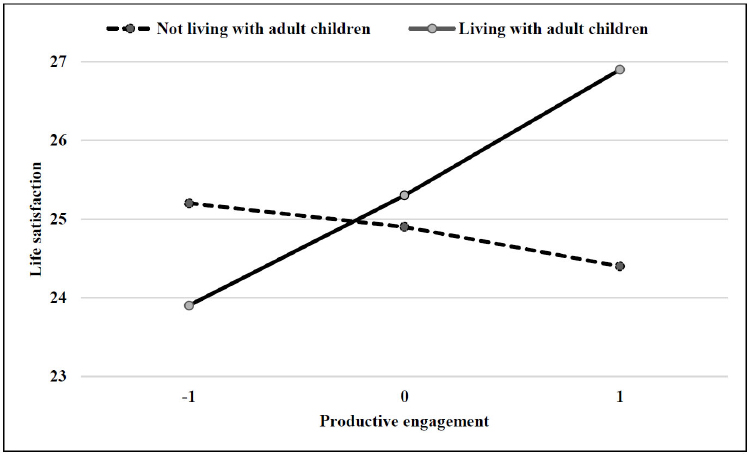
Interaction between intergenerational co-residence and productive engagement in predicting life satisfaction.
4. DISCUSSION
This study aimed to examine the moderating effect of productive engagement in the relationship between intergenerational co-residence and life satisfaction among older adults. The results showed that intergenerational co-residence did not directly predict life satisfaction, even after controlling for the education levels of older adults and adult children and the employment status of adult children. This finding contrasts with previous studies, which reported that living with adult children is associated with higher life satisfaction among older adults [20, 21].
Nevertheless, productive engagement significantly moderated this relationship. These findings suggest that living with adult children does not necessarily lead to greater life satisfaction. Rather, the association depends on older adults' level of productive engagement. This pattern is consistent with previous research showing that the direct relationship between intergenerational co-residence and life satisfaction was not significant, whereas the moderating effect (specifically, homeownership) was significant [48]. Their study showed that living with adult children was associated with lower life satisfaction among older adults who owned their homes. This finding underscores that the relationship between intergenerational co-residence and life satisfaction is contextual and requires consideration of moderating variables.
The non-significant direct effect of intergenerational co-residence and life satisfaction may be explained by several factors. First, the relationship is inherently complex. Living with adult children may provide emotional and instrumental support, assistance with household tasks, and reduce loneliness, thereby enhancing older adults’ life satisfaction [16, 17]. On the other hand, intergenerational co-residence may also become a source of intergenerational conflict, reduced autonomy, and increased depressive symptoms, which can negatively affect life satisfaction [23, 51]. Second, participants' actual living arrangements may not be aligned with their preferences. In this study, most participants were older adults who lived with their adult children, had relatively high levels of education, and were married. However, previous findings suggest that highly educated older adults tend to prefer living independently due to greater economic independence [52]. Similarly, married older adults are more likely to choose independent living, as spousal relationships provide substantial emotional support and better mental health outcomes [52, 53]. Misalignment between actual and preferred living arrangements has been associated with lower subjective well-being [25], which may help explain the absence of a direct association between intergenerational co-residence and life satisfaction in the present study.
Productive engagement was found to moderate the relationship between intergenerational co-residence and life satisfaction. Among older adults with higher levels of productive engagement, this relationship tended to be more positive. This result aligns with the role enhancement perspective, which suggests that engagement in multiple productive roles enhances well-being through the accumulation of social and psychological benefits, such as social connectedness, sense of purpose, and reduced stress [54]. This finding is further supported by prior studies suggesting that productive engagement is associated with better physical health, lower depressive symptoms, and greater resilience and psychological well-being [42, 43, 55]. These benefits are particularly important for older adults living in multigenerational households, which are often characterized by a heightened potential for conflict and stress [51]. Accordingly, productive engagement may function as a protective factor that mitigates the negative effects of intergenerational co-residence on life satisfaction.
Beyond its moderating role, this study also found that productive engagement was significantly correlated with higher life satisfaction. This indicates that higher levels of engagement in productive activities were associated with greater life satisfaction. When examined by activity type, both paid work and volunteering showed significant positive correlations with life satisfaction. Consistent with prior studies, paid work provides not only financial stability but also opportunities for social participation and reduces depressive symptoms, which contribute to higher life satisfaction [56, 57]. Similarly, volunteering enhances life satisfaction by expanding social networks, strengthening perceived self-worth, and reducing loneliness [58, 59]. In contrast, no significant correlation was found between grandparenting and life satisfaction. The finding differs from previous studies that have reported a positive association between grandparenting and life satisfaction [41]. This finding may be explained by the fact that most participants in this study lived with their adult children, which may have led grandparenting to be experienced as a routine and potentially demanding responsibility. While this condition may reduce loneliness and enhance feelings of usefulness, it can also lead to physical fatigue and psychological strain [60, 61].
Additional analyses showed that life satisfaction was positively associated with older adults' education level. It was also positively associated with adult children's education level and employment status. Consistent with prior studies, higher levels of education among older adults have been associated with greater life satisfaction [62, 63]. Education serves as a long-term resource that supports life satisfaction in later life through better cognitive functioning and psychological well-being [64]. Regarding adult children’s characteristics, these findings align with previous research showing that children’s education level and employment status are positively associated with parents’ life satisfaction [65, 66]. Adult children with higher levels of education and stable employment have been shown in prior studies to be more likely to provide financial and emotional support, and to be associated with better cognitive functioning among older parents, which may contribute to higher life satisfaction [62]. Overall, these findings highlight the importance of both individual resources and family support in shaping older adults’ life satisfaction.
It is also important to note that the model explained 6.7% of the variance in life satisfaction, indicating that other factors not included in this study may also play an important role. Life satisfaction is influenced by various factors, such as health status, financial conditions, and relationship quality. Therefore, future studies are encouraged to include additional predictors to provide a more comprehensive understanding of older adults’ life satisfaction.
5. IMPLICATIONS AND LIMITATIONS
Theoretically, this study contributes to the literature by highlighting the moderating role of productive engagement in the relationship between intergenerational co-residence and life satisfaction among older adults. Specifically, the findings demonstrate that productive engagement functions as a protective factor within this relationship. Practically, the findings emphasize the importance of supporting older adults’ participation in productive activities according to their individual capacities, particularly in multigenerational family contexts. Programs and policies that promote engagement in meaningful activities may also help enhance older adults’ life satisfaction and support successful aging.
However, this study has several limitations. First, the sampling approach may limit the generalizability of the findings. The use of convenience sampling may have introduced selection bias, and the predominance of younger older adults may limit the generalizability of the findings to older-old populations. Second, intergenerational co-residence was measured dichotomously, which may not fully capture the complexity of intergenerational dynamics within households. Third, because the study was conducted within a collectivistic cultural context, the findings may not be directly generalizable to societies characterized by more individualistic values.
Future studies are recommended to include a larger and more heterogeneous sample to enhance sociodemographic diversity, representativeness, and the robustness of the findings. In addition, future studies may benefit from more nuanced measures of intergenerational co-residence that account for relationship quality and older adults’ living arrangement preferences. Future studies could also explore a broader range of productive engagement activities and examine how different cultural contexts influence the relationships among intergenerational co-residence, productive engagement, and life satisfaction.
CONCLUSION
This study aimed to examine the moderating role of productive engagement in the relationship between intergenerational co-residence and life satisfaction among older adults. The results indicated that intergenerational co-residence was not directly associated with life satisfaction. However, productive engagement significantly moderated this relationship after controlling for the sociodemographic characteristics of older adults and their adult children. These findings suggest that the association between intergenerational co-residence and life satisfaction depends on the level of productive engagement, such that living with adult children was more positively associated with life satisfaction among older adults with higher levels of productive engagement.
AUTHORS’ CONTRIBUTIONS
The authors confirm contribution to the paper as follows: M.A.D. and S.R.R.P.: Study conception and design; M.A.D.: Data collection; M.A.D. and S.R.R.P.: Analysis and interpretation of results; M.A.D. and S.R.R.: Draft manuscript. All authors reviewed the results and approved the final version of the manuscript.
LIST OF ABBREVIATIONS
| CI | = Confidence Interval |
| LL | = Lower Limit |
| SD | = Standard Deviation |
| SE | = Standard Error |
| UL | = Upper Limit |
ETHICS APPROVAL AND CONSENT TO PARTICIPATE
The study protocol was approved by the Committee on Research Ethics at the Faculty of Psychology, Universitas Indonesia (202/FPsi.Komite Etik/PDP.04.00/2024).
HUMAN AND ANIMAL RIGHTS
All human research procedures followed were in accordance with the ethical standards of the committee responsible for human experimentation (institutional and national), and with the Helsinki Declaration of 1975, as revised in 2013.
CONSENT FOR PUBLICATION
Informed consent was obtained from all older adults participating in this study.
AVAILABILITY OF DATA AND MATERIALS
The data supporting the findings of the article are available from the corresponding author [M.A.D.] upon reasonable request.
FUNDING
The study is funded by the Directorate of Research Funding and Ecosystem, Universitas Indonesia under the PUTI Grant 2025 (Grant No. PKS-411/UN2.RST/HKP. 05.00/2025).
ACKNOWLEDGEMENTS
The authors thank their research team colleagues at FRBA and TAP for their contributions to the study preparation and data collection processes. They are also deeply grateful to all participants for their time and valuable contributions to this research.