All published articles of this journal are available on ScienceDirect.

Bidirectional Links between Relational Aggression and Victimization in Adolescents: Different Effects of Maternal and Paternal Psychological Control

Abstract
Introduction/Objective
Relational aggression and victimization are important forms of peer violence during adolescence. However, how these behaviors evolve over time and the specific roles of maternal versus paternal psychological control remain poorly understood. This study examined prospective reciprocal associations among perceived maternal and paternal psychological control, relational aggression, and relational victimization in a sample of Chilean adolescents.
Methods
This three-wave longitudinal study involved students in Grades 7-9. The study included 530 participants at Wave 1, 474 at Wave 2, and 458 at Wave 3. Full information maximum likelihood (FIML) was employed to retain all available data under the missing-at-random assumption. Baseline ages ranged from 11 to 15 years (M = 12.68, SD = 0.82). Of these, 47% identified as female, 50% as male, and 3% as another gender. Adolescents reported on perceived maternal and paternal psychological control, as well as relational aggression and victimization. A cross-lagged panel model (CLPM) was used to examine longitudinal associations.
Results
Results showed reciprocal prospective associations between relational victimization (RV) and relational aggression (RA), such that higher levels of one construct were associated with higher subsequent levels of the other. Paternal psychological control (PPC) was linked to higher subsequent levels of RV, and RV was also associated with a small subsequent increase in perceived PPC. Additionally, maternal psychological control (MPC) showed a negative prospective association with later victimization, although this finding should be interpreted cautiously.
Discussion
Peer dynamics played a central role in the longitudinal coupling between relational aggression and victimization, whereas perceived PPC showed a specific prospective association with later victimization.
Conclusion
Prevention efforts should address aggression and victimization jointly and incorporate parent-focused components aimed at reducing psychologically intrusive parenting practices, particularly those perceived by adolescents as PPC.
1. INTRODUCTION
School violence affects children and adolescents worldwide, cutting across cultures, ethnicities, ages, and genders, and harming both cognitive and social-emotional development [1, 2]. While many studies focus on externalizing behaviors and physical violence [3], less attention has been given to RA and RV, which are often grouped with other aggressive behaviors [4-6]. Consequently, some harmful peer behaviors, especially among adolescents, may go unnoticed [7-9].
RA refers to behaviors intended to manipulate, disrupt, or damage peer relationships [10]. These behaviors can occur either face-to-face or online through social media [11-13]. Examples include social exclusion, rumor spreading, or deliberate peer rejection [3, 10, 11].
As children develop, relational aggression (RA) can take different forms, ranging from more direct behaviors (e.g., excluding someone from a group) to more indirect strategies (e.g., spreading rumors). Direct forms are more common in childhood, whereas indirect and covert behaviors tend to increase during adolescence [14]. Because these behaviors are less visible to adults, adolescent self-report measures are particularly appropriate for assessing RA during this developmental period [15].
Conversely, RV, defined as being the target of exclusion, rumor-spreading, and other forms of social harm, has significant effects on students’ school adjustment [16]. Both RA and RV are linked to increased internalizing and externalizing problems [3, 17]. Meta-analyses indicate that both behaviors are associated with externalizing problems, but RV is consistently linked to internalizing difficulties [16]. Longitudinal studies show that adolescent RV correlates with higher levels of depression and anxiety [18-20]. Overall, these findings suggest that RA and RV are common and substantially affect students’ social and emotional adjustment within schools.
Although RA and RV may occur within broader bullying dynamics, they should not be treated as synonymous constructs. Bullying is typically understood as repeated aggression enacted in the context of a power imbalance, whereas relational aggression refers more specifically to behaviors intended to harm others through the manipulation or damage of their social relationships, and relational victimization refers to being the target of such behaviors [10, 16, 21]. Thus, the present study focuses on relational forms of aggression and victimization as specific interpersonal processes that may overlap with, but are not reducible to, broader bullying frameworks.
Research indicates that RA and RV frequently co-occur and show reciprocal prospective associations over time. Studies suggest that RA can lead to increased RV, and RV can similarly increase RA, creating cycles of escalation or retaliation [16]. These patterns may vary based on social status and gender [21, 22]. Therefore, research using longitudinal school-based data should consider the bidirectional relationship between RA and RV [16, 23].
1.1. Parental Psychological Control and its Relationship with Relational Aggression and Relational Victimization
Aggressive behavior and victimization are shaped by family dynamics, peer relationships, and self-regulation [24-26]. Within this broader developmental context, parenting characterized by psychological control, rejection, overprotection, and conflict has been described as a risk factor, whereas autonomy support and emotional warmth are recognized as protective factors [27-31]. More specifically, parental psychological control may be linked to adolescents’ RA and RV through complementary socioemotional and interpersonal pathways [32, 33]. From a self-determination theory perspective, psychologically controlling parenting frustrates adolescents’ basic psychological needs, especially autonomy, thereby undermining emotion regulation, interpersonal agency, and adaptive coping in peer contexts [29, 34].
At the same time, from a social learning perspective, repeated exposure to guilt induction, love withdrawal, and other manipulative relational strategies may model coercive ways of managing conflict and closeness, which adolescents may later reproduce in their peer relationships [33, 35]. Thus, rather than representing competing explanations, self-determination theory and social learning theory serve as complementary frameworks for explaining why psychological control may foster RA by normalizing manipulative interpersonal tactics and weakening emotion regulation [32, 33, 36], while also increasing vulnerability to RV by undermining interpersonal trust, confidence, and effective responses to peer exclusion or hostility [34, 37].
This integrated perspective is especially relevant for relational forms of aggression and victimization, which are embedded in the management of closeness, exclusion, and social power [16, 25]. Recent evidence supports this perspective: parental psychological control has been linked to poorer youth emotion regulation, lower basic psychological need satisfaction in the context of peer victimization, and social-interpersonal vulnerabilities such as lower interpersonal trust and greater shyness or social withdrawal [32-34, 37, 38].
However, Li et al.’s meta-analysis indicates that parental psychological control and RA influence each other over time, although the effects are modest [33]. Furthermore, longitudinal studies show that children’s behaviors can prompt changes in parenting practices, and these changes can be as significant as the effects of parenting on children’s behaviors, although outcomes vary by informant and context [38].
Recent longitudinal studies suggest that parental psychological control and aggression may be related, but findings remain inconsistent. More broadly, longitudinal evidence on parenting and adolescent conduct problems has shown that adolescents’ behavior may also be accompanied by changes in parenting practices [39]. For example, a three-wave study identified reciprocal effects between adolescent aggression and parental psychological control over time [35]. Similarly, another study found this bidirectional relationship mainly between mothers and children, whereas the effect of fathers on children was largely unidirectional and small in magnitude [36]. In early adolescence, fathers’ psychological control can predict later aggression, but aggression does not consistently increase paternal control. Additionally, association with deviant peers can prompt both parents to use more psychological control [40]. Since not all studies report these patterns, further research is needed to clarify when these effects occur [40, 41].
Examining mothers and fathers separately is theoretically important because parent-adolescent relationships may differ in caregiving involvement, emotional closeness, authority dynamics, and gender-role socialization [17, 27]. These differences may shape how psychological control is expressed, how adolescents interpret it, and how strongly it relates to peer functioning. This distinction may be especially relevant in Chile, where father involvement has become increasingly salient, although caregiving responsibilities remain partly structured along gendered lines [42]. From this perspective, potential differences between maternal and paternal psychological control are not only an empirical possibility but also a theoretically meaningful question about whether the same intrusive parenting process may show different prospective associations depending on the parent from whom it is perceived.
More specifically, perceived paternal psychological control may be particularly relevant for relational victimization because it may involve autonomy restriction, lower interpersonal confidence, and reduced capacity to respond adaptively to exclusion or relational hostility. From a self-determination theory perspective, psychologically controlling parenting may undermine adolescents’ sense of agency and the perceived legitimacy of their own emotional experiences, thereby increasing socioemotional vulnerability in peer contexts [29, 34]. In the case of fathers, these processes may acquire specific relational meanings when paternal control is embedded in patterns of authority, emotional closeness, and gendered expectations regarding parental roles [17, 27, 42]. Consistent with this interpretation, recent evidence suggests that parental psychological control is associated with lower basic psychological need satisfaction, poorer emotion regulation, interpersonal mistrust, and greater vulnerability to peer victimization [32-34, 37, 38]. Thus, perceived paternal psychological control may be prospectively associated with relational victimization not because fathers exert a uniformly stronger influence than mothers, but because adolescents may interpret paternal psychological control through relational and sociocultural meanings.
In summary, prior research reveals two central gaps for this study. First, although PPC has been linked to adolescents’ peer functioning, there is limited longitudinal evidence on whether PPC is differentially associated with subsequent RA and RV, or how these associations compare with those involving MPC [4]. Second, most longitudinal studies have not examined RA and RV together or tested their reciprocal prospective associations over time, even though they are related but distinct constructs [43]. This is important because earlier research suggests that RA may be followed by higher subsequent RV, whereas RV may also be associated with higher subsequent RA. These patterns may vary by social status and gender [16, 22, 23, 43]. These gaps highlight the need to examine RA and RV jointly over time and to distinguish between maternal and paternal psychological control as potentially non-equivalent sources of perceived parental intrusiveness. Taken together, the available literature suggests that parental psychological control may be associated with adolescents’ RA and RV through intertwined pathways involving interpersonal modeling [33, 35] and socioemotional vulnerability [29, 34], while these peer processes may, in turn, be linked to subsequent parent-child dynamics over time [38, 40].
The present study examines prospective associations among perceived maternal and paternal psychological control, relational aggression, and relational victimization over time within the school context. It also examines the cross-lagged association between RA and RV. To this end, we advance the following hypotheses: (H1) Higher levels of perceived maternal and paternal psychological control will be associated with higher subsequent levels of adolescents’ RA. (H2) Higher levels of perceived maternal and paternal psychological control will be associated with higher subsequent levels of adolescents’ RV. (H3) Higher levels of adolescents’ RA will be associated with higher subsequent levels of perceived maternal and paternal psychological control. (H4) Higher levels of adolescents’ RV will be associated with higher subsequent levels of perceived maternal and paternal psychological control. (H5) RA and RV will exhibit reciprocal longitudinal associations, with each being associated with higher subsequent levels of the other. (H6) These cross-lagged associations will vary in magnitude between mothers and fathers, with no assumption of equivalence across parents.
2. MATERIALS AND METHODS
2.1. Design and Procedure
This study adhered to the ethical principles outlined in the Declaration of Helsinki and was approved by the Ethics Committee of the Pontificia Universidad Católica de Chile (Approval ID: 210828001).
A three-wave longitudinal study was conducted to assess how relational aggression, victimization, and adolescents’ views of their parents’ psychological control influence each other over time. Adolescents completed self-report questionnaires in their classrooms at each wave to measure both relational aggression and victimization. They also reported on their perceptions of psychological control by mothers and fathers using parallel items. All measures used the same item wording, response scales, administration mode (paper and pencil during regular class time), and instructions across waves.
Data were collected between March 20 and November 27, 2023, from students in public schools across four cities in Chile using in-person questionnaires administered during regular class time. Data collection followed a staggered school-based schedule: the date of Wave 1 varied across schools depending on when each school entered the study, but within each school, Waves 2 and 3 were scheduled approximately two months after the preceding assessment.
After institutional authorization, principals granted school-level permission, and the lead researcher briefed teachers on study procedures. Written parental consent was obtained at school meetings, and eligible students provided assent/consent before participation. Participation was voluntary, confidentiality was emphasized, and students could withdraw at any time. All data were anonymized and handled in accordance with prevailing ethical standards.
2.2. Participants
The sample included students in Grades 7-9 from publicly subsidized urban schools in four Chilean cities. Eligible participants were all students in Grades 7-9 enrolled in participating schools and present on assessment days. Inclusion required adolescent assent and parental consent. No additional exclusion criteria were applied beyond standard consent procedures. There were 530 participants in the first wave, 474 in the second wave (10.6% attrition), and 458 in the third wave (3.4% attrition from the second wave). To address attrition and maximize data use, models were estimated using FIML, allowing inclusion of all participants with sufficient data [44]. The final analytic sample comprised 452 students (85.3% of the original sample) with valid data on the study’s central variables. Loss to follow-up mainly resulted from student absences on assessment days (such as illness), school transfers and enrollment changes, and incomplete questionnaire administration caused by limited time during regular classes.
Attrition analyses were conducted to examine whether adolescents retained in the analytic sample differed from those lost to follow-up on key baseline variables. The retained and lost participants were compared on age, gender, maternal psychological control, paternal psychological control, relational aggression, and relational victimization at T1. No significant differences were observed between retained and lost participants on any of the baseline variables examined. This pattern was considered when interpreting the longitudinal findings, and missing data were handled using FIML.
At study entry, participants were 11 to 15 years old (M = 12.68, SD = 0.82). Regarding gender identity, 47% identified as female, 50% as male, and 3% as another gender. In terms of family structure, 52.4% lived with both parents, 26.6% with only their mother, 19% with only their father, and 2% with neither parent.
Race and ethnicity were not assessed. In Chilean school-based research with minors, Indigenous or ethnic identification can be socially sensitive and may raise confidentiality risks in identifiable settings with small subgroup sizes. Because these variables were not central to the prespecified hypotheses or analytic plan, they were not collected.
2.3. Measures
Parental psychological control was assessed using the Disrespect subscale from Barber [45] in its adapted and validated version for the local context [46]. The subscale includes eight items measuring intrusive parenting practices such as emotional manipulation, guilt induction, and autonomy invalidation. Adolescents completed separate reports for their mother and father, indicating how often they experienced these behaviors. For both parental reports, adolescents were instructed to respond with reference to their biological mother and biological father whenever applicable, regardless of co-residence. If either biological parent was deceased or had never been part of the adolescent’s life, participants were asked to report on their primary maternal or paternal figure. Example items include: “My [mother/father] puts me down or ridicules me,” and “My [mother/father] embarrasses me in public.” Responses were given on a five-point Likert scale (1 = Never; 5 = Always), with higher scores reflecting greater perceived psychological control. In the present study, internal consistency was adequate for both scales across waves (mother: ω = 0.88 at T1, 0.95 at T2, and 0.97 at T3; father: ω = 0.86 at T1, 0.95 at T2, and 0.86 at T3).
RA and RV were assessed as parallel dimensions using the same five items from the Relational Aggression subscale of the Problem Behavior Frequency Scale (PBFS) [47]. These items had previously been administered by the authors in a Chilean adolescent sample as part of unpublished research. Consistent with common practice in the field, two matched versions of these items were administered: a perpetration form and a victimization form. In this way, the same relationally harmful behaviors (e.g., exclusion, spreading rumors, manipulating peer relationships) were assessed from both perspectives (behaviors the adolescent directed toward others versus behaviors others directed toward the adolescent) using parallel wording. Examples of perpetration items include: “You spread a false rumor about another student” and “You left other students out of an activity,” with corresponding victimization items phrased in parallel (e.g., “Other students spread a false rumor about you,” “Other students left you out of an activity”). Although the PBFS relational aggression items have not been formally validated in a published Chilean sample, their content captures core relationally harmful behaviors, including exclusion, rumor spreading, and manipulation of peer relationships. Parallel wording was used to assess these behaviors from two perspectives: perpetration and victimization. In the present study, internal consistency, longitudinal measurement invariance, and additional analyses distinguishing relational aggression from relational victimization provided internal evidence supporting their use. Responses were provided on a 5-point frequency scale (0 = Never, 5 = 6 or more times), with higher scores indicating greater frequency of relational aggression or victimization. In the present study, internal consistency was adequate for both self-report scales across waves (RA: ω = 0.79 at T1, 0.87 at T2, and 0.92 at T3; RV: ω = 0.88 at T1, 0.89 at T2, and 0.91 at T3).
To reduce potential order effects, questionnaire administration was counterbalanced using two equivalent forms containing the same measures but presented in different sequences. Specifically, the order of the relational aggression/victimization block was varied across participants, minimizing systematic biases related to presentation order and strengthening internal validity.
2.4. Data Analysis
Structural equation modeling was applied to estimate a three-wave CLPM with latent factors, examining both prospective and reciprocal associations between adjacent time points (T1 to T2 and T2 to T3) [47, 48]. At each wave, mothers’ psychological control, fathers’ psychological control, RA, and RV were modeled as separate unidimensional latent constructs.
In the longitudinal CFA models, configural measurement models were identified by fixing latent factor variances to 1 and latent means to 0 at each wave, while all factor loadings were freely estimated. This approach allowed us to estimate longitudinal relationships while accounting for random measurement error [49, 50]. Robust maximum likelihood (MLR) was used for estimation, and missing data was addressed with FIML [44, 51].
The distribution of the observed indicators was examined prior to model estimation; evidence of non-normality was found, particularly for the RA and RV items, which showed marked positive skew. Therefore, the models were estimated using MLR, which provides robust standard errors and chi-square statistics [51]. Because the indicators were measured on five-point Likert-type scales, they were treated as continuous in the SEM analyses. However, this should be understood as a pragmatic approximation, especially for the more skewed aggression and victimization items, given that support for treating ordinal indicators as continuous is strongest when variables have five or more categories and category thresholds are reasonably symmetric [52].
Before analyzing the longitudinal paths, it was examined whether each measure functioned consistently over time by testing longitudinal measurement invariance across the three waves. A sequence of increasingly constrained models was evaluated across measurement occasions, and their fit was compared using changes in CFI and RMSEA (ΔCFI; ΔRMSEA). Specifically, we tested: (1) a configural invariance model (same factor structure across waves, with parameters freely estimated), (2) a metric invariance model (factor loadings constrained to be equal across waves), (3) a scalar invariance model (factor loadings and item intercepts constrained to be equal), and (4) a strict invariance model (factor loadings, item intercepts, and residual variances constrained to be equal). Invariance was interpreted as supported when the imposition of additional constraints yielded only trivial changes in global fit, using cutoffs of ΔCFI ≤ 0.01 and ΔRMSEA ≤ 0.015 [53-55]. To account for item-specific stability not fully captured by the latent factors, residual correlations were specified among repeated indicators of the same item across waves in the longitudinal CFA models. Based on the longitudinal invariance analyses, the final structural model retained equal factor loadings across waves for all constructs. Equal item intercepts were also retained across waves for all constructs, except for the first RA indicator at Time 2, whose intercept was freely estimated to achieve partial scalar invariance. The final CLPM was built sequentially: first, estimating the longitudinal measurement models for each construct; then testing configural, metric, scalar, and strict invariance; and finally estimating the structural model, which included within-wave covariances, autoregressive paths, cross-lagged paths, covariates, and nested equality constraints for temporal stationarity and parent equivalence.
The final CLPM included (a) T1 within-wave covariances, (b) autoregressive paths to model stability, and (c) cross-lagged paths to test directional effects. In addition, participants’ age at T1 and the instrument form administered at each wave (T1-T3) (i.e., alternative instrument presentation orders) were adjusted for. Paths from maternal and paternal psychological control to later relational aggression and victimization were estimated to test H1-H2. Paths from relational aggression and victimization to later maternal and paternal psychological control were estimated to test H3-H4; reciprocal cross-lagged links between aggression and victimization were also estimated (H5). Parent differences were tested by entering both parents’ psychological control simultaneously and comparing constrained versus freely estimated mother-father cross-lagged paths (H6) using nested models. The overall fit of the model was assessed using standard fit indices, including χ2, CFI, TLI, RMSEA, and SRMR. In interpreting model fit, conventional guidelines were considered, suggesting that higher CFI and TLI values and lower RMSEA and SRMR values reflect better fit, with values close to .95 for CFI/TLI and close to .06 and .08 for RMSEA and SRMR, respectively, generally indicating good fit [49].
A nested model-comparison approach was used for two purposes. First, temporal stationarity was tested by constraining the autoregressive and cross-lagged paths to be equal across adjacent intervals and assessing changes in model fit relative to a freely estimated baseline model. Second, to test H6, focal cross-lagged effects were constrained to be equal for mothers and fathers. For the nested structural comparisons, equality constraints were imposed only on the focal lagged regression coefficients (autoregressive and cross-lagged paths), whereas the remaining structural parameters were left freely estimated. Thus, these tests addressed the invariance of the substantive structural relations of interest rather than full structural equality of the entire model [56]. For these nested comparisons, ΔCFI was primarily relied on as the decision criterion, interpreting values greater than .01 as evidence of meaningful deterioration in fit [54, 55]. Although χ2 and degrees of freedom are reported for completeness, they were not treated as the primary basis for interpretation because chi-square-based comparisons are known to be sensitive to sample size and minor model misspecification [49]. Accordingly, decreases in CFI beyond this threshold were taken as evidence against the equality constraints and, for H6, in favor of parent-specific effects.
Descriptive statistics and internal consistency indices (ω) were computed in R using the psych package [57], whereas confirmatory factor analyses (CFA) for longitudinal measurement invariance and the latent SEM/CLPM models were estimated in Mplus [51].
3. RESULTS
Table 1 presents descriptive statistics and Pearson correlations for maternal and paternal psychological control, relational aggression, and relational victimization across three waves. MPC and PPC were consistently correlated, ranging from moderate at T1 (r = 0.56) to very strong at T2 and T3 (r = 0.88 and r = 0.87). RA and RV showed moderate stability across waves, and their within-wave correlations were positive (rs = 0.24-0.40). Associations between psychological control and RA/RV were generally positive at T1 but smaller and more variable at T2 and T3, with several non-significant correlations.
| Variable | n | M | SD | Min | Max | 1 | 2 | 3 | 4 | 5 | 6 | 7 | 8 | 9 | 10 | 11 |
|---|---|---|---|---|---|---|---|---|---|---|---|---|---|---|---|---|
| 1. MPC_T1 | 522 | 1.95 | 0.81 | 1 | 5 | - | - | - | - | - | - | - | - | - | - | - |
| 2. MPC_T2 | 464 | 3.09 | 1.38 | 1 | 5 | 0.19** | - | - | - | - | - | - | - | - | - | - |
| 3. MPC_T3 | 464 | 3.12 | 1.43 | 1 | 5 | 0.05 | -0.15** | - | - | - | - | - | - | - | - | - |
| 4. PPC_T1 | 456 | 1.78 | 0.72 | 1 | 5 | 0.56*** | 0.14* | 0.03 | - | - | - | - | - | - | - | - |
| 5. PPC_T2 | 412 | 2.76 | 1.34 | 1 | 5 | 0.09 | 0.88*** | -0.17** | 0.15** | - | - | - | - | - | - | - |
| 6. PPC_T3 | 401 | 2.79 | 1.39 | 1 | 5 | -0.02 | -0.18** | 0.87*** | 0.09 | -0.13* | - | - | - | - | - | - |
| 7. RA_T1 | 522 | 1.33 | 0.53 | 1 | 3.8 | 0.29*** | 0.03 | 0.03 | 0.33*** | 0.04 | 0.02 | - | - | - | - | - |
| 8. RA_T2 | 467 | 1.55 | 0.78 | 1 | 5 | 0.27*** | 0.30*** | 0.03 | 0.29*** | 0.22*** | -0.02 | 0.37*** | - | - | - | - |
| 9. RA_T3 | 464 | 1.57 | 0.84 | 1 | 5 | 0.22*** | 0.06 | 0.33*** | 0.28*** | 0.01 | 0.31*** | 0.37*** | 0.40*** | - | - | - |
| 10. RV_T1 | 522 | 1.83 | 0.91 | 1 | 5 | 0.32*** | 0.08 | 0.02 | 0.39*** | 0.09 | 0.02 | 0.40*** | 0.50*** | 0.41*** | - | - |
| 11. RV_T2 | 466 | 1.49 | 0.75 | 1 | 5 | 0.26*** | -0.15** | 0.11 | 0.38*** | -0.18** | 0.15** | 0.35*** | 0.24*** | 0.53*** | 0.45*** | - |
| 12. RV_T3 | 464 | 1.59 | 0.89 | 1 | 5 | 0.22*** | 0.16** | -0.14* | 0.19** | 0.14* | -0.15** | 0.46*** | 0.51*** | 0.29*** | 0.44*** | 0.28*** |
Note: MPC = Maternal Psychological Control; PPC = Paternal Psychological Control; RA = Relational Aggression; RV = Relational Victimization.
*** p < 0.001; ** p < 0.01; *p < 0.05.
To examine whether relational aggression and relational victimization were empirically distinguishable, additional measurement models were estimated at each wave. Specifically, a two-factor model distinguishing relational aggression and relational victimization was compared with a one-factor model in which perpetration and victimization items were specified as indicators of a single latent construct. Across the three waves, the two-factor model showed better fit than the one-factor model (Table 2), supporting the empirical distinction between relational aggression and relational victimization despite the use of parallel item wording. These results indicate that the two constructs were related but not redundant and support their specification as separate latent factors in the longitudinal CLPM.
| Wave | Model | χ2 | df | CFI | TLI | RMSEA 90% IC | SRMR |
|---|---|---|---|---|---|---|---|
| T1 | One-factor | 294.85*** | 35 | 0.735 | 0.659 | 0.12 (0.11, 0.13) | 0.10 |
| T1 | Two-factor | 104.25*** | 34 | 0.928 | 0.905 | 0.06 (0.05, 0.08) | 0.04 |
| T2 | One-factor | 490.46*** | 35 | 0.572 | 0.450 | 0.17 (0.15, 0.18) | 0.16 |
| T2 | Two-factor | 64.03** | 34 | 0.972 | 0.963 | 0.04 (0.03, 0.06) | 0.05 |
| T3 | One-factor | 838.94*** | 35 | 0.432 | 0.270 | 0.22 (0.21, 0.23) | 0.19 |
| T3 | Two-factor | 128.21*** | 34 | 0.933 | 0.912 | 0.08 (0.06, 0.09) | 0.06 |
Note: CFI = comparative fit index; TLI = Tucker-Lewis index; RMSEA = root mean square error of approximation; SRMR = standardized root mean square residual. The one-factor model specified all relational aggression and victimization items as indicators of a single latent factor, whereas the two-factor model specified relational aggression and relational victimization as separate but correlated latent factors.
** p < 0.01. ***p < 0.001.
The longitudinal measurement invariance analyses supported sufficient temporal comparability for the subsequent latent CLPM (Table 3). Relational victimization and maternal psychological control achieved full scalar invariance, whereas paternal psychological control achieved strict invariance. Relational aggression achieved partial strict invariance: all factor loadings and residual variances were constrained to equality across waves, and all item intercepts were constrained to equality except the intercept of the first relational aggression item at Time 2, which was freely estimated due to localized non-invariance. Thus, all constructs reached at least full or partial scalar invariance, which was considered sufficient for interpreting longitudinal structural associations among latent factors measured on comparable scales over time [55, 58, 59].
| Models | χ2(df) | CFI | RMSEA | SRMR | ∆CFI | ∆RMSEA |
|---|---|---|---|---|---|---|
| Relational Aggression | ||||||
| Configural | 140.10 (72)*** | 0.961 | 0.042 | 0.044 | NA | NA |
| Metric | 162.56 (80)*** | 0.953 | 0.044 | 0.053 | 0.008 | -0.002 |
| Scalar | 196.84 (88)*** | 0.938 | 0.048 | 0.054 | 0.015 | -0.004 |
| Partial Scalar | 176.30 (87)*** | 0.949 | 0.044 | 0.053 | 0.004 | 0 |
| Partial Strict | 198.41 (96)*** | 0.942 | 0.044 | 0.058 | 0.007 | 0 |
| Relational Victimization | ||||||
| Configural | 125.95 (72)*** | 0.975 | 0.037 | 0.036 | NA | NA |
| Metric | 137.84 (80)*** | 0.974 | 0.037 | 0.042 | 0.001 | 0 |
| Scalar | 163.40 (88)*** | 0.966 | 0.040 | 0.045 | 0.008 | -0.003 |
| Strict | 281.75 (98)*** | 0.916 | 0.059 | 0.068 | 0.050 | -0.019 |
| Maternal Psychological Control | ||||||
| Configural | 572.36 (225)*** | 0.949 | 0.054 | 0.043 | NA | NA |
| Metric | 648.75 (239)*** | 0.940 | 0.057 | 0.056 | 0.009 | -0.003 |
| Scalar | 705.38 (253)*** | 0.933 | 0.058 | 0.058 | 0.007 | -0.001 |
| Strict | 821.68 (269)*** | 0.919 | 0.062 | 0.064 | 0.014 | -0.004 |
| Paternal Psychological Control | ||||||
| Configural | 501.09 (225)*** | 0.951 | 0.050 | 0.051 | NA | NA |
| Metric | 561.98 (239)*** | 0.942 | 0.053 | 0.061 | 0.009 | -0.003 |
| Scalar | 627.24 (253)*** | 0.933 | 0.055 | 0.065 | 0.009 | -0.002 |
| Strict | 659.09 (269)*** | 0.930 | 0.054 | 0.067 | 0.003 | -0.002 |
Note: Boldface indicates the highest level of measurement invariance retained for each construct. CFI = Comparative Fit Index; RMSEA = Root Mean Square Error of Approximation; SRMR = Standardized Root Mean Square Residual. ΔCFI and ΔRMSEA represent changes relative to the immediately preceding model, except for the partial scalar model, which was compared with the metric model.
For relational aggression, partial strict invariance was achieved by freeing the intercept of Item 1 at Time 2 while constraining the remaining intercepts, all factor loadings, and residual variances to equality across waves.
*p< 0.05, **p< 0.01, ***p< 0.001.
3.1. Cross-Lagged Panel Model Results
The freely estimated latent CLPM showed acceptable overall fit for the data, χ2(3146) = 5532.78, CFI = 0.90, TLI = 0.89, RMSEA = 0.04, 90% CI (0.040, 0.042), and SRMR = 0.06. Table 4 and Fig. (1) summarize the results of this unrestricted model.
| Outcome | Predictor | B | SE | β | p | 95% CI for B |
|---|---|---|---|---|---|---|
| Autoregressive paths | ||||||
| Maternal psychological control_T2 | Maternal psychological control_T1 | 0.25 | 0.10 | 0.12 | 0.007 | 0.06, 0.45 |
| Maternal psychological control_T3 | Maternal psychological control_T2 | 0.002 | 0.03 | 0.002 | 0.956 | -0.06, 0.07 |
| Paternal psychological control_T2 | Paternal psychological control_T1 | 0.11 | 0.09 | 0.05 | 0.247 | -0.07, 0.28 |
| Paternal psychological control_T3 | Paternal psychological control_T2 | 0.06 | 0.04 | 0.06 | 0.132 | -0.02, 0.13 |
| Relational aggression_T2 | Relational aggression_T1 | 0.27 | 0.15 | 0.19 | 0.048 | -0.03, 0.56 |
| Relational aggression_T3 | Relational aggression_T2 | 0.29 | 0.08 | 0.29 | <.001 | 0.14, 0.44 |
| Relational victimization_T2 | Relational victimization _T1 | 0.32 | 0.07 | 0.35 | <.001 | 0.18, 0.47 |
| Relational victimization_T3 | Relational victimization _T2 | 0.28 | 0.08 | 0.27 | <.001 | 0.12, 0.43 |
| Cross-lagged paths | ||||||
| Maternal psychological control_T2 | Relational aggression_T1 | -0.09 | 0.16 | -0.02 | 0.593 | -0.41, 0.23 |
| Relational victimization_T1 | -0.04 | 0.09 | -0.02 | 0.604 | -0.21, 0.13 | |
| Maternal psychological control_T3 | Relational aggression_T2 | 0.10 | 0.12 | 0.03 | 0.416 | -0.13, 0.32 |
| Relational victimization_T2 | 0.08 | 0.11 | 0.03 | 0.459 | -0.14, 0.30 | |
| Paternal psychological control_T2 | Relational aggression_T1 | 0.12 | 0.17 | 0.03 | 0.466 | -0.22, 0.46 |
| Relational victimization _T1 | -0.02 | 0.10 | -0.01 | 0.862 | -0.21, 0.17 | |
| Paternal psychological control_T3 | Relational aggression_T2 | -0.19 | 0.12 | -0.07 | 0.094 | -0.42, 0.05 |
| Relational victimization_T2 | 0.23 | 0.11 | 0.10 | 0.035 | 0.02, 0.45 | |
| Relational aggression_T2 | Maternal psychological control_T1 | 0.06 | 0.06 | 0.07 | 0.313 | -0.05, 0.17 |
| Relational victimization_T1 | 0.41 | 0.10 | 0.48 | < 0.001 | 0.22, 0.61 | |
| Paternal psychological control_T1 | -0.04 | 0.06 | -0.04 | 0.558 | -0.16, 0.09 | |
| Relational aggression_T3 | Maternal psychological control_T2 | -0.02 | 0.04 | -0.06 | 0.125 | -0.10, 0.05 |
| Relational victimization_T2 | 0.44 | 0.08 | 0.48 | < 0.001 | 0.29, 0.58 | |
| Paternal psychological control_T2 | 0.07 | 0.04 | 0.18 | 0.074 | -0.01, 0.15 | |
| Relational victimization_T2 | Maternal psychological control_T1 | -0.01 | 0.06 | -0.01 | 0.912 | -0.12, 0.11 |
| Relational aggression_T1 | 0.31 | 0.14 | 0.21 | 0.017 | 0.04, 0.59 | |
| Paternal psychological control_T1 | 0.18 | 0.08 | 0.19 | 0.019 | 0.02, 0.33 | |
| Relational victimization_T3 | Maternal psychological control_T2 | -0.13 | 0.05 | -0.31 | 0.015 | -0.24, -0.02 |
| Relational aggression_T2 | 0.56 | 0.11 | 0.51 | <.001 | 0.34, 0.78 | |
| Paternal psychological control_T2 | 0.12 | 0.06 | 0.29 | 0.030 | 0.01, 0.24 |
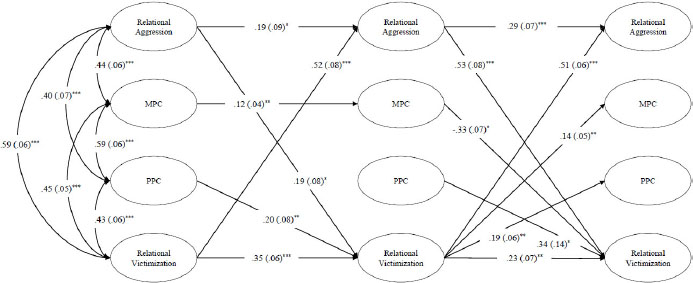
Significant standardized paths from the cross-lagged panel model (CLPM) linking maternal and paternal psychological control, relational aggression, and relational victimization across three waves.
Note: Only statistically significant paths are displayed. Coefficients are standardized; standard errors are reported in parentheses.
3.1.1. Autoregressive Stability
Regarding temporal stability, MPC showed modest continuity from T1 to T2 (β = 0.12, p = 0.007), but not from T2 to T3. PPC did not show significant autoregressive effects across either interval. In contrast, relational aggression and relational victimization demonstrated significant stability across waves (RA: β = 0.19, p = 0.048 from T1 to T2, and β = 0.29, p < 0.001 from T2 to T3; RV: β = 0.35, p < 0.001 from T1 to T2, and β = 0.27, p < 0.001 from T2 to T3).
3.1.2. Cross-lagged Effects of Parental Psychological Control on Relational Aggression and Victimization
With respect to prospective associations from parental psychological control to relational aggression, neither maternal nor paternal psychological control was significantly associated with higher subsequent levels of relational aggression, although PPC at T2 showed a marginal association with higher relational aggression at T3 (β = 0.18, p = 0.074). For relational victimization, PPC was prospectively associated with higher subsequent levels across both intervals (β = 0.19, p = 0.019; β = 0.29, p = 0.030). MPC was not significantly associated with subsequent victimization in the first interval and was associated with lower subsequent victimization in the second interval (β = −0.31, p = 0.015).
3.1.3. Cross-lagged Effects of Relational Aggression and Victimization on Parental Psychological Control
Evocative effects of peer processes on parental psychological control were generally non-significant. Relational aggression was not significantly associated with later maternal or paternal psychological control. Likewise, relational victimization did not predict later MPC. The only significant peer-to-parent association indicated that higher relational victimization at T2 was prospectively associated with higher PPC at T3 (β = 0.10, p = 0.035).
3.1.4. Reciprocal associations between Relational Aggression and Victimization
The results also indicated a robust transactional association between relational aggression and relational victimization. Higher relational victimization was associated with higher subsequent relational aggression across both intervals (β = 0.48, p < 0.001 in each interval), and higher relational aggression showed the same prospective pattern in relation to subsequent relational victimization (β = 0.21, p = 0.017 from T1 to T2; β = 0.51, p < 0.001 from T2 to T3).
3.1.5. Comparison of Maternal versus Paternal Paths
Model comparisons focused on equality constraints imposed on the focal lagged regression coefficients, while the remaining structural parameters were freely estimated. Table 5 presents the full fit indices for the freely estimated CLPM and the constrained models. Imposing equality constraints on all autoregressive paths reduced model fit relative to the freely estimated model according to the pre-specified ΔCFI criterion. The same pattern was observed when constraining only the autoregressive paths between relational aggression and relational victimization, only the paternal psychological control autoregressive paths, all cross-lagged paths, and the cross-lagged paths involving maternal and paternal psychological control. In all cases, the constrained models showed a decrease in CFI greater than .01 relative to the freely estimated model. Therefore, the freely estimated CLPM was retained as the final model because it provided the best representation of the data while allowing the focal prospective associations to vary across adjacent intervals and parental figures.
| Model | χ2(df) | CFI | TLI | RMSEA (90% CI) | SRMR | ΔCFI |
|---|---|---|---|---|---|---|
| Freely estimated CLPM | 5532.78 (3146) | 0.900 | 0.894 | 0.04 [0.040, 0.042] | 0.06 | - |
| All autoregressive paths constrained equal | 5951.12 (3159) | 0.882 | 0.876 | 0.04 [0.04, 0.05] | 0.09 | 0.018 |
| RA/RV autoregressive paths constrained equal | 5939.98 (3157) | 0.883 | 0.877 | 0.04 [0.04, 0.05] | 0.09 | 0.016 |
| PPC autoregressive paths constrained equal | 5951.81 (3157) | 0.882 | 0.876 | 0.04 [0.04, 0.05] | 0.09 | 0.017 |
| All cross-lagged paths constrained equal | 5982.64 (3163) | 0.881 | 0.875 | 0.04 [0.04, 0.05] | 0.10 | 0.018 |
| Mother-father cross-lagged paths constrained equal | 5940.89 (3159) | 0.883 | 0.877 | 0.04 [0.04, 0.05] | 0.09 | 0.016 |
Note: CLPM = cross-lagged panel model; RA = relational aggression; RV = relational victimization; PPC = paternal psychological control; CFI = Comparative Fit Index; TLI = Tucker-Lewis Index; RMSEA = Root Mean Square Error of Approximation; SRMR = Standardized Root Mean Square Residual. ΔCFI refers to the difference in CFI between each constrained model and the freely estimated CLPM. The freely estimated model was retained as the final model.
Table 6 reports the within-wave covariances at T1 and the within-wave residual correlations at T2-T3 from this model.
| Panel A. Wave T1 | |||
|---|---|---|---|
| - | MPC_T1 | PPC_T1 | RA_T1 |
| MPC_T1 | - | - | - |
| PPC_T1 | 0.59*** | - | - |
| RA_T1 | 0.44*** | 0.40*** | - |
| RV_T1 | 0.45*** | 0.43*** | 0.52*** |
| Panel B. Wave T2 | - | - | - |
| MPC_T2 | PPC_T2 | RA_T2 | |
| MPC_T2 | - | - | - |
| PPC_T2 | 0.62*** | - | - |
| RA_T2 | 0.02 | -0.19* | - |
| RV_T2 | 0.35*** | 0.19** | 0.12 |
| Panel C. Wave T3 | |||
| MPC_T3 | PPC_T3 | RA_T3 | |
| MPC_T3 | - | - | - |
| PPC_T3 | 0.56*** | - | - |
| RA_T3 | -0.03 | -0.02 | - |
| RV_T3 | 0.10 | 0.06 | 0.14 |
Note: MPC = Maternal Psychological Control; PPC = Paternal Psychological Control; RA = Relational Aggression; RV = Relational Victimization.
*p< 0.05, **p< 0.01, ***p< 0.001.
4. DISCUSSION
The findings indicate that relational aggression and relational victimization showed reciprocal prospective associations over time, supporting H5. Specifically, higher RV was associated with higher subsequent RA, and higher RA was associated with higher subsequent RV, even after accounting for autoregressive stability and covariates. This pattern is consistent with transactional perspectives and prior longitudinal research suggesting that victimization and aggression may become mutually reinforcing over time [21]. RV may function as a salient interpersonal stressor associated with defensive or aggressive responses, including the use of relational tactics. In contrast, RA may be followed by negative peer reactions, rejection, and heightened conflict, thereby increasing subsequent vulnerability to RV [21]. These findings suggest that focusing only on aggression or only on victimization is insufficient, because reciprocal peer dynamics may sustain both processes [16, 21].
Overall, the reciprocal prospective association between RA and RV represents the most robust and consistent finding of the study. In contrast, the findings involving perceived PPC should be interpreted as more specific and secondary. PPC was prospectively associated with later RV, but it was not consistently associated with later RA, and the peer-to-parent associations were generally weak. Thus, the present findings should not be interpreted as indicating a broad or uniform paternal psychological control effect across relational peer outcomes. Rather, they suggest a more circumscribed association between perceived PPC and adolescents’ subsequent relational victimization, which requires cautious interpretation and replication.
Because parental psychological control was assessed through adolescent reports, the results should be interpreted as reflecting adolescents’ perceptions of autonomy-limiting parent-child interactions, such as guilt induction, love withdrawal, or invalidation, rather than directly observed parenting practices. This distinction is important because socialization theories conceptualize psychological control as an intrusive parenting style that may frustrate basic psychological needs and increase socioemotional vulnerability [29, 45]. Within this framework, perceived PPC was prospectively associated with higher subsequent RV, whereas neither maternal nor paternal psychological control was clearly associated with subsequent RA. Thus, the results provided partial support for H2, particularly for perceived PPC, but no clear support for H1. Taken together, these patterns suggest that, after accounting for the reciprocal association between RA and RV, perceived parental psychological control may be more closely linked to adolescents’ vulnerability to negative peer experiences than to relational aggression itself.
The prospective association between perceived PPC and later RV should be interpreted cautiously and in theoretically specific terms. Rather than suggesting that fathers exert a uniformly stronger developmental influence than mothers, this finding may indicate that adolescents interpret paternal psychological control through relational and sociocultural meanings. One plausible interpretation is that perceived PPC may be linked to relational victimization through autonomy restriction and socioemotional vulnerability. Psychologically controlling behaviors may undermine adolescents’ sense of agency, interpersonal confidence, and perceived legitimacy of their own emotional experiences, thereby limiting their capacity to respond adaptively to exclusion, rejection, or relational hostility in peer contexts [29, 34, 60]. More broadly, evidence linking parenting styles with socioemotional and behavioral vulnerabilities in early adolescence also supports the relevance of considering parenting processes in adolescents’ peer adjustment [61]. In contexts where paternal authority and caregiving roles are embedded in gendered family expectations, such behaviors may acquire a specific meaning for adolescents’ peer-related vulnerability [17, 27, 42]. However, because the present study did not directly assess father-adolescent attachment, social competence, coping strategies, or interpersonal confidence, these mechanisms should be understood as theoretically informed interpretations rather than empirically tested mediators.
The model comparisons further underscore the importance of examining maternal and paternal psychological control separately. For the hypothesis concerning parent-specific differences in cross-lagged associations (H6), forcing the model to treat mothers and fathers equivalently worsened model fit, suggesting that perceived maternal and paternal psychological control should not be assumed to operate interchangeably. This pattern should also be interpreted considering the Chilean sociocultural context, where father involvement has become increasingly salient, although caregiving responsibilities, emotional closeness, and family expectations may still be partly structured along gendered lines [42]. Thus, the parent-specific pattern observed here should not be understood as evidence of essential differences between mothers and fathers, but rather as suggesting that the same psychologically controlling process may be embedded in different relational meanings depending on the parent from whom it is perceived.
Taken together, these findings also suggest that combining both parents into a single parental psychological control measure could mask important differences [54, 55]. In this sense, the present results support examining maternal and paternal psychological control separately rather than assuming that both parental pathways operate in equivalent ways. At the same time, the unexpected negative association between MPC and subsequent RV should be interpreted with caution. In models with many pathways and related predictors, suppression effects can occur, leading an apparently protective association to reflect residualized variance rather than a genuinely protective process [62]. Accordingly, this finding should not be interpreted as strong evidence that MPC protects against later victimization, but rather as a result that warrants cautious interpretation and replication.
Regarding peer-to-parent associations, the findings provided partial support for H4, as RV was associated with later perceived PPC, but not H3, as RA was not associated with subsequent maternal or paternal psychological control. Specifically, RV was associated with later increases in perceived paternal psychological control, whereas RA did not predict subsequent maternal or paternal psychological control. This association may reflect a pattern in which adolescent stress is followed by more intrusive parental responses, whether out of concern, because they see their child as vulnerable, or to protect them [29, 63]. However, since both parental psychological control and peer experiences were measured by adolescent self-report, it is also possible that victimized adolescents may be more sensitive to perceived parental intrusiveness. Future research should use multiple informants and test models that better separate within-person from between-person effects, especially in traditional CLPM frameworks [48, 64].
5. LIMITATIONS AND FUTURE DIRECTIONS
First, the traditional CLPM cannot clearly separate within-person changes from stable between-person differences. As a result, some cross-lagged effects may reflect between-person differences rather than within-person changes [65]. Future research should compare these results with models that separate these components, such as RI-CLPM or dynamic and multilevel approaches [48, 65].
Second, this study relied on adolescent self-reports to measure parental psychological control and RA/RV, which can introduce bias and make the associations harder to interpret. This is especially important for interpreting the limited support for H1 and the partial support for H2. Research shows that the link between parental psychological control and relational aggression can change depending on the informant, so using multiple sources is important [59]. Future studies should include parent reports, peer nominations, teacher ratings, and observations to confirm the results and avoid reliance on a single viewpoint [21].
Third, an additional limitation is that several observed indicators, especially those assessing relational aggression and victimization, showed marked positive skew. Although MLR was used to address non-normality, treating these five-point indicators as continuous should be understood as a pragmatic approximation. Future studies should examine whether the findings replicate using analytic approaches better suited to highly skewed or ordinal indicators.
Furthermore, while parental psychological control was measured separately for mothers and fathers, and the models supported this, some differences may still reflect how adolescents perceive their parents and their expectations regarding each parental figure. Moreover, although the same reporting criterion was used for both parents, the maternal and paternal referents were not fully homogeneous across participants, as responses referred mainly to biological parents but, in some cases, to the primary maternal or paternal figure. This may have introduced some variability in the meaning of the parental psychological control measures. It is important to examine how perceived parental psychological control, especially from fathers, affects peer vulnerability by considering factors such as self-control, self-efficacy, and coping with social stress [29, 60]. Because RA/RV cycles may differ across groups, future research should also examine whether sex, gender, emotional sensitivity, or peer status influences these patterns [22].
Moreover, the unexpected negative association between MPC and later RV should be interpreted cautiously and considered tentative. In models with closely related peer processes and predictors, explained variance can shift or be suppressed when many pathways are tested at once [62]. Researchers should use robustness checks, alternative models, sensitivity analyses, and internal replications to determine whether this finding arises from the model or the sample.
Finally, these findings are limited by the sample, the context, and the timing of the measurements. Race and ethnicity were not assessed, which prevented the examination of potential differences across groups and warrants caution when generalizing the findings to children from racially and ethnically heterogeneous populations. Future studies should therefore replicate these findings in broader sociocultural and rural contexts and across different time periods, as RA/RV patterns may vary according to school climate, group norms, and opportunities for interaction [16]. Including school-context measures would also help determine whether peer-system and parental psychological control effects differ across environments.
In summary, future research should use models that separate within-person and between-person effects, include multiple informants, examine mediators such as self-regulation and coping with social stress, and explore for whom and under what conditions RA-RV cycles become more intense [21, 22, 48, 56, 60, 65].
CONCLUSION
This study provides longitudinal evidence that relational aggression and relational victimization are reciprocally associated during adolescence, underscoring the importance of addressing these processes together rather than separately. The findings further suggest that maternal and paternal psychological control may have different implications for adolescents’ peer experiences, with paternal psychological control showing a more consistent prospective association with later relational victimization. Although perceived PPC showed a specific prospective association with later RV, the most consistent finding was the reciprocal longitudinal association between RA and RV. Overall, the results support the value of examining family and peer processes simultaneously and of distinguishing between maternal and paternal sources of perceived psychological control in order to better understand adolescents’ vulnerability to relational difficulties over time.
AUTHORS’ CONTRIBUTIONS
The authors confirm contribution to the study as follows: F.G.: Study conception and design; F.G. and F.P.: Data collection; F.G.: Analysis and interpretation of results; F.G. and F.P.: Manuscript drafting. All authors reviewed the results and approved the final version of the manuscript.
LIST OF ABBREVIATIONS
| RA | = Relational Aggression |
| RV | = Relational Victimization |
| MPC | = Maternal Psychological Control |
| PPC | = Paternal Psychological Control |
| CLPM | = Cross-Lagged Panel Model |
| SEM | = Structural Equation Modeling |
| FIML | = Full Information Maximum Likelihood |
ETHICS APPROVAL AND CONSENT TO PARTICIPATE
This study was approved by the Ethics Committee of the Pontificia Universidad Católica de Chile, Chile (Approval ID: 210828001).
HUMAN AND ANIMAL RIGHTS
All human research procedures followed were in accordance with the ethical standards of the committee responsible for human experimentation (institutional and national), and with the Helsinki Declaration of 1975, as revised in 2013.
CONSENT FOR PUBLICATION
Adolescent assent and written parental/legal guardian consent were obtained, with inclusion limited to students who provided both.
AVAILABILITY OF DATA AND MATERIALS
The data supporting the findings of this article, together with the corresponding analysis scripts, are available in the Open Science Framework (OSF) at https://osf.io/436t5/overview?view_only=64cba74bc7364ca79af2d50de5834e05, reference number 436t5.
FUNDING
This research was funded by the National Agency for Research and Development (ANID), Chile, through FONDECYT Postdoctoral Grant No. 3220152.
ACKNOWLEDGEMENTS
Declared none.