All published articles of this journal are available on ScienceDirect.

The Influence of Authentic Leadership on Innovative Work Behavior: A Systematic Review
 iD
Sylvia Samuel2
iD
Richard A. Sunarjo3
iD
iD
Sylvia Samuel2
iD
Richard A. Sunarjo3
iD
Authors Info & Affiliations
Abstract
Introduction/Objective
Authentic leadership is increasingly recognized as a predictor of innovative work behavior, yet the psychological mechanisms and boundary conditions underlying this relationship remain fragmented across isolated empirical studies. This systematic review aims to synthesize the relationship between authentic leadership and innovative work behavior, identify the mediating mechanisms and moderating boundary conditions, and propose an integrative multi-theoretical framework.
Methods
Following PRISMA 2020 guidelines, a systematic search of Scopus, Web of Science, Wiley Online Library, and APA PsycNet identified 20 studies published between 2020 and 2025. Study quality was assessed using Joanna Briggs Institute critical appraisal checklists. Narrative thematic synthesis organized findings through three complementary theoretical lenses: Social Exchange Theory, Social Identity Theory, and Person-Environment Fit Theory.
Results
The large majority of studies reported a significant positive association between authentic leadership and innovative work behavior. Twelve mediating variables were organized into three clusters: relational mechanisms (leader-member exchange, identification with leader, employee loyalty, employee creativity), psychological resource mechanisms (proactive personality, psychological capital, flow at work, psychological empowerment), and contextual alignment mechanisms (work engagement, innovation climate, readiness for change, work-family enrichment). Four moderating variables were identified, revealing substitution and enhancement patterns.
Discussion
The integrative framework demonstrates that no single theory adequately explains the relationship between authentic leadership and innovative work behavior. The predominantly cross-sectional evidence base and same-source self-report measures represent important methodological limitations that qualify the strength of causal inferences.
Conclusion
Authentic leadership is consistently associated with innovative work behavior through multiple complementary pathways. Future research should employ longitudinal and multi-source designs to validate the proposed framework.
1. INTRODUCTION
Innovation has evolved from a peripheral organizational activity into a critical strategy for ensuring competitiveness and long-term sustainability. Contemporary business environments, characterized by volatility, uncertainty, complexity, and ambiguity (VUCA), demand that organizations continuously adapt [1]. At the individual level, this capacity is driven by innovative work behavior (IWB), defined as a multistage process through which employees generate, champion, and implement novel and useful ideas to enhance organizational processes, products, or services [2, 3]. When effectively cultivated, IWB constitutes a significant source of competitive advantage, enabling organizations to navigate disruption and sustain performance in dynamic environments [4, 5].
Among the various organizational factors that influence IWB, leadership has consistently emerged as one of the most powerful and proximal antecedents [6, 7]. Leadership shapes the psychological climate, relational dynamics, and motivational conditions under which employees decide whether to invest discretionary effort in innovation [8]. While numerous leadership paradigms have been investigated in relation to IWB, including transformational, ethical, and servant leadership, authentic leadership has attracted growing scholarly attention for its distinctive capacity to foster the psychological conditions necessary for innovation [1, 9].
Authentic leadership is conceptualized as a pattern of leader behavior grounded in four core dimensions: self-awareness, relational transparency, balanced processing, and an internalized moral perspective [10]. Unlike leadership styles that primarily emphasize vision or charisma, authentic leadership operates through distinctly psychological mechanisms, fostering cognitive trust, promoting psychological safety, and strengthening followers' internal moral and identity-related resources [11]. These mechanisms are particularly relevant to IWB because innovation inherently involves risk-taking, vulnerability to failure, and cognitive uncertainty. When employees perceive their leaders as genuine and ethically grounded, they experience greater psychological safety to voice novel ideas and persist through the ambiguity of the innovation process [1, 12].
Empirical evidence across diverse sectors, including hospitality [8], healthcare [13], manufacturing [14], banking [15], nonprofit organizations [16], education [17], and state-owned enterprises [18], has demonstrated that authentic leadership is positively associated with employees' innovative behavior.
However, the relationship between authentic leadership and innovative work behavior is not a simple direct pathway. An expanding body of research reveals that this relationship is mediated by various mechanisms and shaped by moderating boundary conditions. To provide a comprehensive theoretical account of these dynamics, this study draws on three complementary theoretical perspectives.
Social Exchange Theory (SET) explains how authentic leaders' genuine concern and transparent communication generate high-quality reciprocal exchanges, motivating followers to reciprocate through discretionary innovative effort [19, 20]. Social Identity Theory (SIT) explains how authentic leadership strengthens followers' identification with the leader and the organization, transforming innovation from an externally imposed requirement into an internally motivated behavior driven by identity-linked psychological resources [21, 22]. Person-Environment (P-E) Fit Theory posits that employee behavior results from the alignment between individual attributes and environmental characteristics; authentic leadership contributes to this alignment by creating supportive work conditions that match employees' intrinsic needs for competence, autonomy, and meaning [23, 24]. Together, these three lenses address complementary dimensions of the AL-IWB relationship: SET explains mechanisms of relational exchange, SIT explains mechanisms of identity and psychological resources, and PE-Fit explains mechanisms of contextual alignment. Prior empirical studies have typically relied on a single theoretical framework, yielding important but fragmented insights. What remains lacking is an integrative synthesis that maps the full landscape of mediating and moderating mechanisms within a coherent multi-theoretical framework.
Prior reviews have examined authentic leadership and innovative behavior within specific sectors, including nursing [25] and tourism and hospitality [26]. The present review differs from the two prior reviews in this area on three key dimensions. In scope, both are sector-bound to nursing [25] and to tourism and hospitality [26], whereas this review synthesizes cross-sector evidence from service, public, and manufacturing settings. In theoretical treatment, neither prior review integrates multiple theories into a single account; this review is the first to organize the mediating and moderating mechanisms within a unified tri-theoretical framework (SET, SIT, and PE-Fit). In focus, it centers specifically on the psychological mechanisms linking authentic leadership to innovative work behavior, rather than the broad outcome arrays or management-oriented implications of prior syntheses. Through this cross-sectoral scope, multi-theoretical integration, and psychological-process focus, the review makes a contribution distinct from, and complementary to, the existing sector-specific reviews.
This review addresses these gaps through three distinct contributions. First, it systematically synthesizes empirical evidence from 20 studies across diverse sectors and cultural contexts, providing a comprehensive cross-sectoral perspective on the authentic leadership-IWB relationship. Second, it proposes an integrative conceptual framework that organizes the identified mediating and moderating variables within three complementary theoretical lenses (SET, SIT, PE Fit), moving beyond the single-theory approaches that have characterized prior research. Third, it centers the analysis on psychological mechanisms, specifically examining how authentic leadership is associated with employees' cognitive resources, affective engagement, relational trust, and motivational states, thereby strengthening its contribution to organizational psychology rather than to the general management literature.
Based on the foregoing analysis, this study formulates the following research questions:
RQ1: To what extent does the existing empirical evidence support a positive relationship between authentic leadership and innovative work behavior across different cultural and organizational contexts?
RQ2: What mediating variables explain the mechanisms through which authentic leadership influences innovative work behavior?
RQ3: What moderating variables define the boundary conditions that strengthen or weaken the relationship between authentic leadership and innovative work behavior?
2. METHODS
2.1. Research Design
A systematic literature review was conducted to identify, evaluate, and synthesize empirical studies examining the relationship between authentic leadership and innovative work behavior. This methodological approach was selected for its capacity to address the research questions through a structured, transparent, and reproducible process, thereby enhancing the validity and reliability of the review findings [27]. The review was guided by the Preferred Reporting Items for Systematic Reviews and Meta-Analyses (PRISMA) 2020 guidelines to ensure comprehensive and transparent reporting [28]. A completed PRISMA 2020 checklist is available as Supplementary Material in Zenodo.
2.2. Search Strategy
The literature search was conducted on April 21st, 2026, across four electronic databases: Scopus, Web of Science Core Collection, Wiley Online Library, and APA PsycNet. These databases were selected to ensure comprehensive coverage of multidisciplinary research spanning psychology, management, organizational behavior, and the social sciences.
The following search query was applied across all four databases: (“authentic leadership” AND (innovati* work behavio*)). The search was applied to title, abstract, and keyword fields (or all available fields where applicable), yielding 43 (Scopus), 112 (Web of Science), 29 (Wiley), and 2 (APA PsycNet) records, totaling 186 records before deduplication.
The search was restricted to the following parameters: (a) publication period: January 2020 to December 2025; (b) document type: journal article; (c) language: English. This timeframe was selected to capture recent empirical developments, complementing existing reviews that synthesized earlier literature [25, 26].
2.3. Inclusion and Exclusion Criteria
Studies were assessed against predefined eligibility criteria to maintain methodological rigor and transparency in the selection process.
Inclusion criteria: (a) Peer-reviewed empirical articles published in English-language journals; (b) studies that examined authentic leadership as an independent variable and innovative work behavior (or service innovative behavior) as a dependent variable; (c) studies that investigated the relationship between authentic leadership and innovative work behavior either directly or indirectly through explicitly tested mediating or moderating variables. To remove ambiguity, the two relationship types were operationalized as follows. A direct relationship was defined as one in which authentic leadership was entered as a predictor of innovative work behavior within the same statistical model and a path coefficient or regression estimate for the AL-IWB association was reported, regardless of its statistical significance. An indirect relationship was defined as one in which the AL-IWB association was transmitted through, or conditioned by, at least one formally tested mechanism. A study was eligible if it reported a direct relationship, an indirect relationship, or both. Studies that tested only indirect pathways and did not report an estimated direct AL-IWB coefficient were retained under the indirect criterion.
Exclusion criteria: (a) Non-peer-reviewed publications, including conference proceedings, book chapters, dissertations, and working papers; (b) studies in which authentic leadership was not operationalized as an independent variable; (c) studies in which innovative work behavior (or a closely operationalized equivalent) was not the dependent variable; (d) review articles, meta-analyses, conceptual papers, and qualitative studies without quantitative empirical data; (e) non-English publications.
The search focused specifically on 'innovative work behavior' rather than broader constructs (e.g., creativity, innovation performance, idea generation) to maintain construct specificity [2, 3]. This decision was deliberate: IWB is a multistage construct encompassing idea generation, championing, and implementation, which is conceptually distinct from creativity (focused on ideation alone) or general innovation performance (an organizational-level outcome). Including these broader terms would have introduced construct heterogeneity that could undermine the coherence of the synthesis. Nevertheless, this focused approach means that some relevant studies operationalizing closely related but differently labeled constructs may have been excluded.
2.4. Screening and Selection Process
The screening process involved two independent reviewers who assessed all records at each stage following the PRISMA 2020 framework, as illustrated in Fig. (1).

PRISMA 2020 framework.
From the initial 186 records, 66 were removed through database automation tools (filters applied for publication year, document type, and language restrictions), and 20 duplicate records were removed using Mendeley Reference Manager, yielding 100 unique records for screening. The records were then screened by title and abstract based on the inclusion and exclusion criteria. One record could not be retrieved (inaccessible full text), leaving 99 reports assessed for eligibility. The 99 full-text articles were independently reviewed to evaluate their eligibility, methodological quality, and relevance to the research questions. Of these, 79 articles were excluded for the following reasons: authentic leadership was not examined as an independent variable (n = 26); innovative work behavior was not examined as a dependent variable (n = 12); neither authentic leadership nor innovative work behavior was present in the study (n = 32); qualitative study design without quantitative empirical data (n = 4); informational or editorial content only (n = 3); no direct or indirect relationship between authentic leadership and innovative work behavior examined (n = 2).
Inter-rater agreement was approximately 93%, with discrepancies resolved through discussion. A total of 20 studies met all eligibility criteria and were included in the final review.
2.5. Data Extraction and Coding
A standardized data extraction form was developed a priori to ensure consistency and transparency. Two reviewers independently extracted bibliographic details, country, industry sector, sample characteristics, research design, theoretical framework, measurement instruments, mediating and moderating variables (including significance), analytical methods, key findings, and level of analysis from each included study (Table 1).
| Source | Country | Industry | Sample Size (n) | Research Design | Level of Analysis | Analytical Method | JBI Rating |
|---|---|---|---|---|---|---|---|
| [17] | Indonesia | Education | 221 | Cross-sectional | Individual | SEM (AMOS) | Moderate |
| [4] | China | SMEs (mixed sectors) | 236 | Cross-sectional | Individual | SEM (AMOS) | High |
| [9] | Slovenia | Manufacturing | 505 | Mixed-methods | Individual | Hierarchical regression | High |
| [1] | Pakistan | Mixed sectors | 311 | Cross-sectional | Individual | SEM (AMOS) | High |
| [14] | South Korea | Manufacturing & service | 256 | Cross-sectional | Individual | Hierarchical regression PROCESS | High |
| [15] | Cyprus | Banking | 428 | Cross-sectional | Individual | SEM (AMOS) | High |
| [29] | China | Mixed sectors | 360 | Cross-sectional | Individual | SEM | High |
| [30] | Pakistan | Pharmaceutical | 348 | Cross-sectional | Multilevel (individual + team) | PLS-SEM | High |
| [13] | China | Healthcare (nursing) | 2018 | Cross-sectional | Individual | PROCESS macro (Model 4) | High |
| [31] | India | Startups | 320 | Cross-sectional | Individual | SEM AMOS | High |
| [32] | Turkey | Mixed sectors | 453 | Cross-sectional | Individual | SEM | High |
| [33] | Indonesia | Creative industry | 297 | Cross-sectional | Individual | SEM (Smart PLS) | High |
| [34] | Australia | Nonprofit organizations | 370 | Cross-sectional | Individual | SEM | High |
| [12] | Pakistan | Mixed sectors | 387 | Cross-sectional | Individual | SEM | High |
| [8] | China | Hospitality (hotels) | 359 | Cohort (3-wave time-lagged) | Multilevel (individual + team) | HLM (Mplus); Monte Carlo | High |
| [35] | Ghana | Hospitality | 468 | Cross-sectional | Individual | SEM | High |
| [36] | Indonesia | SMEs | 270 | Cross-sectional | Individual | SEM (AMOS) | High |
| [37] | Thailand | Transport & logistics | 614 | Cross-sectional | Individual | SEM (AMOS) | High |
| [18] | Indonesia | State-owned enterprises | 400 | Cross-sectional | Individual | SEM -SmartPLS | High |
| [16] | China | Nonprofit / social service | 667 | Cross-sectional | Individual | Hierarchical regression CFA (AMOS) | High |
Coding followed an a priori protocol applied independently by two reviewers. Variables were classified as mediators if statistically tested in an indirect pathway between authentic leadership and IWB (e.g., via bootstrapped confidence intervals or structural equation mediation models) and as moderators if tested as interaction terms; for each moderator, the specific path on which the interaction was tested (the direct AL-IWB path versus a mediated path segment) was recorded. Mediators were then assigned to one of three theory-driven clusters using the following decision rule: a mediator was coded as a relational mechanism (SET) if it represented a property of the leader-follower exchange relationship; as a psychological resource mechanism (SIT) if it represented an individual-level cognitive, affective, or dispositional resource activated through identity-relevant processes; and as a contextual alignment mechanism (PE-Fit) if it represented the fit between the employee and features of the work environment. Where a construct could plausibly map to more than one cluster, it was assigned to the cluster that best reflected the primary theoretical mechanism articulated in the source study, and such boundary cases were flagged for joint review (as discussed in Section 4.2). The full coding protocol, including all decision rules and the completed extraction sheet for the 20 studies, is available as Supplementary Material in Zenodo. Extraction and classification were performed independently by both reviewers and reconciled through discussion; all discrepancies were resolved by consensus.
2.6. Quality Assessment
The methodological quality of each included study was assessed using the Joanna Briggs Institute (JBI) Critical Appraisal Checklists [38]. The JBI Checklist for Analytical Cross-Sectional Studies (8 items) was applied to 18 studies; the JBI Checklist for Cohort Studies (11 items) was applied to 1 study [8]; and both the Checklist for Analytical Cross-Sectional Studies and the Checklist for Qualitative Research (10 items) were applied to 1 mixed-methods study [9].
Each study was independently assessed by two reviewers. Quality scores were calculated as the percentage of applicable criteria met. Studies were categorized as high quality (≥ 70% of criteria met) or moderate quality (50%-69% of criteria met). Studies scoring below 50% would have been excluded; however, no studies fell below this threshold [38].
Of the 20 included studies, 19 were rated as high quality (scores ranging from 75% to 100%) and 1 was rated as moderate quality [17] across the two independent assessments. Common methodological limitations included unclear participant inclusion criteria, insufficient control for confounding variables, and the absence of strategies to address common method variance. The complete quality assessment results are available as Supplementary Material in Zenodo.
2.7. Approach to Synthesis
A narrative thematic synthesis was adopted because the included studies exhibited substantial conceptual and methodological heterogeneity that precluded meaningful meta-analytic pooling of effect sizes. Established guidance indicates that meta-analysis is inappropriate when studies differ markedly in their populations, constructs, measurement instruments, and analytical approaches, because pooling effect sizes under such conditions yields a statistically precise but substantively uninterpretable average [39]. In the present corpus, this heterogeneity was evident on several dimensions: the mediating and moderating variables tested differed across nearly every study; analytical methods ranged across SEM, PLS-SEM, PROCESS, HLM, and hierarchical regression; the measurement instruments for innovative work behavior varied; and the studies spanned diverse cultural and sectoral contexts. Reporting was also inconsistent, with studies presenting standardized path coefficients, unstandardized estimates, or conditional indirect effects that are not directly commensurable. Consequently, we judged that a structured, non-statistical synthesis would represent the evidence more faithfully than a forced quantitative pooling.
The thematic synthesis followed an established three-stage approach [40]: (a) line-by-line coding of study findings, (b) development of descriptive themes based on the identified mediators, moderators, and contextual factors, and (c) generation of analytical themes organized around the three theoretical frameworks (SET, SIT, PE Fit). Findings were systematically compared by geographic region, industry sector, level of analysis, and study quality rating to identify patterns and boundary conditions. The adequacy of the corpus rests not on a claim of thematic saturation but on the exhaustiveness of the search within its defined scope. The 20 included studies constitute the complete set of records meeting the pre-specified eligibility criteria across four databases (Scopus, Web of Science, Wiley Online Library, and APA PsycNet) within the 2020–2025 window, rather than a sample drawn to a stopping point. The corpus is therefore best understood as a within-scope census of the recent peer-reviewed literature on this specific relationship. At the same time, n = 20 is a small evidence base: it constrains the stability of the descriptive patterns reported across study characteristics (Section 3.1), limits the generalizability of the findings, and means the integrative framework should be regarded as a preliminary model to be expanded and validated as the literature grows (Section 4.6).
3. RESULTS
3.1. Overview of Included Studies
A total of 20 empirical studies met all eligibility criteria (Table 1). The geographic distribution reveals a strong concentration in Asia (15 studies, 75%), with the remaining 5 studies (25%) conducted in non-Asian contexts (Fig. 2). This concentration likely reflects the growing organizational emphasis on fostering employee innovation within rapidly developing Asian economies, where competitive pressures from globalization and digital transformation have intensified scholarly attention to leadership-driven innovation. However, this geographic skew also means that the generalizability of findings to Western and other non-Asian contexts should be interpreted with caution, a limitation discussed further in Section 4.6.
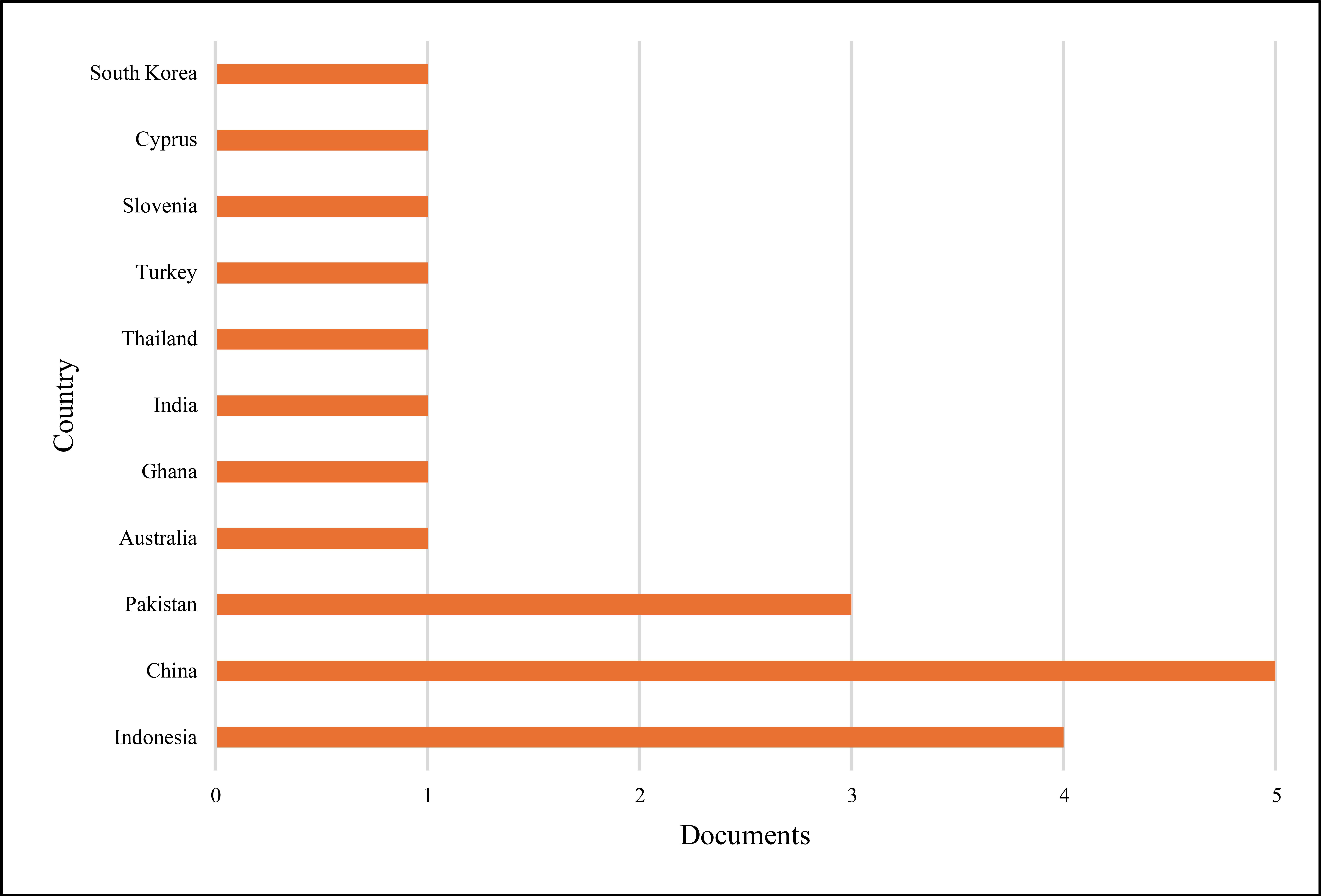
Documents by country.
All studies employed quantitative designs: 18 cross-sectional, 1 cohort with three-wave time-lagged data [8], and 1 mixed-methods [9]. Most operated at the individual level (18 studies), with 2 multilevel studies [8, 30]. Sample sizes ranged from 236 to 2,018 (median ≈ 428).
The reviewed studies spanned three broad sector categories: service/hospitality (9 studies), private/manufacturing (7 studies), and public/semi-public (4 studies). The distribution of the AL-IWB association across these and other study characteristics is examined in Table 2.
| Study Characteristic | Studies (n) | Supporting Direct Effect | Non Supporting | Mediator Clusters |
|---|---|---|---|---|
| Research Design | ||||
| Cross-sectional | 18 | 16 | 2 | SET, SIT, PE-Fit |
| Cohort (3-wave) | 1 | 1 | 0 | SET |
| Mixed methods | 1 | 1 | 0 | N/A |
| Sector Category | ||||
| Service/hospitality | 9 | 8 | 1 | SET, PE-Fit |
| Public/semi-public | 4 | 4 | 0 | SET, PE-Fit |
| Private/manufacturing | 7 | 6 | 1 | SET, SIT, PE-Fit |
| Region | ||||
| Asian contexts | 15 | 13 | 2 | SET, SIT, PE-Fit |
| Non-Asian contexts | 5 | 5 | 0 | SET, SIT, PE-Fit |
To move beyond aggregate description and examine whether the AL-IWB association varied systematically across study characteristics, the included studies were cross-tabulated against three dimensions: research design, sector category, and regional context (Table 2). This comparison was descriptive rather than statistical; because the corpus did not permit meta-analytic pooling (Section 2.7), the cell entries are vote counts and are not weighted by sample size, precision, or study quality.
Across research designs, support for a significant positive direct effect was broadly consistent: 16 of 18 cross-sectional studies, the single three-wave time-lagged study [8], and the one mixed-methods study [9] all reported evidence in support. The two studies that did not report a significant direct effect [33, 37] were both cross-sectional, and both nonetheless retained significant indirect pathways, indicating that the absence of a direct effect did not reflect an absence of association but rather a fully mediated or structurally constrained one (discussed in Section 4.1).
Across sectors, the association held in the large majority of studies in each category: 8 of 9 service/ hospitality studies, all 4 public/semi-public studies, and 6 of 7 private/manufacturing studies. Notably, the two non-supporting cases fell in the service/hospitality [33] and private/manufacturing [37] categories rather than clustering in a single sector, suggesting that the exceptions reflect specific contextual conditions (an embedded innovation expectation in the creative industry; structural constraints on discretionary innovation in logistics) rather than a sector-wide pattern.
Across regions, all 5 non-Asian studies reported supportive evidence, as did 13 of the 15 Asian studies; the 2 exceptions [33, 37] occur in Asian contexts. While this is consistent with the cross-cultural applicability of the AL-IWB association, the corpus's heavy concentration in Asian settings (75%) means this apparent consistency should be read with caution, and the regional pattern is revisited as a limitation on generalizability in Section 4.6.
Two broader observations follow from this cross-tabulation. First, the mediator clusters identified in this review (relational, psychological-resource, and contextual-alignment; Section 3.3) were represented across all three design types, both supporting and non-supporting outcomes, and across all regions, indicating that no single mechanism family is confined to a particular study type or context. Second, the only design capable of supporting temporal ordering, the three-wave study [8], is represented by a single case; the predominance of cross-sectional evidence therefore constrains the inferential weight that can be placed on any of these patterns, a limitation addressed in detail in Sections 4.1 and 4.6.
3.2. Direct Relationship between Authentic Leadership and Innovative Work Behavior (RQ1)
Of the 20 included studies, 18 reported a statistically significant positive direct relationship between authentic leadership and innovative work behavior. This figure represents a vote count and should be interpreted with appropriate caution. Vote counting does not weight studies by sample size, precision, or methodological quality, and is recognized as a comparatively weak form of evidence synthesis [39]. Moreover, because the present review was restricted to peer-reviewed journal articles and could not formally assess publication bias (Section 4.1), this proportion should be regarded as an upper-bound estimate of the true rate of positive findings rather than an unbiased point estimate. The strength of the association varied considerably across studies, ranging from modest to strong effects depending on the organizational and cultural context (Table 3).
| Variable | Role | Theory | Study | Mediation Type | Significant |
|---|---|---|---|---|---|
| Leader-member exchange (LMX) | Mediator | SET | [1, 14] | Partial & Partial | Yes & Yes |
| Identification with leader | Mediator | SET | [1] | Partial | Yes |
| Employee loyalty | Mediator | SET | [8] | Partial | Yes |
| Employee creativity | Mediator | SET | [36] | Partial | Yes |
| Proactive personality | Mediator | SIT | [15, 29] | Partial & Partial | Yes & Yes |
| Psychological capital | Mediator | SIT | [17] | Partial | Yes |
| Flow at work | Mediator | SIT | [12] | Partial | Yes |
| Psychological empowerment | Mediator | SIT | [18] | Partial | Yes |
| Work engagement | Mediator | PE-Fit | [13] & [33] | Partial & Full | Yes & Yes |
| Innovation climate | Mediator | PE-Fit | [32] | Partial | Yes |
| Readiness for change | Mediator | PE-Fit | [31] | Partial | Yes |
| Work-family enrichment | Mediator | PE-Fit | [35] | Partial | Yes |
| Organizational climate | Mediator | N/A | [31] | - | No |
| Acceptance of change | Mediator | N/A | [34] | - | No |
| Psychological empowerment | Moderator | N/A | [9] | N/A | Yes |
| Creative self-efficacy | Moderator | N/A | [12] | N/A | Yes |
| Motivating language | Moderator | N/A | [36] | N/A | Yes |
| Professionalism | Moderator | N/A | [16] | N/A | Yes |
The strongest direct associations were observed in East Asian manufacturing and service contexts [14, 30]. Moderate effects were consistently reported across studies conducted in Turkey [32], India [31], Slovenia [9], China [4, 16], and Indonesia [18, 36].
Two notable exceptions were identified. In Indonesia's creative industry, the direct path was non-significant, with the relationship fully mediated by work engagement [33]. In Thailand's logistics sector, the direct effect was statistically significant but notably modest [37]. Additionally, a third study tested only indirect paths through LMX and identification with the leader [1]. The theoretical implications of these exceptions are discussed in Section 4.1.
3.3. Mediation Mechanism (RQ2)
The review identifies 12 significant mediating variables across 14 studies, organized into three theory-driven clusters (Table 3; Fig. 3). As illustrated in Fig. (3), the framework positions authentic leadership as influencing innovative work behavior through three complementary pathways: relational mechanisms grounded in SET (upper cluster), psychological resource mechanisms grounded in SIT (middle cluster), and contextual alignment mechanisms grounded in PE-Fit (lower cluster). The direct pathway between authentic leadership and innovative work behavior is shown at the base, with four moderating variables serving as boundary conditions that strengthen or weaken this association. This visual representation highlights that the AL-IWB relationship operates simultaneously through multiple theoretical channels rather than through a single dominant mechanism.
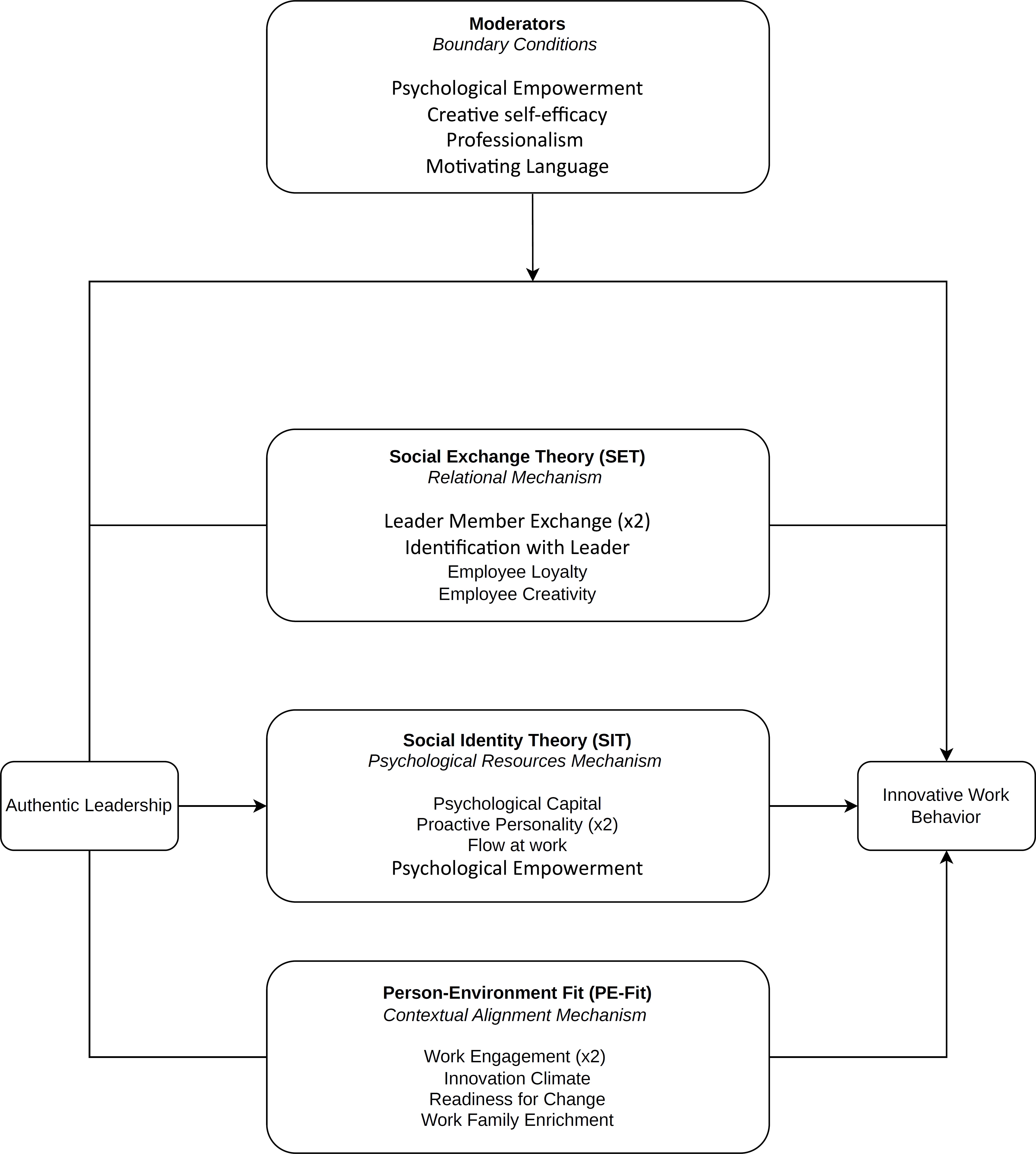
Integrative conceptual framework.
Three mediators: LMX, proactive personality, and work engagement were each replicated in two independent studies. Two additional variables (organizational climate [31]; acceptance of change [34]) were tested but did not reach significance.
3.3.1. Relational Mechanisms
Four mediating variables reflect the dynamics of relational exchange consistent with SET’s emphasis on reciprocity, trust, and high-quality interpersonal relationships.
Leader-member exchange (LMX), the quality of the reciprocal relationship between leaders and followers, emerged as a significant partial mediator in two studies [1, 14]. One study further demonstrated that the mediating effect of LMX was stronger when accompanied by a supportive organizational learning culture, although this moderation operated on the LMX-to-IWB path rather than the direct AL-to-IWB path [14].
Identification with leader, the degree to which followers internalize the leader's values and vision as part of their own self-concept, was a significant partial mediator demonstrating the strongest indirect effect among the mediators tested in that study [1].
Employee loyalty, an affective attachment motivating discretionary effort on behalf of the organization, served as a partial mediator in a cross-level study of Chinese hotel employees [8]. This study uniquely employed a three-wave time-lagged design with leader-rated IWB, providing the strongest temporal evidence in the corpus: authentic leadership at Time 1 predicted loyalty at Time 2, which predicted IWB at Time 3.
Employee creativity, the generation of novel and useful ideas, functioned as a partial mediator in Indonesian SMEs [36].
3.3.2. Psychological Resource Mechanisms
Four mediating variables reflect the psychological resources and identity-linked capacities that authentic leadership cultivates in followers.
Proactive personality, a stable disposition characterized by the tendency to take initiative, challenge the status quo, and influence one's environment, was confirmed as a significant partial mediator in two studies across Chinese [29] and Cypriot [15] contexts, providing cross-cultural support. Psychological capital, a composite construct encompassing hope, efficacy, resilience, and optimism, was a significant partial mediator among Indonesian university lecturers [17]. Flow at work, an optimal psychological state characterized by deep absorption, intrinsic enjoyment, and effortless concentration, partially mediated the AL-IWB relationship among Pakistani employees [12].
Psychological empowerment, comprising perceived meaning, competence, self-determination, and impact, functioned as a partial mediator in Indonesian state-owned enterprises [18]. Notably, psychological empowerment also serves as a moderator in a different study [9], demonstrating that this construct operates through different mechanisms depending on the organizational context. This dual role carries important theoretical implications discussed in Section 4.
3.3.3. Contextual Alignment Mechanisms
Four mediating variables reflect the alignment between individual employees and their work environment.
Work engagement, a positive, fulfilling work-related state of vigor, dedication, and absorption, emerged as the most robustly supported mediator, confirmed in two studies: partial mediation among Chinese nurses [13] and full mediation in Indonesia's creative industry [33]. The contrasting mediation patterns represent a key finding with theoretical implications discussed in Section 4.2.3.
Innovation climate, employees' shared perception of organizational support for creativity and experimentation, partially mediated the AL-IWB relationship in Turkish organizations [32]. Readiness for change, employees' cognitive and emotional preparedness for organizational transformation, served as a partial mediator among Indian startup employees [31].
In the same study, organizational climate (broadly defined) was tested but did not significantly mediate the relationship. Work-family enrichment, the positive transfer of resources and affect from work to family domains, partially mediated the AL-IWB relationship among Ghanaian hospitality employees [35].
3.3.4. Non-significant Mediators
Two variables were tested as mediators but did not reach statistical significance. Organizational climate (broadly defined) was not supported as a mediator between AL and IWB in the Indian startup context [31], while the more targeted construct of innovation climate was supported in a separate study [32]. Acceptance of change was tested but not supported as a mediator in Australian nonprofit organizations [34].
3.4. Moderation Mechanism (RQ3)
The review identifies 4 moderating variables that define the boundary conditions under which authentic leadership's direct influence on innovative work behavior is strengthened or weakened. All four of these cataloged moderators were tested on the direct AL-to-IWB path. This is conceptually distinct from moderation occurring on a mediated pathway: one study additionally reported a mediated-moderation model in which organizational learning culture moderated the LMX-to-IWB path, and thereby the indirect effect of authentic leadership on innovative work behavior via LMX, rather than the direct AL-to-IWB path [14]. This mediator-level boundary condition is therefore not counted among the four direct-path moderators synthesized here.
Psychological empowerment moderated the AL-IWB relationship among Slovenian manufacturing employees [9]. The interaction effect indicated that the direct influence of authentic leadership on IWB was stronger among employees with lower psychological empowerment, suggesting substitution patterns.
Creative self-efficacy, defined as an employee's belief in their ability to produce creative outcomes, moderated the AL-IWB relationship in a study of Pakistani employees [12]. Employees with higher creative self-efficacy responded more strongly to authentic leadership, leading to enhanced innovative behavior, suggesting an enhancement effect.
Motivating language, defined by leaders' use of direction-giving, empathetic, and meaning-making speech, moderated the AL-IWB relationship among Indonesian employees [36]. Authentic leadership was more effective when accompanied by clear, supportive verbal communication.
Professionalism, conceptualized as an internalized value orientation encompassing ethical commitment, self-regulation, and intrinsic motivation, moderated the AL-IWB relationship among Chinese social service workers [16]. Professionalism enhanced AL's effect on IWB while substituting for AL's effect on job satisfaction, an outcome-specific moderation pattern discussed in Section 4.3.
4. DISCUSSION
This systematic review synthesized findings from 20 empirical studies to examine how authentic leadership influences innovative work behavior, the mechanisms by which it operates, and the boundary conditions that shape its effectiveness. The discussion is organized around three main themes: (1) the robustness and contextual boundaries of the direct AL-IWB relationship, (2) the theoretical integration of mediating mechanisms, and (3) the nature and implications of moderating boundary conditions. The section concludes with theoretical implications, practical implications, limitations, and directions for future research.
4.1. The Direct AL-IWB Relationship: Robustness and Contextual Boundaries
The finding that 18 of 20 reviewed studies confirm a significant positive association between authentic leadership and innovative work behavior provides preliminary support for this relationship across diverse cultural and organizational contexts. This evidence extends across Asian and non-Asian settings, spanning service industries, manufacturing, public organizations, nonprofits, and startups.
However, this high confirmation rate should be interpreted with caution due to potential publication bias. As noted in Section 3.2, the high proportion of positive findings must be interpreted as an upper-bound estimate. The well-documented tendency for journals to preferentially publish statistically significant positive results means that studies finding no relationship between authentic leadership and IWB may remain unpublished [41]. The present review's restriction to peer-reviewed journal articles, which excluded dissertations, conference proceedings, and working papers, may have amplified this bias by excluding grey literature sources where null results are more commonly reported. Because this review adopted a narrative thematic synthesis rather than a meta-analytic approach, formal assessments of publication bias (e.g., funnel plots, Egger's regression test) could not be conducted. Nevertheless, the corpus includes two studies reporting non-significant direct effects or weak associations [33, 37], suggesting that the peer-reviewed literature is not entirely uniform in reporting strong positive findings. The proportion of positive results should therefore be interpreted as an upper-bound estimate.
Beyond these inferential limitations, the corpus exhibited substantial conceptual and methodological heterogeneity, warranting explicit consideration when interpreting the synthesis. Because this diversity precluded meta-analytic pooling, formal statistical heterogeneity indices (e.g., I2, Q, τ2) could not be computed; instead, the sources of diversity were assessed structurally, with full per-study measurement and analytical details reported in the Supplementary Material. This assessment indicates that heterogeneity was uneven across measurement domains. Authentic leadership was measured with relative consistency, predominantly via the Authentic Leadership Questionnaire [10], which lends some comparability to the predictor across studies. By contrast, innovative work behavior was operationalized through a wider range of instruments, and the analytical approaches varied considerably (SEM, PLS-SEM, PROCESS, HLM, and hierarchical regression). This pattern implies that the comparability of reported effect magnitudes is constrained more by the outcome measurement and analytical diversity than by inconsistency in the leadership construct itself. We therefore treat the convergence of findings across studies as evidence of a robust qualitative pattern rather than as grounds for inferring a common quantitative effect size, and we regard structured heterogeneity assessment as the appropriate level of analysis for a narrative synthesis of this kind [39].
A further critical caveat concerns the inferential limitations imposed by the predominance of cross-sectional research designs. Of the 20 included studies, 18 employed cross-sectional designs in which perceptions of authentic leadership, mediating variables, and innovative work behavior were all measured at a single time point. Statistical mediation analyses conducted on cross-sectional data can demonstrate that the observed data are consistent with the proposed causal pathway, but cannot establish temporal precedence, rule out reverse causality, or exclude the influence of unmeasured confounding variables [42]. For instance, the finding that work engagement mediates the AL-IWB relationship is equally consistent with the possibility that employees who are already innovative become more engaged, which in turn leads them to perceive their leaders as more authentic. Only the three-wave time-lagged study provides evidence for temporal ordering within the reviewed corpus, and even this design cannot fully eliminate confounding [8]. The theoretical claims advanced in the following sections should therefore be understood as representing plausible causal pathways supported by correlational evidence, rather than empirically established causal mechanisms.
The methodological quality of the evidence base also warrants comment regarding common method variance (CMV). In 18 of the 20 reviewed studies, all variables were assessed through self-report measures completed by the same respondent at a single time point. This design creates optimal conditions for CMV to inflate observed correlations through response consistency motives, implicit leadership theories, and social desirability [43]. While many studies reported using Harman's single-factor test, this approach has been shown to lack sensitivity for detecting moderate levels of CMV [43]. Only two studies in the corpus partially addressed this threat, used supervisor-rated IWB, and supplemented quantitative data with qualitative evidence [8, 9]. The remaining 18 studies are susceptible to inflated effect estimates. The consistently positive associations reported across the corpus should be interpreted in this methodological context.
However, the two contextual exceptions identified in Section 3.2 offer theoretically important insights that prevent overgeneralization. The non-significant direct path in Indonesia’s creative industry [33] can be interpreted through the PE-Fit lens: in creative industry contexts where innovation is an embedded, routine expectation rather than a discretionary extra-role behavior, the alignment between employees' internal motivational states (engagement) and environmental demands may be a necessary precondition for leadership influence to translate into innovative action. In contrast, in sectors where innovation is more discretionary, authentic leadership may directly predict innovative behavior without requiring full emotional engagement as a prerequisite.
The modest direct effect observed in Thailand's logistics sector points to a different boundary condition: structural constraints on innovation [37]. In highly standardized, procedure-driven operational environments, the scope for discretionary innovative behavior may be limited regardless of leadership quality. Authentic leadership in this context was strongly associated with employee resilience and overall work performance, suggesting that its benefits manifest through multiple outcome pathways rather than specifically through innovation. This exception aligns with contingency perspectives that emphasize the role of task characteristics and industry structure in determining when leadership behaviors translate into specific outcomes [26].
Together, these two exceptions underscore that the AL-IWB relationship is not mechanistically uniform. Its strength and directness are contingent upon at least two factors: (a) whether the organizational context treats innovation as a routine expectation or a discretionary behavior, and (b) whether the task environment provides sufficient autonomy and flexibility for innovative action. Future research should explicitly test these contextual moderators.
4.2. Theoretical Integration of Mediating Mechanisms
The identification of 12 unique mediating variables across 14 studies constitutes a substantial body of evidence on the mechanisms through which authentic leadership is hypothesized to shape innovative work behavior. Rather than treating these mediators as an undifferentiated catalog, a limitation identified in prior reviews, this study organizes them into three theory-driven clusters that collectively provide a more comprehensive explanatory framework than any single theoretical lens alone.
4.2.1. Relational Mechanisms (SET Perspective)
The four SET-aligned mediators demonstrate that the quality of interpersonal relationships between leaders and followers serves as a key transmission pathway for innovation. The replication of LMX as a mediator across two independent studies conducted in different cultural contexts (Pakistan and South Korea) provides particularly strong evidence for this relational pathway [1, 14].
The finding that identification with the leader demonstrated the strongest indirect effect suggests that the deepest form of relational exchange, where followers internalize the leader's values, is associated with the strongest innovation outcomes [1]. This extends SET by showing that relational reciprocity operates not only through behavioral exchanges but also through identity-level alignment.
Employee loyalty [8] and employee creativity [36] enrich the SET cluster by demonstrating that relational mechanisms can operate through both affective commitment (loyalty as an emotional attachment that motivates discretionary effort) and cognitive processes (creativity as the ideation precursor to innovation implementation). The temporal evidence from the three-wave study [8] provides the strongest available evidence for temporal ordering within the reviewed corpus. However, even this time-lagged design cannot rule out the influence of unmeasured time-varying confounds.
These four relational mediators appear most operative where leader-follower interaction is frequent and where employees retain discretion over whether to invest extra-role effort. In such settings, the quality of the exchange relationship governs whether followers reciprocate with innovation, consistent with LMX and identification with the leader carrying the strongest indirect effects in relationally proximate work [1, 14]. Where innovation is discretionary and reciprocity-sensitive, the relational pathway is theoretically expected to dominate.
4.2.2. Psychological Resource Mechanisms (SIT Perspective)
The four SIT-aligned mediators reveal that authentic leadership is associated with innovation by cultivating employees' internal psychological capacities.
The classification of these constructs under the SIT umbrella warrants explicit justification, as several of these variables, particularly proactive personality, are not inherently identity constructs. Rather, the theoretical rationale rests on the proposition that authentic leadership activates these psychological resources through identity-relevant mechanisms. Specifically, SIT and its extension, self-categorization theory [21, 44], propose that individuals' self-concepts are partly derived from their group memberships and identification with group prototypes. When authentic leaders model initiative, ethical conduct, and transparent decision-making, they serve as identity prototypes that followers identify with [45]. This identification process creates the psychological conditions under which followers' internal resources, whether stable dispositions, malleable states, or transient experiences, are more readily expressed in the service of group-aligned innovative behavior [21, 44].
Thus, proactive personality is classified under SIT not because proactivity is itself an identity construct, but because the behavioral expression of proactive dispositions in organizational settings is contingent on whether the social and leadership context provides identity-relevant cues that legitimize initiative-taking [46]. Authentic leaders who model proactive behavior signal to followers that initiative-taking is valued and identity-congruent within the workgroup, thereby activating proactive tendencies that might otherwise remain latent. The replication of proactive personality as a mediator across Chinese [29] and Cypriot [15] contexts provides cross-cultural support for this pathway.
More generally, the SIT pathway appears activated not merely by the presence of psychological resources but by a leadership context that renders their expression identity-congruent: it operates where the work demands sustained individual initiative and where authentic leaders supply the identity-relevant cues that legitimize it.
These psychological resource mediators share a common theoretical thread: authentic leadership is associated with the activation of employees' self-concept and identity-linked resources, potentially transforming innovation from an externally imposed requirement into an internally motivated behavior. What distinguishes these mediators is their variation in temporal stability, ranging from stable traits (proactive personality) through malleable state-like resources (psychological capital, empowerment) to transient optimal states (flow). This variation suggests that authentic leadership may operate across multiple psychological timescales simultaneously. Leaders do not merely activate a single psychological mechanism; they create conditions that may foster trait expression, build state-like resources, and facilitate optimal experiences, all of which contribute to innovative behavior through different temporal pathways. This multi-timescale perspective represents a more nuanced understanding than prior reviews that have treated psychological mediators as a homogeneous category.
It should be acknowledged, however, that the classification of these constructs under SIT involves interpretive judgment. Constructs such as flow at work sit at the boundary between the SIT and PE-Fit clusters. Similarly, psychological capital draws on the Conservation of Resources theory [47] and positive organizational behavior traditions that are distinct from SIT. The present classification reflects the primary theoretical mechanism through which each mediator is hypothesized to operate in the authentic leadership context, rather than an exhaustive theoretical account.
4.2.3. Contextual Alignment Mechanisms (PE-Fit Perspective)
The four PE-Fit-aligned mediators demonstrate that authentic leadership is associated with innovation by creating alignment between employees and their work environment. The replication of work engagement as a mediator across Chinese healthcare [13] and the Indonesian creative industry [33] contexts provides the strongest evidence in this cluster, though the degree of mediation differed markedly: partial mediation in healthcare versus full mediation in the creative industry.
This difference in mediation patterns is theoretically informative. In the Chinese healthcare context, authentic leadership continued to have a significant direct effect on IWB even after accounting for work engagement, suggesting that multiple pathways (relational, psychological, and contextual) operate simultaneously. In the Indonesian creative industry, the full mediation indicates that work engagement is a necessary gateway, a finding consistent with the PE-Fit proposition that innovation in creative contexts depends heavily on the alignment between employees' internal motivational states and environmental demands. This contrast demonstrates that the same mediating variable can operate with different strengths and patterns depending on industry characteristics and cultural context.
This contrast suggests that PE-Fit mechanisms shift from a contributing pathway to a necessary one as innovation moves from a discretionary behavior to an embedded role expectation: where innovation is intrinsic to the role, person-environment alignment becomes the gateway through which leadership influence must pass.
The non-significant finding for the broad organizational climate [31], contrasted with the significant finding for the more targeted innovation climate construct [32], suggests that authentic leadership's contextual influence is most effective when it specifically targets innovation-supportive conditions rather than general organizational atmosphere. This finding carries practical implications: organizations seeking to leverage authentic leadership for innovation should focus on building specific innovation-oriented climate elements rather than relying on broad improvements to organizational culture.
Work-family enrichment [35] extends the PE-Fit perspective beyond the workplace by demonstrating that authentic leadership can influence innovation through cross-domain spillovers. When leaders create conditions that positively enrich employees' family experiences, this enrichment generates additional resources and positive affect that employees bring back to the workplace, manifesting as enhanced innovative effort. This finding suggests that the environment in PE-Fit should be understood broadly to encompass both work and non-work domains.
4.2.4. Cross-cluster Observations
Several patterns emerge from the cross-cluster analysis. First, the three mediator clusters are not mutually exclusive but complementary. Studies that tested mediators from multiple clusters simultaneously found that multiple mechanisms can operate in parallel within the same organizational context [1]. This supports the rationale for adopting a multi-theoretical framework rather than relying on a single theory.
Second, the mediators that appeared in two or more studies, namely work engagement, proactive personality, and LMX, span all three theoretical clusters, suggesting that these mechanisms represent particularly robust and generalizable pathways regardless of the theoretical lens applied. These three mediators may constitute the core transmission mechanisms of the AL-IWB relationship, warranting prioritized attention in both future research and the design of practical interventions.
Third, several mediating constructs share conceptual proximity. Two pairs warrant clarification. Psychological capital and psychological empowerment, both within the SIT cluster, differ in content and lineage: psychological capital is a positive-resource composite (hope, efficacy, resilience, optimism) rooted in Conservation of Resources [47] whereas psychological empowerment is a motivational cognition (meaning, competence, self-determination, impact), a reservoir of resources versus an orientation toward one's role. Employee creativity (SET) and flow at work (SIT) both pertain to the creative process but differ in kind: creativity is an output (the generation of novel ideas), whereas flow is a transient experiential state of absorption during task engagement. This proximity does not justify consolidation. Each construct was tested as a distinct mediator in its primary study, and none were modeled jointly, so collapsing them at the review stage would impose a judgment the evidence cannot support. We therefore retain each mediator as tested, make the overlap explicit, and identify the partitioning of their incremental validity through competitive mediation models as a priority for future research.
Fourth, assigning mediating variables to theoretical clusters involves interpretive judgment, and some constructs could plausibly be classified within alternative theoretical frameworks. For example, proactive personality might equally be explained through trait activation theory [48], which posits that personality traits are expressed when situational cues are relevant to the trait in question. The three-cluster framework should be understood as one theoretically grounded organizational scheme among possible alternatives, rather than a definitive taxonomy. Future research should empirically test whether the proposed cluster structure is supported by the data.
Fifth, the operation of a mechanism is conditional rather than fixed, as the dual role of psychological empowerment demonstrates most directly. In the collectivist, high power-distance environment of Indonesian state-owned enterprises [18], empowerment functioned as a mediator; authentic leadership had to first empower employees before innovation followed, whereas in the more individualistic Slovenian manufacturing context [9] the same construct functioned as a moderator, a pre-existing resource shaping responsiveness to leadership rather than a state the leader instilled. Whether a psychological construct mediates or bounds the AL-IWB relationship therefore depends on cultural and structural context, not on the construct's properties alone, reinforcing the case that no single theoretical lens can specify the mechanism's operation a priori.
4.3. Moderating Boundary Conditions
The four moderating variables identified in this review reveal an important and previously underexplored dimension of the AL-IWB relationship: the conditions under which authentic leadership's direct influence on innovation is amplified or attenuated. Two contrasting patterns emerge.
The substitution pattern is observed with psychological empowerment [9] where employees possessing higher empowerment showed a weaker AL-IWB relationship. This finding aligns with the substitutes-for-leadership framework [49], which posits that individual resources can functionally replace leadership influence when they provide equivalent motivational or structural guidance. This has practical implications for organizations with highly empowered employees: the innovation-related benefits of authentic leadership may plateau, and leaders may achieve greater returns by redirecting their efforts toward other outcomes.
The enhancement pattern is observed with creative self-efficacy [12], motivating language [36], and professionalism [16], which shows that individual resources and leadership combine multiplicatively rather than substituting for one another. The professionalism findings are particularly nuanced: professionalism substituted for the effect of authentic leadership on job satisfaction (an internal attitudinal outcome) but enhanced its effect on innovative behavior (an external behavioral outcome). This outcome-specific moderation suggests that substitution dynamics depend not only on the moderating variable but also on the nature of the dependent variable. Innovation, as an externally oriented and risk-laden behavior, may require a complementary combination of internal professional commitment and external leadership support, whereas internal states such as satisfaction can be sustained by professionalism alone.
The relatively large interaction effect for motivating language highlights communication as a critical but underexplored amplifier of authentic leadership's innovation effects [36]. Authentic leaders who combine behavioral authenticity with clear, empathetic, and meaning-making verbal communication may be substantially more effective at promoting innovation than those whose authenticity is expressed only through behavior, without deliberate communicative reinforcement.
The dual role of psychological empowerment, discussed in Section 4.2.4, exemplifies how the same construct can function as either a mediating or a moderating mechanism depending on context.
4.4. Theoretical Implications
This review offers three theoretical contributions to organizational psychology and leadership literature.
First, the integrative conceptual framework (Fig. 3) advances beyond single-theory explanations by suggesting that SET, SIT, and PE-Fit may jointly account for the AL-IWB relationship through complementary mechanisms. No single theory captures all three dimensions; the integrative framework offers a more comprehensive explanatory architecture to guide future hypothesis development. However, it must be emphasized that the framework represents a set of hypothesized causal pathways derived from the synthesis of predominantly cross-sectional evidence. While the proposed pathways are theoretically plausible and consistent with the observed data, they require validation through longitudinal and experimental designs before causal claims can be substantiated.
Second, the identification of context-dependent mechanisms, exemplified by psychological empowerment's dual function as both a mediator and a moderator, challenges the common practice of assigning fixed theoretical positions to psychological constructs. This finding suggests that future research should adopt more flexible analytical approaches (such as testing competing mediation and moderation models within the same study) rather than assuming a priori that a given variable functions only as a mediator or only as a moderator.
Third, the distinction between substitution and enhancement patterns in the moderator findings extends the substitutes-for-leadership framework to the domain of authentic leadership and innovation. The outcome-specific nature of these patterns (substitution for satisfaction, enhancement for innovation) suggests that substitution dynamics are not properties of the moderating variable alone but depend on the interaction among the moderator, leadership style, and the specific outcome under consideration. This three-way interaction represents a more nuanced theoretical position than the original substitution framework, which treated moderating effects as outcome-independent.
4.5. Practical Implications
This review provides several evidence-based recommendations for organizational practice, framed through a psychological lens to align with the contribution to organizational psychology rather than general management.
First, the finding that work engagement, proactive personality, and LMX represent the most robustly supported mediating pathways suggests that organizations seeking to foster innovation through authentic leadership should prioritize three complementary interventions: (a) engagement-building programs that enhance employees' vigor, dedication, and absorption in their work (PE-Fit pathway), (b) recruitment and development practices that identify and cultivate proactive personality characteristics through structured mastery experiences, role modeling, and job crafting opportunities (SIT pathway), and (c) relational quality initiatives that strengthen leader-member exchange through regular one-on-one interactions, participative decision-making, and transparent communication (SET pathway). The convergence of three independent mediating pathways suggests that multi-pronged interventions targeting all three mechanisms simultaneously will produce stronger innovation outcomes than single-mechanism approaches.
Second, the moderator findings carry direct implications for leadership development. The strong amplifying effect of motivating language suggests that authentic leadership training programs should incorporate explicit communication skills development, not merely behavioral authenticity, but also the capacity to articulate direction, express empathy, and create meaning through language. Similarly, the creative self-efficacy finding suggests that organizations should invest in building employees' confidence in their creative abilities through structured success experiences, vicarious learning, and constructive feedback on creative attempts, thereby creating the individual-level conditions that maximize the innovation effects of authentic leadership.
Third, the contextual exceptions highlight that the benefits of authentic leadership for innovation are not automatic across all organizational settings. In highly standardized operational environments, leaders may achieve greater returns on innovation by first restructuring work processes to increase autonomy and discretionary decision-making. In creative industry contexts, engagement-focused interventions should accompany authentic leadership development to ensure the complete pathway from leadership to innovation is activated.
Fourth, the dual role of professionalism suggests that organizations should not assume that highly professional employees require less leadership attention. While professional employees may maintain satisfaction independently, achieving innovation outcomes still requires active, authentic leadership support, even among the most professionally committed workforce.
4.6. Limitations and Future Research
This review has several limitations that should be acknowledged and that suggest directions for future research.
First, despite expanding the database coverage to include Scopus, Web of Science, Wiley Online Library, and APA PsycNet, some relevant studies may have been excluded due to the focused search terms (specifically innovative work behavior) or the restriction to English-language publications. Future reviews should consider incorporating additional databases such as EBSCO and regional databases (e.g., SINTA for Indonesian research), as well as related constructs such as creativity, innovation performance, and idea generation, to capture a broader range of empirical evidence. The exclusion of grey literature (dissertations, conference proceedings, working papers) also increases the risk of publication bias.
Second, the predominance of cross-sectional designs (18 of 20 studies) substantially limits causal inferences. The mediation findings are particularly affected, as cross-sectional mediation analysis cannot establish temporal ordering or rule out reverse causality [42]. Future research should employ longitudinal designs with multiple measurement points and experimental or quasi-experimental interventions to establish causal directionality.
Third, the pervasive reliance on same-source self-report measures (18 of 20 studies) introduces common method variance, which may inflate observed associations. The limited effectiveness of post-hoc statistical remedies such as Harman's single-factor test underscores the need for stronger a priori design-based controls [43]. Future studies should employ multi-source designs, objective innovation metrics, or experimental manipulations to reduce method bias.
Fourth, the geographic concentration of studies in Asian contexts (75%) limits the generalizability of findings to Western and other non-Asian organizational settings. While the consistency of findings across the included Asian and non-Asian studies provides some evidence for cross-cultural applicability, systematic differences in cultural values, particularly collectivism, power distance, and uncertainty avoidance, may shape how authentic leadership influences innovation. Future research should explicitly test cultural dimensions as moderators of the AL-IWB relationship, potentially through cross-cultural comparative designs.
Fifth, the review focused on individual-level innovative work behavior. Only two studies examined team-level dynamics [8, 30]. Consequently, the integrative framework proposed in this review should be understood as an individual-level model: the mediating mechanisms it specifies were established almost entirely through individual-level designs and cannot be assumed to operate identically at the team or organizational level without multilevel validation. However, organizational innovation ultimately depends on collective innovation capabilities, including team creativity, organizational innovation climate, and systemic innovation processes. Future research should adopt multilevel frameworks that examine how authentic leadership simultaneously influences individual, team, and organizational innovation outcomes, and how cross-level interactions between these levels shape overall innovation performance.
Sixth, the imbalance between identified mediating variables (12 unique) and moderating variables (4) suggests that the boundary conditions of the AL-IWB relationship remain underexplored. Future studies should expand the range of moderating variables to include individual traits (e.g., learning goal orientation, tolerance for ambiguity), organizational features (e.g., organizational size, innovation maturity, hierarchical structure), and external environmental conditions (e.g., industry competitiveness, regulatory environment, economic volatility) to build a more complete picture of when and for whom authentic leadership most effectively promotes innovation.
Seventh, while this review proposes the integrative conceptual framework as a theoretical contribution, the framework is derived from the synthesis of separate empirical studies rather than validated as a unified model. Future empirical work should test the framework holistically, examining the three mediator clusters simultaneously within a single study, testing for competitive mediation across clusters, and determining whether the three theoretical mechanisms are additive, interactive, or compensatory in their effects on innovative work behavior. Relatedly, the formal specification of testable propositions is best undertaken within such primary validation studies, where the conditional relationships among mediators and moderators can be evaluated against longitudinal or experimental data rather than inferred from predominantly cross-sectional evidence.
Eighth, the classification of mediating variables into three theory-driven clusters, while grounded in the theoretical frameworks guiding this review, involves interpretive judgment that may be contested. Constructs such as proactive personality and flow at work sit at the boundaries between theoretical traditions. Alternative classification schemes, for example, organizing mediators by their temporal stability (traits vs. states) or by their level of analysis (individual vs. contextual), might yield different theoretical insights. Future research should empirically test the validity of the proposed cluster structure and explore alternative organizational frameworks.
CONCLUSION
This systematic review provides consistent evidence that authentic leadership is positively associated with innovative work behavior across diverse organizational and cultural contexts, though this relationship is neither automatic nor uniform. Its effectiveness depends on the mediating mechanisms through which leadership influence is transmitted and the boundary conditions that amplify or attenuate its direct impact. However, the predominance of cross-sectional designs and same-source self-report measures in the reviewed corpus means that these findings should be interpreted as plausible associations rather than confirmed causal pathways.
The integrative conceptual framework proposed in this review represents the study's central contribution. By organizing the identified mediating mechanisms into three complementary theory-driven clusters: relational exchanges (SET), psychological resources (SIT), and contextual alignment (PE-Fit), the framework moves beyond single-theory explanations to offer a more comprehensive architecture for understanding how authentic leadership is linked to innovation. The classification of mediating variables into these clusters, while grounded in established theoretical traditions, involves interpretive judgment that future research should empirically validate. The identification of substitution and enhancement dynamics among the moderating variables further demonstrates that the conditions under which authentic leadership promotes innovation are outcome-specific and context-dependent.
For organizational practice, these findings suggest that fostering innovation requires multi-pronged strategies that go beyond developing authentic leaders in isolation. Organizations should simultaneously strengthen relational quality between leaders and followers, build employees' psychological capacities, particularly proactive dispositions and creative self-efficacy, and cultivate innovation-supportive environmental conditions. Leadership development programs should integrate deliberate communication skills alongside behavioral authenticity, given the substantial amplifying role of motivating language.
Future research should prioritize longitudinal and experimental designs to establish causal directionality, expand the investigation of moderating boundary conditions across cultural and organizational contexts, and empirically validate the proposed integrative framework as a unified model within single studies.
AUTHORS’ CONTRIBUTIONS
The authors confirm their contribution to the paper as follows: S.D.K.: Contributed to the study design, data interpretation, analysis, and manuscript writing; S.P.S.: Contributed to the study design, data collection, analysis, and manuscript writing; A.A.: Contributed to the study writing manuscript revision and supervision; Y.C.P.M.: Contributed to the study writing manuscript revision and supervision; S.S.: Contributed to the study writing manuscript revision and visualization; R.A.S.: Contributed to the study methodology, manuscript revision and supervision. All authors reviewed the results and approved the final version of the manuscript.
LIST OF ABBREVIATIONS
| AL | = Authentic Leadership |
| APA | = American Psychological Association |
| CMV | = Common Method Variance |
| IWB | = Innovative Work Behavior |
| JBI | = Joanna Briggs Institute |
| LMX | = Leader-Member Exchange |
| PE-Fit | = Person-Environment Fit |
| PRISMA | = Preferred Reporting Items for Systematic Reviews and Meta-Analyses |
| RQ | = Research Question |
| SET | = Social Exchange Theory |
| SINTA | = Science and Technology Index |
| SIT | = Social Identity Theory |
| VUCA | = Volatile, Unpredictable, Complex, and Ambiguous |
AVAILABILITY OF DATA AND MATERIALS
The data supporting the findings of the article are available in the Zenodo Repository at https://zenodo.org, reference numbers 10.5281/zenodo.19760910. (PRISMA 2020 checklist), 10.5281/zenodo.19739813 (JBI quality assessment of the 20 included studies), and 10.5281/zenodo.20682240 (coding protocol and data extraction sheet).
ACKNOWLEDGEMENTS
Declared none.