All published articles of this journal are available on ScienceDirect.

Parental Supervision and School Bullying among Adolescents: A Multiple Mediation Analysis

Abstract
Introduction/Objective
This study focused on parental supervision of school bullying among adolescents, examining mediating psychological mechanisms. Aggression, delinquent friends, and violent media were identified as mediators to examine the multiple mediating effects of parental monitoring on school bullying.
Method
To test the model using a cross-sectional design, this study surveyed 467 middle school and 641 high school students. It utilized covariance-based structural equation modeling to analyze the structural relationships among the variables.
Results
The results showed that parental supervision was not significantly related to adolescent school bullying but was indirectly and negatively associated with it through adolescent violent media use, delinquent peer associations, and aggression.
Discussion
This finding indicates that parental monitoring of children may be an important factor in shielding adolescents from school bullying by mitigating their exposure to risk environments and negative effects, as well as conduct problems.This finding indicates that parental monitoring of children may be an important factor in shielding adolescents from school bullying by mitigating their exposure to risky environments, negative effects, and conduct problems.
Conclusion
Based on the findings, this study advocates for parental supervision as a major factor in the prevention of school bullying. It offers practical suggestions and directions for future research on enhancing parent education programs to include parents, with specific guidance on adolescent media consumption, the use of interventions for peer relations, and the drafting of counselling protocols for the special handling of aggression.
1. INTRODUCTION
According to UNESCO, approximately one-third of adolescents worldwide have recently experienced bullying at school [1]. The World Health Organization’s Health Behavior in School-aged Children (HBSC) survey of approximately 279, 000 adolescents aged 11 to 15 years across four countries found that 11% reported being bullied in the past few months and 6% reported bullying others [2]. In Korea, the 2025 School Violence Survey showed an increase in the overall school violence rate to 2.5%, with decreases in verbal and physical violence but increases in bullying and cyberbullying [3]. Similarly, U.S. The School Crime Supplement data indicate that 19% of students experienced bullying, including 26% of middle school students and 16% of high school students, during the previous school year [4]. As bullying is increasing worldwide, prevention should be focused on middle and high school students, as they are considered the most vulnerable to this problem.
Within Bronfenbrenner’s socioecological framework, multiple concentric layers of environmental contexts converge to influence an individual’s behavior and decision-making at the intrapersonal, interpersonal, community, and societal levels [5]. Taking this model as a reference point, Allen et al. [6] adapted it to the school setting by specifying the elements at each stratum. This socioecological view can provide a valuable lens for analyzing school bullying, including peer bullying, as an outcome of converging factors across different ecological levels.
At the individual level, significant risk factors for school bullying perpetration include high levels of impulsivity and aggression, low levels of empathy [7-10], and impairments in emotional regulation and self-control [11]. These individual traits promote aggressive responses in situations of peer conflict and, in turn, increase the likelihood of involvement in bullying.
At the interpersonal level, parents, teachers, and peers are important factors influencing involvement in bullying. Low parental monitoring and family conflict, poor teacher support and classroom management, and involvement with aggressive peers who normalize or reinforce aggressive behavior have all been identified as significant bullying predictors [12-15]. Negative family interactions, parental neglect, lack of emotional and physical safety, and the absence of trustworthy adults are also closely associated with bullying perpetration [12]. In contrast, positive parent-child relationships, open communication, consistent parental monitoring, and rule enforcement function as important protective factors that mitigate adolescent involvement in bullying behaviors [16-18].
Peer influence is a key mechanism for promoting bullying perpetration among adolescents. Ugwu et al. [19] reported that adverse childhood experiences interact with peer influence and individual personality traits to increase bullying behavior. Peer cultures in which violence is normalized or modeled socially encourage adolescent involvement in violence.
At the environmental level, a substantial body of research across diverse cultural contexts has consistently demonstrated a significant association between exposure to violent media and increased bullying [20-22]. Previous studies have shown that adolescents’ exposure to violent media and contact with delinquent peers mediate aggression and contribute to heightened bullying perpetration [21, 23]. Specifically, exposure to media violence has been linked to elevated levels of anger and aggressive tendencies, which, in turn, increase the likelihood of engaging in bullying behaviors in school [21].
Furthermore, affiliation with delinquent peers has been identified as a critical pathway through which exposure to violent media translates into aggressive and bullying behavior [24]. Recent studies have also demonstrated that violent media exposure indirectly influences bullying and cyberbullying perpetration through delinquent behavior and poor emotional regulation [21, 25-27].
Parental supervision (monitoring) of children has been equated with “supervision” or “directive supervision” in the context of a range of parenting behaviors associated with setting limits and communicating knowledge/ information about the location, activities, and companions of children, and attending to and monitoring children's adjustment [28-30]. It is an essential element of the child-parent relationship, and it can reduce risk behaviors. Parental monitoring is a buffer against risky behaviors [29, 31, 32]; therefore, it is necessary to examine parental monitoring in the context of bullying. Nevertheless, parental supervision (monitoring) and bullying perpetration are not uniformly associated. Parental supervision is regarded as a powerful protective factor in adolescence [33, 34]; therefore, it is important to investigate the association between parental monitoring and bullying perpetration.
There is also a need to examine the protective factors against bullying and the adverse effects on adolescent mental health. Warm parenting is a salient protective factor for mitigating mental health risks associated with bullying involvement among both bullies and bully victims. Adolescents who reported that they had received the highest levels of support from their parents and other adults were the least likely to engage in school violence compared to those who reported the lowest levels [35], and parental support acts as a protective factor against school violence [36].
However, there is limited research on how parents can prevent bullying or protect children from its effects. Bullying is sometimes nurtured in the shadows; therefore, parents do not always know when their children are being bullied, which makes it harder to intervene.
Multiple interacting factors at the individual, interpersonal, and environmental levels influence adolescent behavior, according to Bronfenbrenner’s socioecological model [5]. From this perspective, bullying in school is the result of interactions among family, peer, and environmental factors, rather than a consequence of a single factor. Parental monitoring is an influential interpersonal protective factor that can reduce adolescents’ risk for environmental (e.g., violent media) and interpersonal (e.g., involvement with delinquent peers) threats. Such risk factors could also promote higher aggression at the individual level, thereby increasing the probability of bullying participation at school. Hence, the present multiple mediation model represents a socioecological pathway by which parental supervision relates to bullying perpetration through exposure to media violence, involvement with delinquent peers, and aggression.
Hence, we examined the multiple mediating effects of exposure to media violence, delinquent peer contact, and aggression in the association between parental supervision and adolescent school violence. To this end, we tested a hypothesized structural model (Fig. 1) in which exposure to media violence, association with contact with delinquent friends, and aggression were specified as multiple mediators between parental supervision and school violence. An alternative model in which there is no direct effect of parental supervision on school violence is shown in Fig. (2).
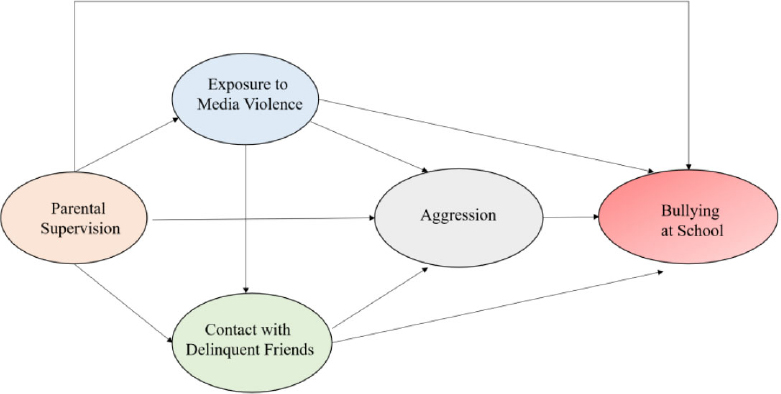
Partial mediation model of media violence exposure, contact with delinquent friends, and aggression in the relationship between parental supervision and bullying at school (hypothesized model).
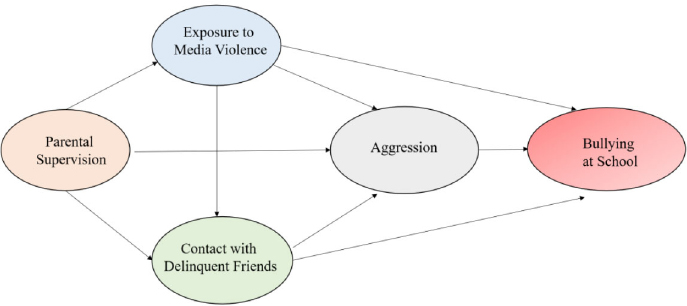
Full mediation model of media violence exposure, contact with delinquent friends, and aggression in the relationship between parental supervision and bullying at school (competing model).
2. METHODS
2.1. Participants and Procedure
This study employed a cross-sectional design, and participants were recruited as a convenience sample from 9 middle schools and 10 high schools across 3 cities in Gyeongsangnam-do Province, South Korea. The first group comprised 600 middle school students and 660 high school. The inclusion criteria were students who were enrolled in the participating middle or high schools in Gyeongsangnam-do Province and provided consent to participate in the study. The exclusion criteria were students who did not provide consent to participate or submitted incomplete questionnaires. In addition, cases identified as multivariate outliers during the data screening process were excluded from the analysis. Data collection took place over 4 weeks from September 2 to 30, 2024. At the school, meetings were held with students through their teachers, and students were invited to complete self-report questionnaires.
The questionnaire included the objectives of the study, the anonymity of participation, and confidentiality. They could also withdraw from the study at any time without penalty. The questionnaire was expected to take approximately 15 minutes. A total of 1,176 questionnaires were completed. A total of 33 participants' responses were excluded from the survey due to incompleteness or unreliability, resulting in a final sample of 1,143 participants included in the analysis. To detect extreme multivariate cases, a multiple regression analysis was conducted with school bullying as the criterion variable, and all study variables were entered simultaneously as predictors. Case-wise diagnostics in SPSS were used to identify cases with extremely large residuals. Following these procedures, 35 cases were identified as potential multivariate outliers and were not further considered. There were 1,108 adolescents in the final sample. Middle school students accounted for 467 (46.9%) of the participants, and high school students accounted for 641 (53.1%). The sample consisted of 504 boys (45.5%) and 604 girls (54.5%), with ages ranging from approximately 13 to 18 years, corresponding to early to middle adolescence.
2.2. Measures
2.2.1. Parental Supervision (Parental Monitoring)
Parental supervision was measured using four items based on the framework of Patterson and Southamer-Loeber [37], adapted from the Korean Youth Panel Survey (KYPS) by Lee and Cho [38]. Responses were rated on a 5-point Likert-type scale, with higher scores indicating higher parental supervision. In the present study, the scale's internal consistency was acceptable, with a Cronbach’s alpha of .72.
2.2.2. Exposure to Media Violence
Exposure to media violence was assessed using an eight-item scale developed by Kim and Kim [39]. Each item was rated on a 5-point Likert-type scale to measure the extent to which participants were exposed to violent content in various media. Higher scores reflect greater exposure to media violence. The internal consistency of the scale in this study was Cronbach’s α = .76.
2.2.3. Contact with Delinquent Friends
Contact with delinquent friends was measured using a 12-item scale originally developed by Kim [40] and later modified by Lee and Kim [21]. Responses were recorded on a 4-point Likert-type scale to assess the frequency of interactions with peers who engage in delinquent behaviors. Higher scores indicate greater contact with delinquent friends. The scale demonstrated high internal consistency in the present study, with a Cronbach’s alpha of .85.
2.2.4. Aggression
Aggression was measured using the Aggression Questionnaire developed by Buss and Perry [41], which Seo and Kwon [42] adapted and validated for use with Korean samples. The scale consists of 27 items rated on a 5-point Likert-type scale and comprises four sub-dimensions: physical aggression, verbal aggression, anger, and hostility. Higher scores indicate higher levels of aggression. In this study, the scale demonstrated good internal consistency (Cronbach’s alpha = .85).
2.2.5. Bullying at School
Bullying perpetration at school was assessed using a six-item scale adapted by Lee and Kim [22] from the bullying perpetration measure originally developed by Olweus [43]. Items were rated on a 4-point Likert-type scale to assess the frequency of bullying behaviors in the school context. Items were rated on a 4-point Likert-type scale to assess the frequency of bullying behaviors in the school context. Higher scores indicate greater involvement in bullying perpetration. The internal consistency of the scale in the present study was Cronbach’s alpha of .80.
2.3. Analyses
Data were analyzed using SPSS 26 and LISREL 8.8. Before the main analysis, SPSS was used to test for missing data, outliers, and skewness and kurtosis. Thirty-five outliers, based on quartile deviation, were removed [44], leaving a final sample of 1,108 participants. Because preliminary analyses showed non-multivariate normality, the Satorra-Bentler scaled chi-square (χ2) statistic, which is robust to non-normality, was used [45]. Structural equation modeling (SEM) was employed to test the mediating effects of exposure to media violence, association with delinquent friends, and aggression on the relationship between parental supervision and school bullying among youth. An asymptotic covariance matrix was calculated using PRELIS 2.8, and covariance structure analyses were performed using LISREL 8.8 [46]. Parceling was used to decrease the number of estimated parameters and increase model stability [47]. Aggression was defined by its relevant subscales, while parental supervision, exposure to media violence, contact with delinquent friends, and school bullying were each composed of two parcels, created using a factor-analytic approach [46]. Model fit was assessed using the Comparative Fit Index (CFI), the Tucker-Lewis Index (TLI), and the Root Mean Square Error of Approximation (RMSEA). CFI and TLI scores ≥ .90 and RMSEA between .05 and .08 were considered to indicate an acceptable model fit [48, 49]. To avoid post hoc model modifications, partial and full mediation models were tested and compared using chi-square difference tests for nested models. When the Satorra-Bentler scaled χ2 difference test was not significant, the more parsimonious model was selected as the final model [45].
3. RESULTS
The descriptive statistics (M, SD, Skew, and Kurt) for all study variables are shown in Table 1. Skewness ranged from 0.69 to 7.37, and kurtosis ranged from 0.19 to 139.90, suggesting non-normal distributions. Hence, the normality-free Satorra-Bentler scaled χ2 difference test was applied in this study.
| - | 1 | 2 | 3 | 4 | 5 | 6 | 7 | 8 | 9 | 10 | 11 | 12 |
|---|---|---|---|---|---|---|---|---|---|---|---|---|
| 1. PS1 | - | - | - | - | - | - | - | - | - | - | - | - |
| 2.PS2 | .50*** | - | - | - | - | - | - | - | - | - | - | - |
| 3. Expo1 | -.15** | -.20*** | - | - | - | - | - | - | - | - | - | - |
| 4. Expo2 | -.08** | -.17*** | .62*** | - | - | - | - | - | - | - | - | - |
| 5. Cont1 | -.07* | -.07* | .21*** | .20*** | - | - | - | - | - | - | - | - |
| 6. Cont2 | -.09** | -.08** | .30*** | .21*** | .65** | - | - | - | - | - | - | - |
| 7. Pagg | -.04 | -.09** | .29*** | .31** | .25** | .26*** | - | - | - | - | - | - |
| 8. Vagg | . 01 | -.02 | .16*** | .15*** | .15** | .15*** | .43*** | - | - | - | - | - |
| 9. Anger | -.04 | -.04 | .11*** | .10*** | .07* | .04 | .40*** | .41*** | - | - | - | - |
| 10.Hosti | -.05 | . -.06 | .18*** | .19*** | .15** | .18*** | .33*** | .22*** | .41** | - | - | - |
| 11.Bull1 | -.08** | -.02 | .21*** | .19*** | .19** | .27*** | .38*** | .23*** | .15*** | .13*** | - | - |
| 12.Bull2 | -.07** | -.10*** | .27*** | .21*** | .21** | .30*** | .37*** | .23*** | .14*** | .25*** | .47*** | - |
| M | 6.31 | 6.60 | 8.87 | 6.63 | 8.70 | 11.43 | 22.72 | 12.41 | 14.52 | 22.08 | 3.65 | 3.74 |
| SD | 2.52 | 2.33 | 3.11 | 2.52 | 2.80 | 3.67 | 5.57 | 3.63 | 4.04 | 6.09 | .94 | .99 |
| Skewness | 7.37 | 4.21 | .69 | .99 | 1.89 | .87 | .28 | .82 | .97 | 1.61 | 1.61 | 1.48 |
| Kurtosis | 139.90 | 72.76 | .31 | .79 | 6.07 | 1.24 | .19 | 1.11 | 5.65 | 16.86 | 2.59 | 1.84 |
Note: *p<.05, **p<.01, ***p<.001. PSI1: Parental Supervision 1, PSI2: Parental Supervision 2, Expo1: Exposure to Media Violence 1, Expo2: Exposure to Media Violence 2, Cont1: Contact with Delinquent Friends 1, Cont2: Contact with Delinquent Friends 2, Pagg: Physical Aggression, Vagg: Verbal Aggression, Anger: Anger, Hosti: Hostility, Bull1: Bullying at School 1, Bull2: Bullying at School 2.
Construct validity was examined by testing convergent and discriminant validity using LISREL [50]. Convergent validity was assessed using the following rules: standardized factor loadings should be higher than .50, the average amount of variance extracted (AVE) should be higher than .50, and the construct reliability (CR) should be higher than .70. The AVE and CR scores were calculated for each latent construct to examine the construct validity of the research variables. The results showed that parental supervision (AVE = .71, CR = .83), exposure to media violence (AVE = .64, CR = .78), and contact with delinquent friends (AVE = .65, CR = .78) satisfied the recommended standards for convergent validity. The construct of aggression had an AVE of .36 and a CR of .70, suggesting that its CR was above the suggested cut-off, but its AVE was not. The construct bullying at school was comprised of four indicators; it satisfied the AVE criterion with a value of 51, yet its CR (.67) was slightly less than the recommended value of .70. However, all the standardized factor loadings were above .50. Both aggression and bullying had CR values >.60. According to Fornell and Larcker [51], convergent validity may still be considered acceptable when the AVE is below .50, provided that the factor loadings are substantial. The CR exceeds .60. The results were acceptable for the convergent validity of the constructs of aggression and bullying at school. Overall, the results indicate that the measurement model for parental supervision, exposure to media violence, association with delinquent peers, aggression, and school bullying demonstrated acceptable convergent validity.
Discriminant validity was assessed using the Fornell-Larcker criterion, which states that the AVE of each construct should be higher than the squared correlation (Φ2) between that construct and any other construct included in the model. Among the study's variables, it shows the highest correlation with aggression and bullying at school (r = .39). This value of 0.15 is much lower than the aggression construct’s AVE (0.36) and the AVEs of the other constructs. Therefore, each construct accounted for more variance among its indicators than among indicators of other constructs, supporting the measurement model's discriminant validity. In summary, the findings suggest good construct validity, both convergent and discriminant, for the measurement model, thus ensuring the suitability of the latent constructs for the present research.
3.1. Model Fit
The fit indices for the proposed model (direct and indirect effects of parental supervision on school bullying through exposure to media violence, association with delinquent peers, and aggression) are shown in Table 2. Although the Satorra-Bentler chi-square statistic was significant, the hypothesized model demonstrated an acceptable fit based on multiple fit indices, including NFI, TLI, CFI, and RMSEA data [Satorra-Bentler χ2 (44) = 199.98, p < .001, NFI = .959, TLI = .952, CFI = .968, RMSEA = .057].
| S-B χ2 | df | p | NFI | TLI | CFI | RMSEA |
|---|---|---|---|---|---|---|
| 199.98 | 44 | <.001 | .959 | .952 | .968 | .057 |
3.2. Model Comparison
The model was compared with an alternative model using the Satorra-Bentler scaled χ2 difference test for nested models. The findings from this contrast are presented in Table 3. There was no meaningful difference in fit between the two models (ΔS-B χ2 = .347, p=.556). Based on parsimony and the absence of a significant difference in model fit, the competing model was selected as the final model.
| Model | S-B χ2 | df | p | NFI | TLI | CFI | RMSEA |
|---|---|---|---|---|---|---|---|
| Hypothesized Model | 199.98 | 44 | <.001 | .959 | .952 | .968 | .057 |
| Competing Model | 200.34 | 45 | <.001 | .9759 | .953 | .968 | .056 |
3.3. Model Analysis
The results of the structural equation model analysis of the competing model are presented in Fig. (3).
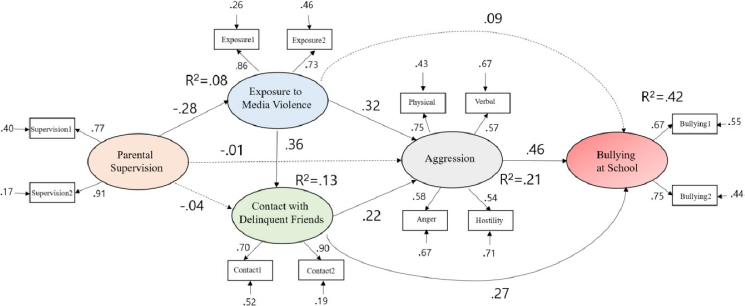
Structural equation modeling results of the final model (all path coefficients are in standard metric).
The SEM analysis output for the final model showed that parental supervision was inversely associated with exposure to violent media (β = −.28, t =−7.36, p < .01). However, it was not significant for delinquent peer association (β = −.04, t = −1.14, p > .05) and aggression (β = −.01, t = −.16, p > .05). Exposure to violent media had a significant positive effect on contact with delinquent friends (β = .36, t = 7.46, p < .01) and aggression (β = .32, t = 7.07, p < .01). Furthermore, contact with delinquent friends also exerted a significant positive impact on aggression (β = .22, t = 5.46, p < .01). Exposure to violent media was not significantly related to school bullying perpetration (β = .09, t = 1.85, p > .05). In contrast, significant positive effects were found for contact with delinquent friends (β = .27, t = 6.18, p < .01) and aggression (β = .46, t = 8.93, p < .01). The SMC (R2) for school bullying perpetration in the final model was .42, suggesting that parental supervision, violent media exposure, delinquent peer contact, and aggression could explain 42% of the variability in school bullying perpetration.
3.4. Test of Mediation
The mediation effects of the final (competing) model are presented in Table 4, and the significant mediation paths are shown in Fig. (4).
| Pathway | Indirect Effect |
|---|---|
| Parental Supervision → Exposure to Media Violence → Aggression → School Bullying | b =-.013 (t =-4.55, p<.01) |
| Parental Supervision → Exposure to Media Violence → Contact with Delinquent Friends → School Bullying | b =-.003 (t =-3.78, p<.01) |
| Parental Supervision → Exposure to Media Violence → Contact with Delinquent Friends → Aggression → School Bullying | b =-.003 (t =-3.78, p<.01) |
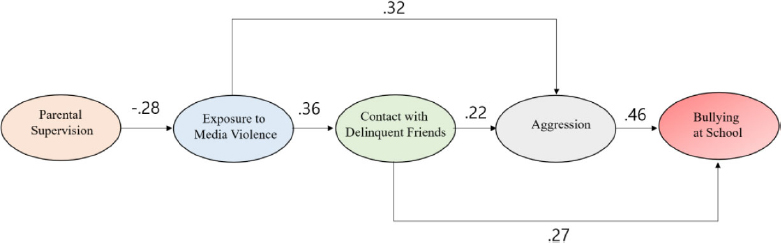
Schematic picture of structural equation model of final model.
The following are the results of the specific indirect effects, as presented in Fig. (4) and Table 4. The specific indirect effects calculated for Fig. (4) and Table 4 are as follows. The serial dual mediation of exposure to violent media and aggression in the relationship between parental supervision and school bullying perpetration was significant (b = −.013, t = −4.55, p < .01). Moreover, the serial dual mediation effect of exposure to violent media and delinquent peer contact was also significant (b = −.003, t = −3.78, p < .01). The serial triple mediation effect of exposure to violent media, delinquent peer contact, and aggression was significant (b= −.003, t = −3.78, p < .01).
4. DISCUSSION
This study examined the direct and indirect relationships between parental supervision and school bullying through three mediating pathways: exposure to violent media, delinquent peer affiliation, and aggression. The results of this study, based on structural equation modeling, partially supported the predictions.
First, parental supervision did not have a direct relationship with adolescent school bullying behavior, but it had a significant indirect relationship through empathy and environmental variables (exposure to violent media, delinquent peer identities, and aggression). These results are in contrast to those of previous research indicating a direct relationship between greater parental supervision and decreased bullying and aggression for adolescents [52], as well as research indicating a direct prediction relationship between parenting patterns and parental monitoring on engagement in school violence and cyberbullying [53]. However, the current results are in line with studies showing that the effect of parental supervision on bullying may be mediated by factors such as delinquent peer affiliation [54].
In this study, we tested the assumption that parental supervision directly protects against school bullying. However, contrary to the hypothesis, the findings demonstrated an indirect effect of parental supervision protection by reducing the consumption of violent media, delinquent peer affiliation, and hostile feelings. This indicates that it is not only parental supervision that prevents adolescents from bullying their peers, but also the social and behavioral context that parents help create, which is a factor in whether a young person bullies. Parents have limited ability to prevent bullying within the peer context or directly influence and control bullying behavior. The present sample consisted of middle and high school students, and it is during this developmental period that individuals tend to distance themselves from their parents and become more connected to their peers. This is an age when young people are more peer-focused and more susceptible to peer norms and social pressure than to parental sanction. Parents may have limited ability to determine whom their adolescents befriend or how they spend their time at school; however, they may still influence major risk factors associated with bullying by reducing screen time, modifying peer group exposure, and promoting positive behavioral patterns. Hence, it is conceivable that the influence of parental monitoring on bullying is indirectly related to bullying through these factors, as opposed to directly influencing it.
These results further strengthen the evidence-based case for conceiving of school bullying as a situation-specific behavior. Behavioral and peer influences are probably closer to bullying involvement in adolescence than parental influence. As such, youth-directed interventions to increase parental supervision and monitoring of youth may be less successful if they fail to address the mechanisms through which parental supervision influences youth behavior. Anti-violent media exposure, anti-delinquent peer association, aggression management, and parent monitoring should be incorporated into bullying prevention/intervention strategies. Such multilevel approaches have the greatest potential to influence the developmental and social processes that contribute to bullying behavior in schools.
Second, parental supervision was also found to have a negative relationship with bullying through exposure to media violence and aggression as sequential mediators. These findings are in line with previous studies showing that parental supervision reduces adolescents’ involvement in school bullying through the sequential mediation of exposure to violent media and aggression [55, 56]. This suggests that parental supervision is a regulating process that includes limiting exposure to violent media and establishing rules for media use that reduce aggression and, in turn, school bullying perpetration. who identified anger as a mediator of the relationship between hostility and school bullying and found that anger predicted school bullying following exposure to media violence.
In addition, meta-analyses indicate that violent video games and media portrayals increase aggressive cognition, affect, and behavior, and reduce prosocial behavior [57, 58], supporting the results of this study. Research indicates that parental supervision and mediation of media use are protective factors that can reduce aggression and problem behaviors among youth [58, 59], findings consistent with this study.
These results are expected from the standpoint of social learning theory [60] and desensitization theory. In particular, if parents closely monitor and control their children’s access to violent media, they may mitigate some of the observational learning processes that encourage the imitation of aggressive acts and counteract some of the desensitization effects associated with repeated exposure to violent material. Consequently, parental supervision is the most important environmental protective factor in regulating violent media exposure and indirectly reducing aggressive and bullying behavior.
Third, parental supervision was associated with bullying via a sequential three-path (exposure to media violence→association with delinquent peers→aggression).
These findings are consistent with those of Lee and Kim [21], who reported that exposure to media violence is positively associated with aggressive and bullying behavior. Holmgren et al. [61] reported that the extent to which parents monitor their children’s media use is indirectly associated with adolescents’ exposure to and selection of content, as well as with aggression and conduct problems. Tian et al. [62] suggested that diminished parental control and/or support predicts increased association with delinquent peers, which in turn is associated with increased aggression and bullying. The current results also align with Velki’s [63] proposition that various environmental factors, such as parental monitoring and the school environment, collectively influence the development of aggressive behaviors.
This study contributes, at least for now, to the literature in a number of ways. Although Lee and Kim [21] validated the involvement of socio-environmental risk factors in school bullying, the present study focuses on a single protective factor, parental supervision, and investigates the sequential mechanisms by which it exerts its effect on victims. Therefore, the current study is expected to present an integrated approach to the potential mediating role of parental supervision in bullying via media violence exposure, delinquent peers, and aggression. Importantly, the present study was conducted with a recent sample and was population-based for Korean adolescents, providing the strongest evidence to date for the enduring positive association between parental supervision and current youth. The findings, which show that parental supervision operates within embedded social and behavioral contexts rather than along a one-way, linear path, are informative and challenge theories of school bullying.
The limitations and future research directions of the present study are as follows: First, the current study did not differentiate between fathers and mothers in overall parental supervision. However, mothers and fathers may have different effects. Therefore, in future research, paternal and maternal monitoring should be considered separately, and differences in their effectiveness should be explored. Second, our focus was specifically on parental supervision and the risk of school bullying. In addition to these considerations, future research should explore the associations between potential protective factors and the mediating influence of interplay among factors, such as peer support, teacher support, and school climate. Third, given that the present study used a cross-sectional design, all variables were assessed at a single time point, and the temporal ordering of parental supervision, violent media exposure, delinquent peer contact, aggression, and school bullying could not be determined. Thus, the meaningful mediation effects found in this study are insufficient to establish causation. Alternative interpretations, such as reverse or bidirectional relationships between variables, are still possible. For instance, teenagers who take part in bullying might go on to associate with delinquent peers, become more exposed to violent media, or have less parental supervision. Therefore, longitudinal and interventional studies are needed to confirm the temporal sequencing of these variables and to further confirm the mediating mechanisms through which parental monitoring affects adolescent school bullying. Fourth, individual- and family-level factors that have been linked to school bullying, including age, sex, SES, and family background, were not controlled for. Including these variables might have reduced the predictive power of the current study for the unique influence of parental control and the mediators examined here. These potential confounders should be controlled for in future studies to improve the validity of the findings and the explanatory power of the applied model.
CONCLUSION
This study also revealed that the link between parental supervision and school bullying is mediated by violent media exposure, delinquent peer contact, and aggression, which is mitigated by parental supervision. It also confirmed the importance of parental supervision as a protective factor against adolescent school bullying. In this respect, the findings of the present study provide a theoretical basis to suggest the need for parent education programs as a feasible counseling intervention modality for adolescents who engage in bullying behavior.
AUTHORS’ CONTRIBUTIONS
The authors confirm contribution to the paper as follows: Y. L. and E. L.: Study conception and design; E. L. and Y. L.: Data collection; E. L and Y. L.: Analysis and interpretation of results; E. L. and Y. L.: Draft manuscript. All authors reviewed the results and approved the final version of the manuscript.
LIST OF ABBREVIATIONS
| PSI1 | = Parental Supervision 1 |
| PSI2 | = Parental Supervision 2 |
| Expo1 | = Exposure to Media Violence 1 |
| Expo2 | = Exposure to Media Violence 2 |
| Cont1 | = Contact with Delinquent Friends 1 |
| Cont2 | = Contact with Delinquent Friends 2 |
| Pagg | = Physical Aggression |
| Vagg | = Verbal Aggression |
| Hosti | = Hostility |
| Bull1 | = Bullying at School 1 |
| Bull2 | = Bullying at School 2 |
ETHICS APPROVAL AND CONSENT TO PARTICIPATE
This study involved human participants and received ethical approval from the Kyungnam University Bioethics Committee, South Korea (Approval No. 1040460-A-2024-017) on August 12, 2024.
HUMAN AND ANIMAL RIGHTS
All human research procedures followed were in accordance with the ethical standards of the committee responsible for human experimentation (institutional and national), and with the Helsinki Declaration of 1975, as revised in 2013.
CONSENT FOR PUBLICATION
Informed consent was obtained from the relevant individual(s) for the collection and publication of their personal data/materials in accordance with the applicable ethical requirements.
AVAILABILITY OF DATA AND MATERIALS
The data and supportive information are available within the article.
ACKNOWLEDGEMENTS
Declared none.