All published articles of this journal are available on ScienceDirect.

Adaptation and Validation of the Social Entrepreneurial Intention Scale among Indonesian University Students

Abstract
Introduction
Social entrepreneurship is of significant importance in the context of economic development and community empowerment. In order to increase the number of social entrepreneurs in Indonesia, it is necessary to develop Social Entrepreneurial Intentions (SEI) among students. For research on students' social entrepreneurial intention to be statistically valid, an appropriate instrument is necessary in the context of research in Indonesia. The objective of this study is to adapt an instrument that demonstrated robust psychometric properties for use within the Indonesian context.
Methods
This study used cross-cultural adaptation procedures following the guidelines established by Beaton. This approach includes forward translation and its synthesis, backward translation, expert committee review, and pretesting (pilot testing). This study evaluated validity with AERA's guidelines by combining three types of validity evidence: evidence based test-content (content validity), evidence based response processes, and evidence based internal structure. Evidence based internal structure was analyzed using Confirmatory Factor Analysis (CFA), involving 432 participants.
Results
The findings indicate that cross-cultural adaptation achieved semantic, idiomatic, experiential, and conceptual equivalence. The validity SEI instruments supported the theoritical construct, revealing a unidimensional structure with factor loading 0.53-0.74. These analysis demonstrated adequate fit (SRMR = 0.041; GFI = 0.996; CFI = 0.930; TLI = 0.903), met established criteria.
Discussion
The cross-cultural adaptation and validation process described in the findings was thorough and effective, ensuring that the instrument maintained its psychometric properties and was culturally appropriate. The CFA result support the validity of the adapted instrument, making it a reliable scale for cross-cultural research and practice.
Conclusion
Based on the results of the analysis, it can be concluded that cross-cultural adaptation has been achieved by meeting all equivalences criteria, and validation confirmed three type of validity evidence, making it feasible to use in research on Indonesian students population.
1. INTRODUCTION
Social entrepreneurship plays an important role in economic growth and community empowerment. This phenomenon has been demonstrated to positively impact quality of life, contribute to the alleviation of poverty, and promote gender equality [1-4]. The concept of social entrepreneurship is based on a triple bottom line model, which integrates the dimensions of people, profit, and planet [5, 6]. The primary objective of social entrepreneurship is to address social issues through the framework of entrepreneurship [7, 8].
A critical component of fostering an increase in the social entrepreneurial landscape is the enhancement of social entrepreneurial intention. Social entrepreneurial intention is defined as a person’s interest and conviction accompanied by a comprehensive plan to establish a social enterprise [9]. It is also defined as an individual's belief and readiness to start a social enterprise [10]. Social entrepreneurial intention has been identified as a significant predictor of behavior, particularly in terms of goals, plans, and goal-directed behavior [11].
The importance of social entrepreneurship has been previously demonstrated in the context of addressing social challenges and promoting sustainable innovation to address issues related to social welfare, health, education, and the environment [12-14]. However, there is a need for further research to develop a comprehensive model that captures the essential elements of social entrepreneurial intention. Research on the social entrepreneurial intentions of university students is of significant importance, as students have the potential to become agents of change [15, 16]. It is therefore hoped that they can comprehensively solve various social problems and formulate policies that can be recommended to policymakers [17].
The social entrepreneurial intention is based on theories that are relevant to the context of intention and entrepreneurship. The development of entrepreneurial intention theory was initiated by the conceptualization of Shapero and Sokol's concept of entrepreneurial event theory [18]. Entrepreneurial intention theory is a theoretical framework that aims to improve the understanding of entrepreneurial intentions. This theory proposes that intentions are formed through a combination of rational and intuitive thinking processes. The process is influenced by several contextual factors, including social, political, economic, and historical elements. Furthermore, research has demonstrated that personality traits and abilities are significant factors in the development of entrepreneurial intentions [15].
The theory of behavioral intention [19] is a specific theoretical framework that focuses on individual intentions regarding specific behaviors, which are then referred to as “behavioral intentions.” Ajzen’s theory offers a general concept, yet it is frequently applied in entrepreneurship because its principles can explain the mechanisms underlying individual intentions. However, a more precise theory of intention is needed in the domain of social entrepreneurship, which led to the development of social entrepreneurial intention formation [20]. This theoretical framework can then provide a detailed explanation of how social entrepreneurial intention is constructed.
The Mair and Noboa theory has been developed and extensively referenced in various studies, particularly in the context of students, as it is most relevant to social entrepreneurship. Research on intentions is particularly relevant for student respondents, as they are entering a phase of career choice and preparation. It is assumed that they may be encouraged to become social entrepreneurs [21]. Furthermore, social entrepreneurship is predominantly driven by young people, as indicated by data from the Global Entrepreneurship Monitor (GEM), which reports that the majority of entrepreneurs are students. This finding is further substantiated by data from the British Council, which indicates that the majority of social entrepreneurs are individuals aged 18 to 34 [22, 23].
A review of the literature reveals that several studies have been conducted on social entrepreneurial intention in Indonesia. However, a review of the extant literature indicates that no new measurement tools have been developed, nor have adapted instruments employed, in Indonesia. A number of studies employ adapted instruments in English; however, these studies do not explicitly explain whether the instruments used were adapted or used initially in English. For instance, this issue has been identified in the research conducted by several previous researchers [24-26].
The absence of standardized instruments to measure social entrepreneurial intentions poses a significant challenge for Indonesian researchers, forcing researchers to utilize instruments developed in different contexts and countries, which can introduce variability and inconsistencies into the research findings. Sperber [27] explains that different research instruments require a process of adaptation first. The cross-cultural adaptation process is of critical importance in ensuring the equivalence of the measuring instrument with the original instrument [28]. Consequently, this study endeavors to address the identified knowledge gap.
A review of the extant literature identifies at least three instruments most frequently used to measure entrepreneurial intention among students. These instruments include the three-item Hockerts’ social entrepreneurial intention measurement tool [29], the six-item Linan and Chen’s entrepreneurial intention measurement tool [30], and the eight-item Ip’s social entrepreneurial intention scale [31].
In the context of research on the social entrepreneurship intentions of Indonesian students, the most suitable measurement instrument for the adaptation and validation process was the one developed by Ip (2017) [31]. The selection of this measurement was based on several reasons: the instrument was developed in Asia (Hong Kong), which is significant in the context of cultural and educational systems that are generally similar across the region. Secondly, the scale was developed and validated in the specific context of university students, indicating its suitability for use in this particular setting. Thirdly, the instrument was developed from an established entrepreneurial intention scale [32] and a credible intention theory [20]. This suggests that the theoretical construct is relatively robust. The selection of instruments is both contextually and theoretically consistent and takes into account good psychometric properties.
Theoretically, social entrepreneurial intention consists of two dimensions: conviction and preparation [31]. Conviction is defined as the degree of interest and confidence individuals have in establishing social enterprises in the future. Preparation refers to the extent of individuals' plans and readiness to become social entrepreneurs. Consequently, individuals with strong convictions and adequate preparation are more likely to become entrepreneurs in the future. However, the results of IP’s (2017) research indicate contradictory findings. Empirical evidence indicates that social entrepreneurial intention is a unidimensional scale, as evidenced by the eigenvalue score, which exceeds 1 [31]. Based on these research results, this study refers to a unidimensional scale.
In the context of the Indonesian language and culture, the researchers were interested in adapting and validating the social entrepreneurial intention scale based on the aforementioned background. This research is expected to significantly contribute to the development of measurement instruments in Indonesia, especially in the context of social entrepreneurial intentions among university students.
2. METHODS
2.1. Materials
The instrument translation process was executed in accordance with the adaptation guidelines established by Beaton et al. [28]. The instrument adaptation process was divided into six stages: forward translation, synthesis, backward translation, expert committee review, pre-final testing, and submission of documentation to the developer or committee coordinator for evaluation of the adaptation process [28]. This process involved qualitative analysis. While the validation process used qualitative methods to check for evidence-based response processes and evidence-based test content, as well as quantitative analysis to check for evidence of internal structure validity, the guidelines outlined by AERA and APA [33] were followed in testing the validity of the measurement.
This adaptation and validation process is further supported by several other guidelines, including those from Peterson, which serve as a reference for conducting cognitive interviews [34]. Additionally, the CVI assessment form aligns with the instrument developed by Polit [35].
2.2. Participants
According to Kline [36], the minimum number of respondents required for this study is 160, assuming 20 respondents for each of the eight items. The criteria for respondents in this study are as follows: first, they must be undergraduate students from all majors who are at least in their third year; second, they must have received entrepreneurship education through training, courses, or internships.
The questionnaire was distributed to 560 students from three private universities; only 472 completed the survey. A total of 432 met the specified criteria, including passing the attention check. The attention check is a procedure employed to ensure that respondents read and respond to the survey according to the instructions provided [37]. Participants who did not complete this process were excluded from the analysis.
The participants in this study consisted of 272 women and 160 men, aged < 19 years or younger: 2 students; 20-22 years: 342 students; 23-25 years: 77 students, and 11 students aged over 25 years. Data collection was conducted through a JotForm from May to June 2024. The data collection method employed non-random convenience sampling, with the criteria of undergraduate students from all majors. Due to the non-random sampling method employed in this study, the external validity of the findings was constrained to the specific area or campus under investigation. Prior to completing the questionnaire, all participants provided written consent by signing an informed consent form. To ensure the ethical conduct of this research, it has been formally registered with an ethics committee. The present study’s design incorporated the contributions of four translators, an observer, five expert reviewers, and six cognitive interview participants.
2.3. Measures
The instrument utilized in this study was the social entrepreneurship intentions scale developed by Ip [31], which comprises eight items. This study used a Likert scale, offering six possible responses ranging from 1 (strong disagreement) to 6 (strong agreement). Previous researchers have tested this scale and found it has adequate psychometric properties (loading factor 0.67-0.90; α: 0.93) [31]. The researcher obtained authorization from the developer of the measurement instrument via email. The original instrument is presented in Table 1 for reference.
| No Item | Item |
|---|---|
| 1 | I wish to start a social enterprise that assists in alleviating environmental issues. |
| 2 | I have a preliminary idea for a social enterprise to act in the future. |
| 3 | My professional goal is to become a social entrepreneur. |
| 4 | I am going to do anything to become a social entrepreneur. |
| 5 | I expect that at some point in the future, I will be involved in launching an organization that aims to promote environmental sustainability. |
| 6 | I expected that at some point in the future, I would be involved in launching an organization that aims to help disadvantaged groups. |
| 7 | I will act as a professional manager by getting involved in the promotion of a social enterprise. promotion. |
| 8 | If I am going to inherit my family’s business, I will plan to transform it into a social enterprise. |
2.4. Procedure
The research process was divided into three distinct stages: translation, cross-cultural adaptation, and validation. Translation can be defined as the process of creating a document from a source language to a target language. Adaptation can be defined as the process of maintaining a document's original meaning. Validation is the process of ensuring that a new questionnaire functions as intended [38]. The following methodological steps have been developed to ensure the equivalence and psychometric quality of the instrument when used in a cross-cultural setting. Consequently, each stage of the process is essential to ensure the accuracy, consistency, and cultural and linguistic bias-free of the data.
The cross-cultural adaptation process aims to achieve equivalence between the original and adapted measures [38]. In order to achieve equivalence in the adaptation process, three approaches can be used: the absolute, relativist, and universalist approaches. The present study uses the universalist approach, which is the most appropriate because it allows for the exploration of universal aspects of the concept (which can be used in various cultures). This approach views culture’s influence on responses to questions, depending on the concept under consideration. The absolutist view holds that culture’s influence on instruments, while the relativist explains that culture’s role in variation makes cross-cultural instruments important [39, 40]. In this approach, the researcher posits that an individual's cultural background may influence their responses to questions, contingent on the concept under study.
The validation concerns the extent to which empirical evidence and theoretical rationales enhance the accuracy of inferences and actions based on specific evidence. Evidence can be categorized as evidence based on test content, evidence based on response processes, and evidence based on internal structure. The guidelines used in this validation process were those from the APA and AERA [33].
The evidence-based test content involved a panel of five expert reviewers (including psychometricians and researchers in social entrepreneurship) who independently assessed the relevance, clarity, and representativeness of each item in the adapted scale. Their feedback was quantified using the Content Validity Index (CVI) to ensure items adequately cover the domain of SEI.
Evidence based on the response process was collected through cognitive interviews with six participants from various majors, universities, and regions. The respondents were undergraduate students from private universities in Indonesia who had completed at least their third year. The participants were recruited from diverse geographical regions to anticipate the influence of cultural variables on the understanding of statement items. Participants were asked to help identify ambiguous terminology or cultural misunderstandings that could cause bias.
Evidence based on internal structure was evaluated using CFA. This analysis tested whether the relationship between items was consistent with the theoretical structure of the social entrepreneurial intention scale. Given that the data were collected using an ordinal Likert scale with six options (1-6), the robust Diagonally Weighted Least Squares (DWLS) estimator was used for the CFA analysis.
2.5. Statistical Analysis
The statistical analysis used in this study was Confirmatory Factor Analysis (CFA) using the JASP [41], [42]. Given that the scale utilized an ordinal Likert format with six response options, the Diagonally Weighted Least Squares (DWLS) estimator was employed. The results of the study will be assessed for model fit by examining two indicators: absolute fit indices and relative fit indices [36], [43], specifically looking at the Standardized Root Mean Square Residual (SRMR), Goodness Of Fit Index (GFI), Comparative Fit Index (CFI), and Tucker Lewis index (TLI) with the fit indices parameters [43]. The SRMR value (excellent fit: ≤ 0.05; acceptable fit: 0.05–0.08; poor fit: < 0.90), GFI, TLI, and CFI (excellent fit: ≥ 0.95; acceptable fit: 0.90–0.95; poor fit: < 0.90). In addition to model fit, reliability will also be checked using Cronbach’s alpha and McDonald’s omega, with a minimum value of 0.07, Average Extraction Value (AVE), and factor loadings (each value > 0.05).
3. RESULTS
3.1. Cross-cultural Adaptation
The cross-cultural adaptation process was carried out with guidance from Beaton [28]. The process began with forward translation by two translators who met specific criteria. The first translator was expected to have a comprehensive understanding of the context of social entrepreneurship, while the second translator was expected to have no understanding of the context. Both translators exhibited no understanding of the context but fluency in both the source language, English, and the target language, Indonesian. The forward translation process yielded two translations: T1 and T2. The subsequent stage entailed the synthesis of the preceding stages. This stage involved a deliberative process between translators 1 and 2 and an observer, aimed at determining the translation that optimally aligned with the language, cultural context, and the intended users of the measurement (students). This process yielded a consensus result designed as T12.
The third stage in this adaptation process was back-translation. The objective of this stage is to ascertain the congruence of the Indonesian translation with the context of the original language. Two translators who are fluent in both languages and live in English-speaking countries were involved in this process. The stage was responsible for the production of forward translation by translators 1 and 2, also known as BT1 and BT2, respectively. A dual approach was employed, integrating both quantitative and qualitative analyses throughout the investigative process. Quantitatively, the experts evaluated each item using the Content Validity Index (CVI), as explained in detail in the validity section, and provided qualitative input on each scale item.
3.2. Validity Evidence
3.2.1. Evidence Based Test-content
The results of the content validity analysis indicated that the content validity of this instrument was adequate. This conclusion can be reached by examining the total Content Validity Index (S-CVI), which has been calculated to be 0.92. S-CVI is a validity calculated for the entire scale instrument. It is defined as the average value of the Item-Content Validity Index (I-CVI). The CVI instrument was developed in response to the standards proposed by Polit et al. (2017) [35]. The scores from each reviewer are presented in Table 2.
| No | E1 | E2 | E3 | E4 | E5 | Total | I-CVI | Interpretation |
|---|---|---|---|---|---|---|---|---|
| 1 | ∨ | ∨ | ∨ | ∨ | ∨ | 5 | 1.00 | yes |
| 2 | ∨ | ∨ | ∨ | - | ∨ | 4 | 0.80 | yes |
| 3 | ∨ | ∨ | ∨ | - | ∨ | 4 | 0.80 | yes |
| 4 | ∨ | ∨ | ∨ | ∨ | ∨ | 5 | 1.00 | yes |
| 5 | ∨ | ∨ | ∨ | ∨ | ∨ | 5 | 1.00 | yes |
| 6 | ∨ | ∨ | ∨ | ∨ | ∨ | 5 | 1.00 | yes |
| 7 | ∨ | ∨ | ∨ | - | ∨ | 4 | 0.80 | yes |
| 8 | ∨ | ∨ | ∨ | ∨ | ∨ | 5 | 1,00 | yes |
| - | 1.00 | 1.00 | 1.00 | 0.62 | 1.00 | (S-CVI) | 0.92 | - |
I-CVI: item validity index
3.2.2. Evidence-based Response Process
The cognitive interview process encompasses five components: understanding, retrieval, judgment, response, and adequacy of content [34]. The process involved a total of six students who were eligible. The result of the cognitive interview indicated that the instrument possessed adequate process response validity, as evidenced by research findings related to understanding, which explained that the majority of participants had a strong understanding of the instrument, with the exception of a few terms that remain challenging to comprehend. The retrieval is indicated by the subject’s ability to understand the introduction, the informed consent form, and the instructions for completing the scale. However, certain participants proposed that this be an implication of the introduction, as this section might otherwise be overlooked.
Regarding the judgement component, participants indicated that, in general, they found the questionnaire to be adequately structured and straightforward to complete. The respondents reported no difficulties in completing the survey. Regarding the response, participants demonstrated a satisfactory understanding of the available answer choices. It was reported by a number of respondents that the six-answer option presented was excessively detailed, thereby complicating the differentiation between similar and distinct responses. Regarding the concept of content adequacy, several participants found the questionnaire difficult to comprehend due to unfamiliar terms. This was a consequence of the participants’ different academic backgrounds.
3.2.3. Evidence-based Internal Structure
The third evidence was based on internal structure. This process has provided evidence of the extent to which the relationships between test items and test components were consistent with the construct being studied, which serves to interpret the existing scores [33]. The validity of the eight-item social entrepreneurial intention scale was previously assessed by the test tool developer using Exploratory Factor Analysis (EFA) with first-order and single-factor models. The analysis yielded factor loadings ranging from 0.67 to 0.90, with a cumulative variance of 68.26%, as indicated by the chi-squared statistic (28) of 1678.27, with a p-value of less than 0.001, and an alpha of 0.93.
According to the findings of Confirmatory Factor Analysis (CFA), the social entrepreneurial intention scales demonstrated adequate reliability and validity, as indicated by SRMR = 0.041; GFI = 0.996; CFI = 0.930; TLI = 0.903 [36], [43]. The finding suggests that the majority of the fit indices (SRMR, GFI, CFI, and TLI) were consistent with the established criteria. Consequently, the scale hypothesized as a one-factor scale demonstrates adequate validity. Table 3 presents a detailed exposition of the specific.
| Psychometric Properties | Evidence | Explanation |
|---|---|---|
|
Unidimensional – single factor |
Fit indices: SRMR = 0.041; GFI=0.996 CFI=0.930; TLI=0.903 |
Exelent fit Acceptable fit |
| Item validity | Factor loadings: 0.53-0.74 | Valid |
| Convergent validity | AVE: 0.457 | Marginal fit |
| Reliability | ω = 0.869; α=0.867 | Reliable |
The results of the Confirmatory Factor Analysis (CFA) in this study demonstrate that eight items have factor loadings greater than 0.5, with values ranging from 0.53 to 0.74 (Fig. 1). The reliability coefficient of the scale was ω = 0.869
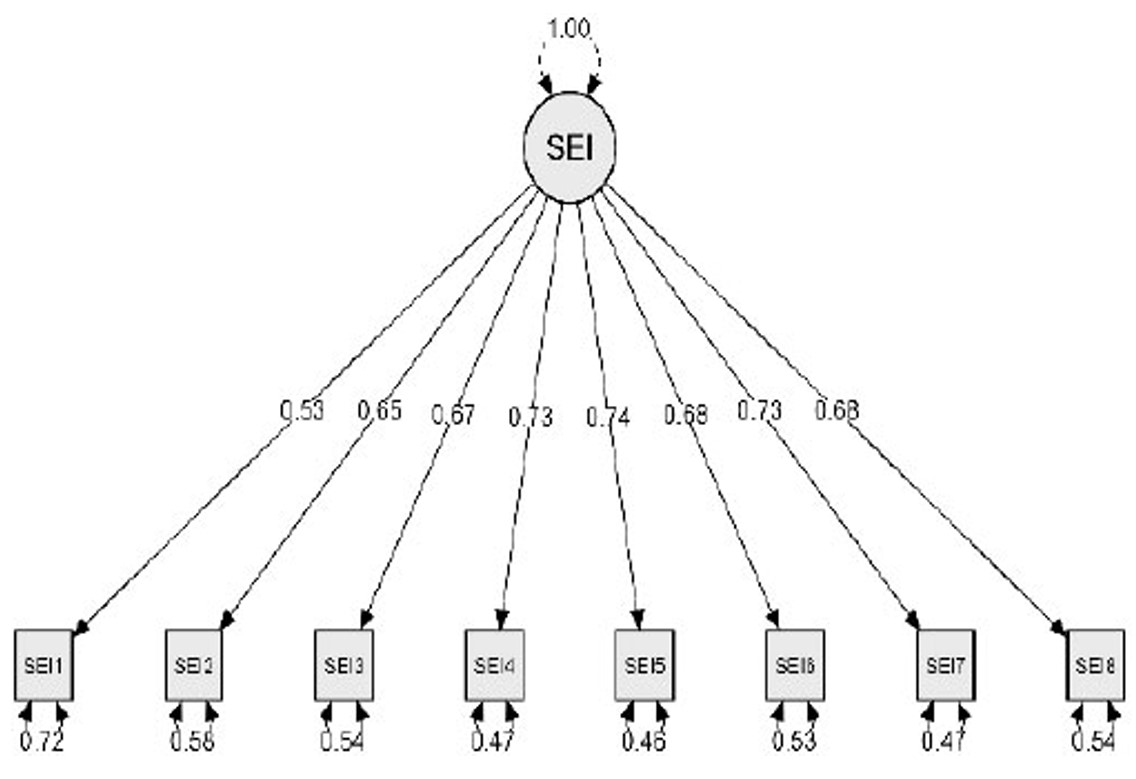
Social entrepreneurial intention scale.
4. DISCUSSION
The present study has yielded an Indonesian version of the social entrepreneurial intention scale. The adaptation and validation processes were performed in accordance with established protocols. A cross-cultural adaptation approach was chosen because it enables cross-cultural comparison, which is essential for accumulating scientific evidence on SEI. Epstein noted that when seeking to obtain an adequate measuring instrument, cross-cultural adaptation is a more probable course of action than the creation of a new instrument, as it proves more efficient with respect to time, energy, and financial resources [38].
Ideally, measuring instruments should be tested under conditions as similar as possible to their intended purpose and use, within the same country. This will prove the conceptual equivalence of translations across nations. In the adaptation process, the social entrepreneurial intention scale fulfilled semantic, idiomatic, experiential, and conceptual equivalence according to Beaton et al. ’s guidelines [28].
The adaptation process prioritized semantic equivalence, with experts conducting a review to identify terms that might possess multiple meanings or present translation challenges. Expert analysis indicates that the number of terms difficult to translate is relatively low. Most of these terms have established Indonesian equivalents, thereby facilitating cross-cultural communication. The process also involved achieving idiomatic equivalence. However, some terms proved challenging for respondents to comprehend. These findings emerged from the cognitive interview process, which involved identifying expressions requiring further clarification and seeking equivalent versions to ensure comprehensibility.
Adjustments were made in the context of experiential and conceptual equivalence. These modifications were essential because cross-cultural adjustment was needed; the concept in different cultures did not fully align with the local context of Indonesian social enterprises, which typically feature less complex organizational structures and distinct operational models. For instance, the original item discussing “I will act as a professional manager by getting involved in the management of social enterprise through promotion” was adjusted and simplified to focus on “I will become a professional social entrepreneurship manager”. Consequently, the items have been adapted and simplified. Beaton [28] posits that the concepts and experiences that exist in one country differ from those in another because they are related to the culture or events in that country. Therefore, these two aspects of equivalence are important.
Validity encompasses the collection of pertinent evidence, providing a robust scientific foundation for interpretation [33]. Validity refers to the extent to which empirical evidence and theoretical frameworks support the interpretation of test scores for their intended use. This study incorporates three distinct categories of validity evidence: evidence derived from test content, evidence derived from response processes, and evidence derived from internal structure.
The first validity evidence employed is content validity. Content validity evidence was assessed using the Content Validity Index (CVI). The process under discussion involved a team of five experts, including linguists, methodologists, and social entrepreneurship experts, in accordance with Polit and Beck’s guidelines [35]. This expert review approach is considered highly adequate because it involves an in-depth discussion to ensure conceptual alignment. The calculation of the eight items on the SEI scale resulted in an S-CVI score of 0.92, exceeding the required minimum of 0.78. This indicates that all items are satisfactory. While the final score shows a high level of agreement, this process involved efforts to resolve initial disagreements on several items, which required intensive justification and modification until a satisfactory consensus was reached.
The second piece of validity evidence is response process evidence. A theoretical and empirical analysis of this evidence provides proof of the suitability between the construct and the responses given by participants [33]. The analysis, conducted through cognitive interviews using a verbal probe approach, included the following: first, identifying the meaning of the questions; second, collecting data; third, analyzing and comparing respondents' interpretations of the intended meaning [34]. The result of the analysis demonstrates that the questionnaire is suitable for participants due to its comprehensibility. The document features no substantial amendments, with the exception of the inclusion of comprehensive clarifications for select terminology that has proven to be challenging for the target audience to comprehend.
Following the completion of the adaptation process, the subsequent step involves the validation and reliability assessment of the instrument. The CFA analysis, as described in the result section, indicates that the factor loadings on the original scale (0.67-0.90) [10, 31]. The score obtained suggests that the adaptation process of the measuring instrument, which was carried out according to the established procedure, may not have been exhaustive. However, in terms of scores, it was adequate. Hair [43] posits that the loading factor is higher than 0.50, with an ideal score of 0.70. This variation may also be explained by the process of translation and the inclusion of different research participants.
Based on the results of the fit indices analysis, it can be seen that the value of the absolute fit indices, as indicated by an SRMR = 0.041, represents an excellent fit. SRMR reflects the average standardized difference between the observed correlation matrix and the correlation matrix predicted by the model. Smaller values indicate a better model fit [28, 29], and this is supported by the GFI value, which shows a score of 0.996 (Excellent fit). This illustrates the proportion of variance-covariance in the data explained by the model [30]. The second standard used is the relative fit indices, which in this study are represented by CFI=0.930 and TLI=0.903 (acceptable fit) [25, 26]. CFI compares the proposed model to a baseline (null) model that assumes there are no correlations among variables, while TLI also compares the proposed model to the baseline model, but applies a penalty for model complexity [44].
The maximum possible Average Extraction Value (AVE) is 0.457. The AVE value is less than 0.5, which is below the optimal range. Hair et al. posited that the optimal AVE value is greater than 0.5 [43], given that the AVE is an indicator of convergent validity, it can be strengthened by other evidence, specifically the factor loading value that has met the requirements. Considering the aforementioned points, it may be concluded that the social entrepreneurial intention scale is acceptable.
To ensure the validity and reliability of the measurement tool, the researcher must implement a validation process capable of anticipating potential biases. The anticipation of bias was undertaken to ensure that the relationship between the constructs [45]. Anticipation of bias was measured by providing a pause between one instrument and another, with the pause consisting of additional questions that were different from the questions in the instrument. This was implemented to prevent participants from identifying the relationship between the predictor and criterion variables, as well as to assess the participants’ level of attention. Abbey and Meloy [37] posit that the attention check was capable of identifying participants who were not paying attention when filling out the questionnaire. Anticipation of bias was also controlled by providing clear instructions and informed consent. The data of participants who completed the questionnaire without anticipation of bias were the only ones considered in this study.
The adaptation and validation processes were carried out to the fullest extent possible; however, this study still has limitations that cannot be avoided. The initial constraint pertains to the sample, which comprises students from three private universities in Indonesia. From a statistical perspective, the sample size can be considered adequate. However, the use of convenience sampling may limit the external validity of the study. The result may not fully represent the student population throughout Indonesia, especially those from public universities, polytechnics, or other institutions with different curricula and environments.
Second, the validity measurement did not reach the maximum value and was lower than the original scale measurements. This phenomenon may be attributed to an imperfect equating process, influenced by factors such as experience and context, each with distinct characteristics. When evaluated from the perspectives of participants in scientific, health-related, and engineering disciplines, the outcomes diverge from those observed among participants in the social sciences. This phenomenon may be attributed to the presence of unfamiliar terminology within the instrument’s items.
Future researchers should prioritize homogeneity among respondents and a more representative sample to address these limitations. In the context of social entrepreneurship, it is imperative to assess the intention to pursue this vocation in a diverse setting. These settings may include academic institutions, community groups, and commercial enterprises.
5. STUDY LIMITATION
The limitation is the sampling technique. We used a non-random sampling method, which limits the ability to generalize the findings on the validity and structure of the instrument to the entire population of Indonesian students. Therefore, the result obtained should be interpreted as strong evidence regarding the validity of the instrument itself in a representative sample of students for the context of measuring SEI. Future researchers in Indonesia who wish to use this adapted instrument are advised to contact the corresponding author to obtain a copy of the final Indonesian questionnaire.
CONCLUSION
The Indonesian version of the instrument was obtained based on the results of the adaptation and validation of the social entrepreneurial intention scale. The adaptation process is carried out through the stages of Beaton, which consist of five stages: forward translation, synthesis of forward translations, backward translation, expert review committee, and pre-final testing. Concurrently, the validation process manifests three distinct manifestations of validation: evidence of the test content, evidence of the process response, and evidence of the internal structure.
The results of the test demonstrate content validity, evidence of process response, and evidence of internal structure, indicating adequate results overall. The results of the content analysis indicate a content validity index (CVI) score of 0.92, which exceeds the minimum threshold of 0.78, thereby substantiating the content's validity. The efficacy of the process response is substantiated by the outcomes of cognitive interviews, encompassing aspects such as comprehension, retrieval, judgment, response, and the adequacy of content. Generally, the participant's response demonstrates a high degree of understanding of the measuring instrument; however, certain inputs related to specific aspects have undergone adjustment. Evidence of internal structure is obtained from the results of Confirmatory Factor Analysis (CFA). This analysis demonstrates factor loading, scale reliability coefficient, and an adequate model fit index. Therefore, it can be assumed that the model of the social entrepreneurial intention scale has adequate data.
The sample primarily consisted of three universities located in a region. Consequently, the findings are not sufficiently representative to draw conclusions about the conditions in other regions. In addition, the findings of the validity measurements did not delineate the maximum value and were lower than the original scale score. Future research should strive to include a more diverse sample in terms of geographic location, institution type, and socioeconomic background. Although the study includes validity evidence from the response process and internal structure, future research could strengthen validity by including evidence from relationships with other variables. Research could test social entrepreneurial intention and other factors, such as empathy, social values, etc.
AUTHORS’ CONTRIBUTIONS
The authors confirm their contribution to the paper as follows: I.I.: Writing design, data collection, writing; N.N.: Article revision, measurement tool synthesis; S.: Article review, editing. All authors reviewed the results and approved the final version of the manuscriptwrite
LIST OF ABBREVIATIONS
| AERA | = American Educational Research Association |
| APA | = American Psychological Association |
| AVE | = Average Variance Extracted |
| CFI | = Comparative Fit Index |
| CFA | = Confirmatory Factor Analysis |
| CVI | = Content Validity Index |
| EFA | = Exploratory Factor Analysis |
| GEM | = Global Entrepreneurship Monitor |
| GFI | = Goodness-Of-Fit Index |
| SRMR | = Standardized Root Mean Square Residual |
| US | = United States |
ETHICS APPROVAL AND CONSENT TO PARTICIPATE
This research has obtained ethical approval from the Surabaya University, Indonesia Ethics Committee, as stated in the ethical approval certificate No. EC 229/KE/IX/2024, which is in accordance with the Helsinki Declaration.
HUMAN AND ANIMAL RIGHTS
All procedures performed in studies involving human participants were in accordance with the ethical standards of institutional and/or research committee and with the 1975 Declaration of Helsinki, as revised in 2013.
CONSENT FOR PUBLICATION
Informed consent was taken from all the participants when they were enrolled.
AVAILABILITY OF DATA AND MATERIALS
Authors deposited their datasets openly to Zenodo Repository, in addition to their own or their institutional archives. For more details please visit https://doi.org/10.5281/zenodo.18320530.
FUNDING
The publication is funded by Beasiswa Pendidikan Indonesia (BPI), Pusat Pelayanan Pembiayaan dan Asesmen Pendidikan Tinggi, Ministry of Higher Education, Science and Technology of Republik Indonesia, Lembaga Pengelola Dana Pendidikan (LPDP) as an Indonesian endowment fund for doctoral degree students with the scholarship program, and the Ministry of Finance of Republik Indonesia.
ACKNOWLEDGEMENTS
Declared none.
DECLARATION OF GENERATIVE AI STATEMENT
During the preparation of this work, the authors used Scopus AI and Gemini in order to check grammar and polish the text. After using this tool, the authors reviewed and edited the content as needed and take full responsibility for the content of the publication.