All published articles of this journal are available on ScienceDirect.

Validation of the Malay Version of the Cognitive Fusion Questionnaire-7 (CFQ-7-M)
 iD
Assis Kamu3
iD
Chong Mun Ho3
iD
Emiral Muhammad Ezmeer1
iD
Mohd Amiruddin Mohd Kassim1
iD
Umberto Volpe2
iD
Laura Orsolini2
iD
Fredie Robinson1
iD
iD
Assis Kamu3
iD
Chong Mun Ho3
iD
Emiral Muhammad Ezmeer1
iD
Mohd Amiruddin Mohd Kassim1
iD
Umberto Volpe2
iD
Laura Orsolini2
iD
Fredie Robinson1
iD
Authors Info & Affiliations
Abstract
Introduction/ Objective
This study aimed to translate and validate the Malay version of the Cognitive Fusion Questionnaire-7 (CFQ-7-M) among Malay-speaking, Malaysian university students. The CFQ-7 measures cognitive fusion, a key ACT process that reflects the extent to which individuals become entangled with their thoughts and treat them as literal truths, which contribute to psychological inflexibility and emotional distress.
Methods
The questionnaire was translated using a rigorous forward-backward protocol, followed by pilot testing. Then, a total of 220 participants completed the CFQ-7-M, the Malay Acceptance and Action Questionnaire-II (AAQ-II-M), and the Depression, Anxiety, and Stress Scale-21 (DASS-21). Internal consistency reliability, Confirmatory Factor Analysis (CFA), convergent validity, and measurement invariance across gender were examined.
Results
The CFQ-7-M demonstrated excellent internal consistency (α = 0.936; ω = 0.937; GLB = 0.956). CFA supported a unidimensional structure, with strong incremental fit (CFI = 0.998, TLI = 0.997) and low residual misfit (SRMR = 0.039), although RMSEA was elevated (0.102). Standardized factor loadings were strong, ranging from 0.796 to 0.901. Convergent validity was supported by strong correlations with AAQ-II-M (Spearman ρ = 0.788; Pearson r = 0.788) and moderate-to-strong correlations with depression, anxiety, and stress (all p < 0.001). Measurement invariance across gender was also established.
Discussion
The findings support the cross-cultural applicability of the CFQ-7-M. However, the elevated RMSEA warrants cautious interpretation, and further validation in more diverse clinical and community samples is needed.
Conclusion
The CFQ-7-M is a reliable and valid instrument for assessing cognitive fusion among Malay-speaking Malaysian university students and shows potential for broader use in Malay-speaking populations.
1. INTRODUCTION
1.1. Background
Cognitive fusion plays a key role in the development of psychological inflexibility. As such, it is defined as a person’s likelihood of becoming trapped or entangled in their own thoughts. A person with strong cognitive fusion is more vulnerable to mental health issues such as depression, anxiety, and even stress. Although the degree of outcome varies, in some severe cases, cognitive fusion can affect a person’s behavior and perception negatively [1-3]. People with high levels of cognitive fusion not only face increased vulnerability to emotional distress [4], but they also often struggle with maladaptive coping strategies, which further complicate the prognosis [5]. This is because individuals with a high level of cognitive fusion firmly believe and treat their internal experiences as the literal truth. However, cognitive fusion is not a fixed trait; rather, it is a dynamic and modifiable psychological process within the ACT framework. The framework involves six main processes, including acceptance, cognitive defusion, present-moment awareness, self-as-context, values, and committed action. ACT is a psychological intervention that aims to increase psychological flexibility, which refers to the ability of a person to stay present even in the moment of difficult experiences and continue to take meaningful actions based on their values in life. Within this framework, cognitive fusion is important because individuals who are highly fused with their thoughts may respond to those thoughts as if they are absolute truths, which can restrict flexible and values-based behaviour. Given that cognitive fusion is the key element of psychological inflexibility, the main therapeutic target within the ACT framework is to reduce it. Reducing cognitive fusion may help individuals relate to their thoughts more flexibly, allowing them to choose behaviors that are guided by personal values rather than being controlled by distressing or self-limiting thoughts [6, 7]. The CFQ-7 questionnaire is therefore useful in ACT-related research and practice because it's used to measure cognitive fusion, allowing researchers and clinicians to assess this specific process and monitor its changes following psychological interventions.
To enable the measurement of this construct, Gillanders and colleagues (2014) developed the Cognitive Fusion Questionnaire (CFQ-7) with seven items as a brief, unidimensional, psychometrically validated self-report tool [8]. Since then, the CFQ-7 has been adapted into different languages (e.g., Chinese, Spanish, Hungarian) across the world, showing excellent internal consistency and construct validity [9]. Among the studies, the CFQ-7 also revealed strong correlations with other related constructs such as experiential avoidance, depression, anxiety, and stress [10, 11].
Despite the growing importance and global utilization of CFQ-7 to measure cognitive fusion, there is no validated version of the CFQ-7 available in Malay or Bahasa Malaysia currently. There is a great need, considering the increasing utilization of ACT-based interventions across Malaysia in both clinical and subclinical studies [12, 13]. A culturally adapted and linguistically validated cognitive fusion questionnaire, such as CFQ-7-M, would enhance both clinicians' and researchers’ measurement of cognitive processes by accurately identifying the underlying problem and changes, especially during the intervention. Moreover, strong collectivist values and cultural norms in Malaysia may shape emotional expression and thought processes unique to the local context. As a result, the evaluation of the theoretical integrity and psychometric performance of the CFQ-7 is crucial to ensure its applicability in the Malaysian setting. Without such validation, the use of CFQ-7 in research and clinical assessments risks conceptual misunderstanding and measurement bias in the local context.
To close the gap, this study’s main objectivewas to translate, adapt, and validate the Malay version of the CFQ-7 (CFQ-7-M). The use of university students was considered appropriate for this initial translation and psychometric validation because the primary objective was to evaluate linguistic clarity, cultural comprehensibility, internal consistency, factor structure, and convergent validity of the CFQ-7-M. Additionally, cognitive fusion is relevant not only to clinical populations but also to non-clinical individuals who may experience varying levels of psychological inflexibility and distress [14]. Furthermore, this study was not designed to examine clinical severity, diagnostic accuracy, or cut-off scores. Therefore, university students provide a suitable starting point for examining whether the Malay version retains the expected conceptual and psychometric properties.
The specific objectives of the study were to examine the item-level distribution of the CFQ-7-M and assess normality assumptions through descriptive statistics, skewness, and kurtosis. The study also aims to evaluate the internal consistency reliability by using Cronbach’s alpha, McDonald’s omega, and the Greatest Lower Bound (GLB) and to assess construct validity of the unidimensional model of CFQ-7-M using Confirmatory Factor Analysis (CFA) with established fit indices, besides establish convergent validity by examining the relationships between CFQ-7-M and theoretically related constructs, including psychological inflexibility (AAQ-II-M) and emotional distress (DASS-21 subscales).
By achieving these objectives, the study contributes to the growing body of ACT-related assessment tools in Malaysia, particularly in measuring cognitive fusion among Malay-speaking populations, supporting the culturally appropriate application of evidence-based psychological interventions in the local context.
2. METHODS
2.1. Study Design
This is a cross-sectional instrument validation study conducted among UMS students. The process flow of the CFQ-7-M translation, pre-test, and psychometric validation process is described in the following sections and presented in Fig. (1). Permission to translate and use the original CFQ-7 was obtained from the original author of CFQ-7, Dr. David T. Gillanders, and ethical clearance was obtained from the UMS Medical Research Ethics Committee. Informed consent was also obtained from all participants following a full explanation of the study procedures.
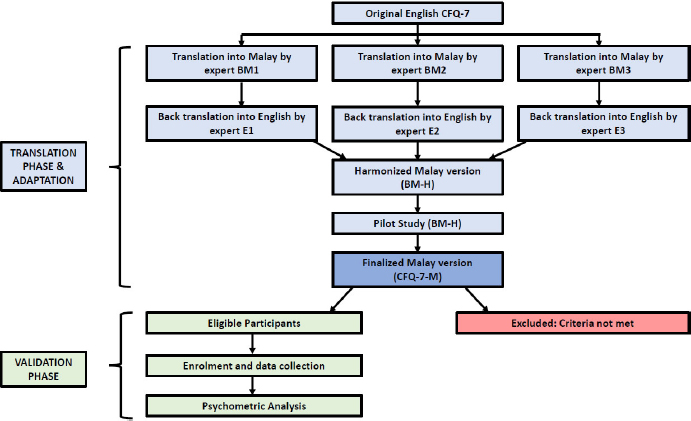
Cross-cultural adaptation and validation process for the CFQ-7-M.
2.2. Translation Phase
The CFQ-7-M was developed through a rigorous forward–backward translation process based on the US Census Bureau's guidelines [15]. The translation process was commenced on 14th and 15th April 2025 by six groups of UMS postgraduate students independently, each with five translators, all of whom demonstrated proficiency in English and Malay at the Sijil Pelajaran Malaysia (SPM) level (the ability to read and understand Bahasa Malaysia at the national secondary school examination standard). Then, the process was followed by a reconciliation meeting on 16th April 2025 involving all translators and the research team to compare, discuss, and further refine each item until consensus was reached on the most acceptable items with conceptual and cultural similarity. The considerable similarities between the original CFQ-7 and the back-translated versions showed high translation quality and produced a harmonized CFQ-7-M.
Subsequently, face validity was assessed during the pilot-testing phase on 17th April 2025, whereby 30 UMS students with a minimum SPM level of Bahasa Malaysia competency participated in a pilot test of the harmonized CFQ-7-M to assess its clarity, understanding, and cultural appropriateness. During the process, participants were asked to provide input on the items' understandability and identify any unclear phrases. Participants also reviewed each item for grammatical structure, subject-verb-object (SVO) order, and sentence flow to ensure clarity and preserve the original meaning of the questionnaire while removing any potential defects that might affect overall comprehension. As a result of this stage, the Malay version of CFQ-7 (CFQ-7-M) was finalized. The final Malay CFQ-7-M items, alongside the original English items, are provided in the Appendix.
2.3. Validation Study
This study employed a cross-sectional design to validate the CFQ-7-M among 220 UMS students from 19th June to 11th July 2025. Convenience sampling was used to recruit participants. Participants were eligible for inclusion if they were aged 18 years or older, enrolled as students at UMS, able to read and understand Malay, and provided informed consent. The participants then completed a self-administered questionnaire through online Google Forms, comprising sections for sociodemographic information, the CFQ-7-M, the Malay version of the Acceptance and Action Questionnaire-II (AAQ-II) [16], and the Malay version of the Depression, Anxiety, and Stress Scale-21 (DASS-21) [17]. The data collected were noted to have minimal missing data.
There was only one missing observation (0.45%) for the length of work (years), while all other variables, including all CFQ-7-M items, had no missing observations. Therefore, CFA and convergent validity analyses were conducted on the full sample (N=220). The sample size was considered adequate for CFA-based validation of a 7-item scale [18].
Descriptive statistics were used to determine the item distributions and skewness. Besides that, the Kurtosis values were checked to determine the normality of the data. Due to the non-normal distribution of the data, non-parametric analyses were eventually performed. Cronbach’s alpha, McDonald’s omega, and the Greatest Lower Bound (GLB) were then used to examine the internal consistency reliability. Since the CFQ-7 has a well-established unidimensional structure, this study chose confirmatory testing of the hypothesized one-factor model over the structure re-exploration with exploratory factor analysis (EFA). The confirmatory factor analysis (CFA) was conducted by treating CFQ-7-M items as ordered categorical indicators using the weighted least squares mean and variance adjusted (WLSMV) estimator (theta parameterisation). Model fit was further assessed using the comparative fit index (CFI), Tucker-Lewis Index (TLI), Root Mean Square Error of Approximation (RMSEA), and standardised root mean square residual (SRMR). Convergent validity was assessed using both Spearman and Pearson correlation coefficients. Spearman correlations were used because the CFQ-7-M and validating measures were derived from Likert-type responses, and some variables showed non-normal distributions. Pearson correlations were also reported to support comparability with previous validation studies and to ensure the findings were consistent across correlation methods.
2.4. Measurement Invariance
Multi-group CFA (MG-CFA) with ordered categorical indicators and WLSMV estimation (theta parameterisation) was used to investigate measurement invariance across gender. This step is critical to ensure that the CFQ-7-M measures the same construct for men and women. Configural, metric (equal loadings), and scalar (equal loadings and thresholds) models were fitted, and changes in approximate fit indices were used to evaluate invariance. As a result, ΔCFI ≤ 0.010 and ΔRMSEA ≤ 0.015 were found to support invariance across groups. Furthermore, the two highest response categories in CFQ-7-M were collapsed (7 to 6) in the invariance analyses to account for sparse response categories in the smaller male sample.
2.5. Selection of Respondents
The sampling frame for this initial validation study included undergraduate and postgraduate students at Universiti Malaysia Sabah who were aged 18 years with the ability to read and understand Bahasa Malaysia at the SPM level. Participants were recruited using convenience sampling. Before data collection, all participants were provided with information about the study objectives and methods, as well as an informed consent form. Participation was solely voluntary, and the respondents’ confidentiality was maintained throughout the process.
2.6. Inclusion and Exclusion Criteria
Participants were eligible for inclusion if they were UMS students aged between 18 and 60 years, possessing SPM-level competency in both English and Bahasa Malaysia, and provided informed consent to participate in the study. Participants were excluded if they did not provide informed consent, had cognitive impairment, or had communication disabilities that could affect their ability to understand or complete the questionnaire.
3. RESULTS
3.1. Descriptive Analysis
Table 1 shows the sociodemographic characteristics of the overall participants. A total of 220 respondents with a mean age of 23 years, took part in the study . Amongst the participants, 58.6% were aged between 21 and 25 years, followed by 29.5% aged 20 years or younger, and only 11.8% were 26 years or above. In terms of gender, most participants were female (79.1%), and a large proportion of them were still single (92.3%), with only a small number married (7.3%) or divorced (0.5%). As for their educational background, most of the participants held a Bachelor's degree (75.0%), followed by those with a Master's degree (8.6%), a Diploma (10.0%), a Doctorate (4.5%), and a High School qualification (1.8%). Meanwhile, for work experience, the majority of participants had less than one year of working experience or were still students (78.2%), followed by 13.2% of them having more than four years of working experience, while another 4.5% reported they only had one to two years, and 4.1% had three to four years of working experience.
| - | Mean | Count | Column N % | |
|---|---|---|---|---|
| Age (years) | 23 | - | - | |
| Age group | ≤ 20 years old | - | 65 | 29.5% |
| 21-25 years old | - | 129 | 58.6% | |
| > 25 years old | - | 26 | 11.8% | |
| Gender | Male | - | 46 | 20.9% |
| Female | - | 174 | 79.1% | |
| Marital Status | Single | - | 203 | 92.3% |
| Married | - | 16 | 7.3% | |
| Divorced | - | 1 | 0.5% | |
| Educational Level | High School | - | 4 | 1.8% |
| Diploma Degree | - | 22 | 10.0% | |
| Bachelor's Degree | - | 165 | 75.0% | |
| Master Degree | - | 19 | 8.6% | |
| Doctoral Degree | - | 10 | 4.5% | |
| Length of work (years) | Less than 1 year (or student) | - | 172 | 78.2% |
| 1-2 years | - | 10 | 4.5% | |
| 3-4 years | - | 9 | 4.1% | |
| more than 4 years | - | 29 | 13.2% | |
In Table 2, the descriptive statistics of the seven items in CFQ-7-M demonstrated moderate variability in responses as the mean scores ranged from 3.03 (Item 2) to 3.48 (Item 1), with standard deviations between 1.57 and 1.84. Additionally, all items showed slight positive skewness (ranging from 0.24 to 0.54), which suggested that more respondents had a tendency to pick the lower scores. This tendency is expected in a generally healthy or non-clinical university student population, as the majority of individuals are likely to report lower levels of cognitive fusion. Meanwhile, kurtosis values ranging from -0.42 to -0.95 suggested slightly flatter distributions than normal. However, the response range for all items was noted to be consistent, given the minimum and maximum values of 1 and 7, respectively, indicating the utilization of the full-scale range by participants. In summary, these results indicated an acceptable symmetric distribution with reasonable variability across all items.
| Item | Mean | Std. Deviation | Skewness | Std. Error of Skewness | Kurtosis | Std. Error of Kurtosis | Minimum | Maximum |
|---|---|---|---|---|---|---|---|---|
| 1 | 3.477 | 1.626 | 0.273 | 0.164 | -0.510 | 0.327 | 1.000 | 7.000 |
| 2 | 3.027 | 1.641 | 0.538 | 0.164 | -0.423 | 0.327 | 1.000 | 7.000 |
| 3 | 3.277 | 1.573 | 0.236 | 0.164 | -0.631 | 0.327 | 1.000 | 7.000 |
| 4 | 3.282 | 1.702 | 0.376 | 0.164 | -0.652 | 0.327 | 1.000 | 7.000 |
| 5 | 3.359 | 1.837 | 0.379 | 0.164 | -0.878 | 0.327 | 1.000 | 7.000 |
| 6 | 3.314 | 1.735 | 0.365 | 0.164 | -0.737 | 0.327 | 1.000 | 7.000 |
| 7 | 3.445 | 1.841 | 0.300 | 0.164 | -0.950 | 0.327 | 1.000 | 7.000 |
3.2. Reliability Analysis
As shown in Table 3, the internal consistency of the CFQ-7 Malay version was excellent, as indicated by the results of the reliability analysis (McDonald’s ω = 0.937, Cronbach’s α = 0.936, and Greatest Lower Bound (GLB) = 0.956). Furthermore, Table 4 showed that individual item-rest correlations ranged from 0.724 to 0.856, which exceeded the recommended threshold of 0.30, indicating that all items had contributed meaningfully to the scale’s total score and were believed to be strongly related to the underlying construct. Overall, these results support the reliability and consistency of the CFQ-7-M in measuring cognitive fusion.
| Estimate | McDonald's ω | Cronbach's α | Greatest Lower Bound |
|---|---|---|---|
| Point estimate | 0.937 | 0.936 | 0.956 |
| Item | Item-rest Correlation |
|---|---|
| Item 1 | 0.756 |
| Item 2 | 0.791 |
| Item 3 | 0.785 |
| Item 4 | 0.856 |
| Item 5 | 0.810 |
| Item 6 | 0.828 |
| Item 7 | 0.724 |
3.3. Construct Validity (Confirmatory Factor Analysis)
The items were treated as ordered categorical indicators and estimated using WLSMV (theta parameterisation) during the CFA. As shown in Table 5, the one-factor CFQ-7-M model had high incremental fit and minimal residual misfit (χ2(14) = 46.187, p < .001; CFI = 0.9977; TLI = 0.9966; SRMR = 0.0387). Although RMSEA was elevated at 0.102, it is interpreted cautiously because, for short, low-degree-of-freedom models such as CFQ-7-M, RMSEA can be inflated [19, 20]. Therefore, emphasis is placed on CFI, TLI, SRMR, and the magnitude of the factor loadings instead. Standardised factor loadings were uniformly strong, with a range between 0.796 and 0.901, supporting a robust unidimensional structure of the CFQ-7-M.
| Chi-square | df | p | CFI | TLI | RMSEA | SRMR |
|---|---|---|---|---|---|---|
| 46.193 | 14 | <.001 | 0.998 | 0.997 | 0.102 | 0.039 |
3.4. Convergent Validity
Table 6 shows the evidence of convergent validity by using Spearman’s rank correlation as the primary analysis due to its appropriateness for ordinal Likert-type responses. Meanwhile, Pearson’s correlation is reported for completeness and to ensure robustness across correlation methods. As a result, the CFQ-7-M’s total score was noted to be strongly associated with AAQ-II-M (Spearman ρ = 0.788; Pearson r = 0.788; all p < 0.001). Besides that, the CFQ-7-M also shows moderate-to-strong positive associations with psychological distress as measured by DASS-21 depression (ρ = 0.616; r = 0.592), anxiety (ρ = 0.569; r = 0.547), and stress (ρ = 0.694; r = 0.705), all p < 0.001. The comparable Spearman and Pearson coefficients suggest that convergent validity is robust across the correlation methods for this study.
| Outcome | Spearman rho | p (Spearman) | Pearson r | p (Pearson) |
|---|---|---|---|---|
| AAQ | 0.788 | <.001 | 0.788 | <.001 |
| DASS_dep | 0.616 | <.001 | 0.592 | <.001 |
| DASS_anx | 0.569 | <.001 | 0.547 | <.001 |
| DASS_str | 0.694 | <.001 | 0.705 | <.001 |
3.5. Measurement Invariance across Gender
Measurement invariance across gender was supported as MG-CFA indicated configural invariance (the same one-factor structure across males and females). Metric invariance was supported (ΔCFI = −0.00084; ΔRMSEA = +0.00565), and scalar invariance was also supported (ΔCFI = +0.00164; ΔRMSEA = −0.05208), indicating that CFQ-7-M item thresholds and loadings function similarly across gender.
Table 7 shows configural, metric, and scalar invariance testing across gender (Female = 174; Male = 46) using MG-CFA with WLSMV (theta parameterisation) and ordered indicators. To account for sparse response categories in the smaller male subgroup (an unobserved category in one item), the two highest response options were collapsed for invariance testing (7 recoded to 6) to ensure stable threshold estimation. The configural model indicated the same one-factor structure across groups (CFI = 0.9976; TLI = 0.9965; RMSEA = 0.1053; SRMR = 0.0442). Constraining loadings supported metric invariance (CFI = 0.9967; TLI = 0.9965; RMSEA = 0.1109; SRMR = 0.0542), with negligible changes in fit (ΔCFI = −0.000842; ΔRMSEA = +0.005646). Adding equality constraints on thresholds supported scalar invariance (CFI = 0.9984; TLI = 0.9984; RMSEA = 0.0588; SRMR = 0.0493), again showing minimal change (ΔCFI = +0.001641; ΔRMSEA = −0.052077). Overall, our findings show that CFQ-7-M item functioning is consistent across gender at the level of factor loadings and thresholds.
| Model | Chi-square | df | p | CFI | TLI | RMSEA | SRMR |
|---|---|---|---|---|---|---|---|
| configural | 61.076 | 28 | <.001 | 0.998 | 0.996 | 0.104 | 0.046 |
| metric | 78.637 | 34 | <.001 | 0.997 | 0.996 | 0.110 | 0.054 |
| scalar | 83.114 | 61 | 0.031 | 0.998 | 0.999 | 0.058 | 0.047 |
4. DISCUSSION
Within the ACT framework, cognitive fusion is treated as a modifiable psychological process rather than a fixed trait. It changes over time, particularly through ACT interventions. Therefore, the CFQ-7 questionnaire can be used to assess cognitive fusion at a given time point, and also to monitor changes in cognitive fusion following ACT-based interventions. The main goal of the study was to translate, culturally adapt, and validate the CFQ-7-M so that it may be used as a reliable and accurate assessment tool for cognitive fusion in Malaysian settings. Overall, our findings support the CFQ-7-M as a psychometrically sound instrument for assessing cognitive fusion among Malay-speaking populations, ensuring accurate assessment of cognitive fusion as a primary process in psychological inflexibility and measuring underlying changes in the application of Acceptance and Commitment Therapy (ACT).
The descriptive statistics showed that the CFQ-7-M items were evenly distributed, with moderate variability and reasonable skewness and kurtosis values, indicating that the full response scale was used appropriately. The internal consistency reliability of the CFQ-7-M was excellent across multiple indices, with Cronbach’s α = 0.936, McDonald’s ω = 0.937, and GLB = 0.956, exceeding recommended thresholds and showing strong item coherence.
The result of CFA supported CFQ-7-M’s unidimensional structure, which is aligned with the original English version. Most fit indices (CFI, TLI, and SRMR) indicated good model fit, although the RMSEA value was higher than desirable. This can be due to its tendency to be inflated in short, low-degree-of-freedom models. Sensitivity to sample size or minor model misspecification could also have contributed to the higher RMSEA value; however, it does not render the overall evidence for a cohesive latent construct invalid. All factor loadings were considerable and statistically significant, showing that each item actually contributes meaningfully to the measurement of cognitive fusion.
The result for convergent validity was robust with both Spearman’s and Pearson’s analyses, showing results of strong positive correlations between CFQ-7-M and AAQ-II (ρ = 0.788, r = 0.778; p <0.001), strengthening the theoretical relationship between cognitive fusion and psychological inflexibility. In addition, CFQ-7-M correlated significantly with depression (ρ = 0.616; r = 0.592), anxiety (ρ = 0.569, r = 0.547), and stress (ρ = 0.694, r = 0.705), with all p <0.001, consistent with ACT literature linking cognitive fusion to emotional suffering. These findings prove that the CFQ-7-M captures relevant psychological constructs and is appropriate for use in both clinical and research settings in the Malaysian context [21].
Although the CFQ-7-M showed moderate-to-strong correlations with psychological inflexibility (AAQ-7) and emotional distress (DASS-21), these correlations do not indicate that the constructs are identical. Cognitive fusion refers specifically to the process of individuals becoming entangled with their thoughts and treating them as literal truths. In contrast, the AAQ-II-M measures broader psychological inflexibility and experiential avoidance [22, 23] while the DASS-21 assesses symptom severity related to depression, anxiety, and stress.
The fact that cognitive fusion is a core target in the increasingly applied Acceptance and Commitment Therapy (ACT) around the world, the CFQ-7-M validation as a psychometric tool holds important clinical and research impacts for mental health practitioners in Malaysia. A consistent and accurate Malay-language instrument will enable more accurate assessment and monitoring of the cognitive fusion level among Malay-speaking clients. Clinicians or researchers can now use the CFQ-7-M among Malay-speaking clients to identify individuals with a high degree of cognitive fusion, which is often linked to experiential avoidance, rigidity in thinking, and an increased risk of psychological distress. This helps to plan and customize treatment based on the client’s progress and adjust therapeutic strategies accordingly, particularly in ACT-based interventions [24].
The study also contributes to the cross-cultural generalizability of cognitive fusion as a psychological construct. The solid unidimensional structure and strong correlations with related constructs such as psychological inflexibility, depression, anxiety, and stress produce statistical evidence for the generalizability of cognitive fusion across cultural contexts. This is parallel with the foundational principles of ACT, emphasizing that the core mechanism in psychological distress is commonly due to the fusion of internal experiences (e.g., thoughts, emotions). Moreover, the validation of the CFQ-7-M contributes to the growing body of literature that indicates cognitive fusion is not only relevant in Western populations, where ACT was originally developed, but also in collectivistic societies such as Malaysia.
Furthermore, the CFQ-7-M provides new opportunities for research applications in various settings. Its psychometric robustness allows it to be used in both clinical research and population-level studies examining cognitive processes with underlying mental health outcomes. Researchers can now investigate the mediating role of cognitive fusion in various psychopathologies by examining its relationship with cultural variables such as religiosity, family obligation, and collectivism. It can also be used as a screening tool in educational, occupational, and healthcare settings. Additionally, future studies may consider longitudinal validation and clinical cut-off development to improve its efficacy in identifying individuals at risk of mental health disorders caused by cognitive rigidity and fusion.
5. LIMITATIONS
Several limitations in this study have been identified. Among them, the study used a cross-sectional design and convenience sampling, which consisted mainly of young, highly educated, and female participants. Although the fit indices indicated configural, metric, and scalar invariance, the smaller male sample may have affected the statistical power and stability of the multigroup CFA estimates, especially at the scalar invariance level, where equality restrictions are more stringent. Future research with bigger and more balanced gender groups is needed to demonstrate the CFQ-7-M's measurement invariance across genders. Secondly, while the CFA supported a unidimensional structure, the elevated RMSEA suggests that future studies may benefit from exploring model refinement, possibly through exploratory structural equation modeling (ESEM). Thirdly, the study did not examine test-retest reliability, which is essential for determining the temporal stability of the questionnaire. Lastly, while convergent validity was established, future studies should explore discriminant validity and predictive validity to further strengthen the evidence base for the CFQ-7-M [25].
CONCLUSION
In summary, the Malay version of the Cognitive Fusion Questionnaire-7 (CFQ-7-M) demonstrates excellent psychometric properties, which include high internal consistency, strong factor loadings, and positive convergent validity with related constructs such as psychological inflexibility, depression, anxiety, and stress. The unidimensional factor structure is comparable with the original English version and theoretical expectations of the ACT framework, supporting its use as a reliable measure of cognitive fusion in Malaysian settings. Despite some limitations, the CFQ-7-M is a promising and valuable tool for clinical assessment and research within the ACT framework, particularly in assessing the role of cognitive fusion in psychological disorders and treatment progress.
AUTHORS' CONTRIBUTIONS
The authors confirm contribution to the paper as follows: C.S.C.S. and N.T.P.P.: Conceptualized and designed the study, coordinated the data collection, and drafted the manuscript; E.M.E.: Contributed to the translation process and expert validation; M.A.M.K. and C.M.H.: Performed the data analysis; U.V., L.O., and F.R.: Provided critical revisions and supervised the study. All authors read and approved the final manuscript.
LIST OF ABBREVIATIONS
| ACT | = Acceptance and Commitment Therapy |
| AAQ-II | = Acceptance and Action Questionnaire-II |
| AAQ-II-M | = Acceptance and Action Questionnaire-II Malay Version |
| CFQ-7 | = Cognitive Fusion Questionnaire-7 |
| CFQ-7-M | = Cognitive Fusion Questionnaire-7 Malay Version |
| DASS-21 | = Depression, Anxiety, and Stress Scale-21 |
| CFA | = Confirmatory Factor Analysis |
| CFI | = Comparative Fit Index |
| TLI | = Tucker-Lewis Index |
| NFI | = Normed Fit Index |
| IFI | = Incremental Fit Index |
| GFI | = Goodness-of-Fit Index |
| GLB | = Greatest Lower Bound |
| RMSEA | = Root Mean Square Error of Approximation |
| SRMR | = Standardized Root Mean Square Residual |
| ESEM | = Exploratory Structural Equation Modeling |
ETHICS APPROVAL AND CONSENT TO PARTICIPATE
This study was approved by the Research and Ethics Committee of Universiti Malaysia Sabah (Ref. No: UMS/FPSK6.9/100-6/1/95 [JKEtika 4/24(6)]).
HUMAN AND ANIMAL RIGHTS
All human research procedures followed were in accordance with the ethical standards of the committee responsible for human experimentation (institutional and national), and with the Helsinki Declaration of 1975, as revised in 2013.
CONSENT FOR PUBLICATION
Informed consent was obtained from all participants before they participated in the study.
AVAILABILITY OF DATA AND MATERIALS
The datasets generated and/or analyzed during the current study are available from the corresponding author upon reasonable request.
CONFLICT OF INTEREST
The authors declare that they have no conflict of interest, financial or otherwise.
ACKNOWLEDGEMENTS
The authors would like to express their sincere gratitude to Dr. David T. Gillanders for granting permission to adapt and validate the Cognitive Fusion Questionnaire-7 (CFQ-7) into the Bahasa Malaysia version. We would also like to acknowledge the UMS Medical Research Ethics Committee for their ethical oversight. We would also like to extend our appreciation to the expert panel members who contributed to the cultural and linguistic validation process. We are also ever grateful to the participants who generously gave their time to take part in this study, as well as the research assistants who supported data collection.
APPENDIX
| Item | Original CFQ-7 Item | CFQ-7-M Item |
|---|---|---|
| 1 | My thoughts cause me distress or emotional pain. | Fikiran saya menyebabkan saya sengsara atau menderita dari segi emosi. |
| 2 | I get so caught up in my thoughts that I am unable to do the things that I most want to do. | Saya tersangkut dalam fikiran diri sendiri sehingga saya tidak dapat membuat perkara-perkara yang paling diingini. |
| 3 | I overanalyze situations to the point where it's unhelpful to me. | Saya terlalu menganalisa situasi sehingga menyebabkannya tidak membantu saya. |
| 4 | I struggle with my thoughts. | Saya bergelut dengan fikiran diri sendiri. |
| 5 | I get upset with myself for having certain thoughts. | Saya berasa kecewa dengan diri sendiri kerana mempunyai fikiran tertentu. |
| 6 | I tend to get very entangled in my thoughts. | Saya mudah terperangkap dalam fikiran diri sendiri. |
| 7 | It's such a struggle to let go of upsetting thoughts even when I know that letting go would be helpful. | Sangat sukar untuk melepaskan fikiran yang mengecewakan walaupun saya tahu melepaskannya akan membantu. |