All published articles of this journal are available on ScienceDirect.

Psychometric Evaluation of the Student Entrepreneurial Achievement Motivation Measure: Evidence of Validity based on Relationships with Locus of Control and Self-Efficacy

Abstract
Introduction
Accurate measurement of entrepreneurial achievement motivation remains a challenge due to the limited availability of psychometrically robust instruments specifically designed to capture both the cognitive and behavioral dimensions of entrepreneurship.
This study aimed to develop and validate the Entrepreneurial Achievement Motivation Measure (EAMM), a new instrument grounded in the theoretical framework of achievement thought and achievement behaviors, to address limitations in existing measures within the entrepreneurship context.
Methods
This study employed a survey-based design involving 683 participants from various educational levels in Indonesia. The psychometric properties of the EAMM were evaluated using exploratory factor analysis (EFA) with 308 participants and Confirmatory Factor Analysis (CFA) with 375 participants. Additionally, validity evidence was obtained by examining the relationship between the EAMM, locus of control, and self-efficacy.
Results
The EFA identified 28 valid and reliable items, which were subsequently evaluated using CFA. Following model refinement, the final measurement model consisted of 20 items organized into two subscales-Entrepreneurial Achievement Thought (EAT) and Entrepreneurial Achievement Behavior (EAB). The final CFA model demonstrated excellent model fit, confirming the validity and reliability of the proposed EAMM.
Discussion
The EAMM is a psychometrically valid instrument that effectively measures achievement motivation across the cognitive and behavioral dimensions of entrepreneurship. Its positive relationships with locus of control and self-efficacy provide strong evidence of construct validity.
Conclusion
The EAMM represents a psychometrically robust, theoretically grounded, and empirically validated instrument for assessing entrepreneurial achievement motivation, with applications in research, educational practice, and entrepreneurial talent development.
1. INTRODUCTION
Although entrepreneurship has been defined in various ways, experts generally agree that it contributes to economic and social development. Global economic growth is closely associated with the quality and quantity of entrepreneurs, market development, the performance of economic actors, and government policies that support business development and entrepreneurial activity [1, 2]. The growth of entrepreneurship is closely related to prospective entrepreneurs’ motivation to establish and manage businesses independently. Entrepreneurship involves innovation, the pursuit of opportunities, business creation, and contributions to economic growth [3, 4]. However, entrepreneurial success may also be influenced by barriers encountered in business activities [5]. Factors affecting entrepreneurial success include business processes, essential business components related to profitability, and market competition [6]. Entrepreneurs may also face challenges related to financial resources, capacity, and market conditions. In addition to those external challenges, environmental factors, internal achievement motivation, and technological factors may also influence entrepreneurial activities.
Various instruments have been developed to measure different aspects of entrepreneurship and achievement motivation. However, the development of instruments specifically designed to assess achievement motivation within the context of entrepreneurship remains limited. Previous researchers have developed various measures of achievement motivation based on different theoretical perspectives [7-12]. The theoretical foundations of achievement motivation were initially advanced through the work of Atkinson and McClelland [1], and later researchers have developed instruments to assess different dimensions of achievement motivation [10, 13]. Given the importance of achievement motivation in influencing individuals’ pursuit of goals and success, examining its role in entrepreneurship is particularly relevant. Accordingly, this study aims to develop an entrepreneurship achievement motivation measure based on the theoretical constructs of achievement motivation proposed by Atkinson and McClelland.
Achievement motivation comprises two related subconstructs: achievement thought and achievement behavior. A prominent theory of achievement motivation was introduced by Atkinson and McClelland, focusing on individual cognitive processes [10]. Their theoretical perspective highlights the relationships among individuals’ thoughts, feelings, actions, and performance in the pursuit of achievement. Recent studies show that entrepreneurial achievement motivation is conceptualized through the dimensions of achievement thought and achievement behavior. These dimensions reflect both individuals’ cognitive orientations toward achievement and the behavioral expressions associated with pursuing entrepreneurial goals. Although numerous studies have examined achievement motivation, the development of a measure specifically designed to assess achievement motivation in the context of entrepreneurship remains limited. As a result, there is a need to develop the theory of entrepreneurial achievement motivation and its measurement to be used as an effort to improve the quality of entrepreneurs [14, 15].
The development of an entrepreneurial achievement motivation measure may also support efforts to prepare future generations for entrepreneurial activities [16]. Educational institutions, particularly higher education institutions, play an important role in preparing young people by providing relevant knowledge and learning experiences. Such a measure could potentially be used to identify and assess individuals’ entrepreneurial achievement motivation and inform entrepreneurship education and development initiatives [17]. Therefore, the development of the Entrepreneurial Achievement Motivation Measure in this study is based on the theoretical constructs of achievement thought and achievement behavior.
A strong desire to become an entrepreneur is essential for achieving high performance, overcoming obstacles, and adapting to change. Individuals who aspire to become entrepreneurs need to demonstrate commitment and persistence in pursuing entrepreneurial success [18]. Entrepreneurship involves two closely related aspects: entrepreneurial thought and behavior, which together reflect different dimensions of entrepreneurial life [5]. Consequently, prospective entrepreneurs need to develop achievement motivation to support their efforts to achieve entrepreneurial success.
Motivation is an important factor contributing to successful academic performance. It is influenced by the environment, the state of the individual, goals that direct behavior, and the means available to achieve those goals [19]. Motivation can also be understood as the study of why humans think, feel, and behave in particular ways [20]. Previous studies have shown a strong relationship between motivation, successful learning, and academic achievement [21]. The development of achievement motivation measures has been undertaken by previous researchers. One prominent theoretical contribution to the study of achievement motivation is Atkinson and McClelland’s theory, which conceptualises achievement motivation in terms of achievement thought and behavior [10].
The development of the Achievement Motivation Measure [10] was based on achievement motive scale theory (AMSt), which focuses on two concepts: hope of success and fear of failure. The original version of the items of AMS consisted of 30 items, whereas the Achievement Motivation Measure consisted of 57 items. Measurement of Achievement Motivation has been carried out by numerous researchers [22]. The theoretical foundations of achievement motivation were established by Atkinson and McClelland [23]. Achievement Motivation identifies three different needs: the need for achievement, the need for affiliation, and the need for power [24].
The development of these different needs takes time and is shaped through learning and experience. These factors have the potential to contribute to success, perceived achievement, and academic skills [24-26]. The Achievement Motivation Measure uses statement-based items developed from the Smith Achievement Motivation Scale [24]. The statement items consist of 14 items, including nine items that assess the achievement thought subscale and five items that assess the achievement behavior subscale [10].
Existing instruments have substantially advanced entrepreneurship research; however, they assess different psychological constructs rather than entrepreneurial achievement motivation itself. General achievement motivation scales lack entrepreneurial contextualization, entrepreneurial motivation scales focus on motives for career choice, entrepreneurial intention scales assess behavioral readiness, and entrepreneurial self-efficacy scales evaluate perceived capability [27]. Consequently, none adequately captures the intrinsic drive to pursue excellence, persistence, innovation, and superior achievement within entrepreneurial activities. This conceptual distinction highlights the need for a dedicated entrepreneurial achievement motivation measure (EAMM) [28] thereby addressing an important theoretical and methodological gap in entrepreneurship research.
Although entrepreneurial achievement motivation has frequently been acknowledged as an important antecedent of entrepreneurial behavior and venture success, the existing measurement instruments predominantly assess general achievement motivation, entrepreneurial motivation, entrepreneurial intention, or entrepreneurial self-efficacy [29, 30]. These constructs capture different psychological domains, including the need for achievement, motives for choosing entrepreneurship, intention to start a business, and confidence in entrepreneurial capability. None of these instruments specifically measures the psychological drive to attain excellence, overcome entrepreneurial challenges [31], and continuously pursue superior entrepreneurial performance. Consequently, there remains a theoretical gap regarding the conceptualization and measurement of entrepreneurial achievement motivation as a distinct construct. Developing a dedicated entrepreneurial achievement motivation measure (EAMM) [30] therefore addresses this gap by providing a context-specific instrument with stronger conceptual specificity and construct validity. Accordingly, this study aimed to develop and validate the Entrepreneurial Achievement Motivation Measure (EAMM), particularly by exploring its factor structure through exploratory factor analysis (EFA), confirming the resulting factor structure through confirmatory factor analysis (CFA), examining its reliability, and assessing validity evidence based on its relationships with locus of control and self-efficacy.
2. METHOD
2.1. Study Design
This study employed a survey-based instrument development design aimed at developing and validating the entrepreneurial achievement motivation measure (EAMM). The instrument development was grounded in the achievement motivation theory proposed by John William Atkinson and David McClelland, which emphasizes two major dimensions: achievement thought and achievement behavior. The validation process was conducted through two sequential studies [17].
The dimensions of achievement thought and achievement behavior were identified within the theoretical framework of achievement motivation proposed by Atkinson and McClelland [23]. The achievement thought dimension comprises needs, actions, hope of success, and fear of failure. Needs refer to a strong desire to achieve a particular goal, whereas actions involve planning and undertaking activities to achieve desired outcomes. Hope of success refers to expectations of achieving success, while fear of failure refers to concerns about failing before an outcome is achieved. Furthermore, the achievement behavior dimension comprises feelings of success, feelings of failure, external obstacles, personal obstacles, and help. Feelings of success refer to positive emotions experienced after achieving success, whereas feelings of failure refer to negative emotions experienced following failure. External obstacles refer to environmental barriers that may interfere with success, while personal obstacles refer to individual barriers that may hinder goal attainment. Meanwhile, help refers to assistance received in pursuing goals [23].
Study 1 focused on developing and improving the quality of EAMM for assessing two domains of entrepreneurial achievement motivation: Entrepreneurial Achievement Thought (EAT) and Entrepreneurial Achievement Behavior (EAB). The original Entrepreneurial Achievement Motivation instrument consisted of 32 items and was developed based on achievement motivation theory. The achievement thought domain comprises four indicators: needs, action, hope of success, and fear of failure. The achievement behavior domain includes five indicators: success feelings, failure feelings, world obstacles, personal obstacles, and help. These nine indicators provide a comprehensive framework for assessing entrepreneurial achievement motivation by capturing both the cognitive processes that precede achievement and the behavioral responses associated with success and failure [23]. The original 32-item instrument was subsequently reviewed in consultation with experts in entrepreneurship and psychology. Following this process, the instrument consisted of 16 items assessing achievement thought and 16 items assessing achievement behavior. The validation of the original instrument was conducted in two stages. The first stage tested the validity of the achievement thought dimension, whereas the second stage examined the validity of the achievement behavior dimension. Exploratory factor analysis (EFA) and confirmatory factor analysis (CFA) were used to evaluate the instrument’s validity and factor structure.
In Study 2, the factor structure identified in Study 1 was examined using confirmatory factor analysis (CFA). The CFA was used to assess the construct validity of the developed instrument by evaluating the fit of the proposed factor structure. Model fit was assessed using several goodness-of-fit indices, including the chi-square statistic (χ2), degrees of freedom (df), the chi-square-to-degrees-of-freedom ratio (CMIN/df), the root mean square error of approximation (RMSEA), the goodness-of-fit index (GFI), the adjusted goodness-of-fit index (AGFI), the Tucker–Lewis index (TLI), and the comparative fit index (CFI). The model was considered to demonstrate an acceptable fit when the chi-square value was relatively small, p ≥ .05, CMIN/df ≤ 2, RMSEA ≤ .08, GFI ≥ .90, AGFI ≥ .90, TLI ≥ .95, and CFI ≥ .95 [32]. All analyses were conducted using AMOS version 23.
2.2. Setting
The study was conducted in Indonesia using an online survey platform (e-form) to facilitate broad participant recruitment across educational institutions. Data were collected from individuals who demonstrated interest or involvement in entrepreneurial activities. Data collection was conducted between March and July 2025. The online distribution allowed participants from different educational backgrounds and geographical areas to participate in the study.
2.3. Participants and Data Collection Procedure
The Entrepreneurial Achievement Motivation Measure was developed and examined using a survey-based study design, which was considered appropriate for examining the validity of the measurement instrument. The development of the initial instrument was guided by the theoretical constructs of achievement thought and achievement behavior. The original instrument was developed through consultations with experts in entrepreneurship and psychometrics [33-36]. The development process involved revising and refining the constructs and items, as well as editing the language to ensure that the instrument was clear and understandable.
Several steps were taken to reduce potential sources of bias. First, the instrument items were reviewed by experts in entrepreneurship and psychometrics to ensure construct validity and clarity of wording [37]. The content validation process involved seven experts with professional experience in entrepreneurship education and curriculum development. These experts were selected based on their expertise in entrepreneurship research, curriculum development, and psychometric instrument evaluation. Content validity refers to the extent to which the instrument adequately represents all dimensions of the construct being measured. To evaluate content validity, each expert independently assessed the relevance of every item using a three-point rating scale: (1) irrelevant, (2) less relevant, and (3) relevant. The level of agreement among experts for each item was quantified using the Item-level Content Validity Index (I-CVI), which indicates the proportion of experts who rated an item as relevant. Items with an I-CVI value of .860 or higher were considered to have acceptable content validity, whereas items with lower values were revised or removed based on the experts’ recommendations. In addition, Aiken’s V coefficient [38, 39] was calculated to provide further evidence of item relevance and the adequacy of the instrument content. The formulas used to calculate both the I-CVI and Aiken’s V are presented in Fig. (1).
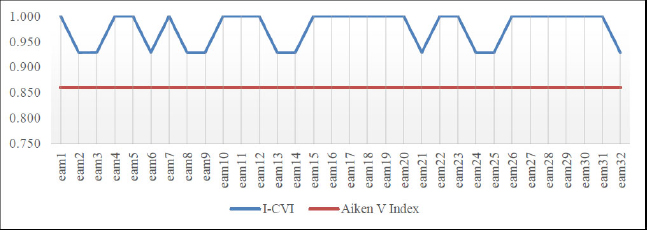
Item-level content validity index.
Second, exploratory and confirmatory factor analyses were conducted to ensure construct validity and eliminate poorly performing items. Third, both positively and negatively worded items were included to reduce response bias.
The construct validity and reliability of the Entrepreneurial Achievement Motivation (EAM) instrument were examined using Analysis of Moment Structures (AMOS) version 23 and the Statistical Package for the Social Sciences (SPSS) version 23. This study employed a cross-sectional survey design, with data collected through an online questionnaire distributed via electronic forms. Participants were eligible to participate if they had an interest in entrepreneurship, had entrepreneurial experience, or were currently running a business. Individuals who did not meet any of these criteria–that is, those who had no interest in entrepreneurship, no entrepreneurial experience, and were not currently running or involved in a business-were excluded. In addition, questionnaires containing incomplete or invalid responses were excluded from the analysis.
A total of 308 participants from Indonesia took part in Study 1. The sample comprised undergraduate students (n = 206, 66.9%), master’s students (n = 76, 24.7%), doctoral students (n = 4, 1.3%), diploma students (n = 10, 3.2%), and high school students (n = 12, 3.9%). Of the participants, 120 (39%) were men and 188 (61%) were women. Most participants were younger than 25 years (n = 208, 67.5%), followed by those aged 26–40 years (n = 96, 31.3%), 41–55 years (n = 2, 0.6%), and over 55 years (n = 2, 0.6%). Participants reported interests in a range of business sectors, including culinary businesses (n = 74, 24.0%), creative industries (n = 28, 9.1%), clothing and jewellery (n = 36, 11.7%), education (n = 36, 11.7%), agriculture (n = 6, 1.9%), services (n = 40, 13.0%), and other sectors (n = 88, 28.6%).
Figure 2 presents the flow diagram of participant recruitment and inclusion in the study. Participants were recruited through an online survey distributed via electronic forms. After screening for eligibility and completeness of responses, 308 participants were included in Study 1 for exploratory factor analysis, and 375 participants were included in Study 2 for confirmatory factor analysis.
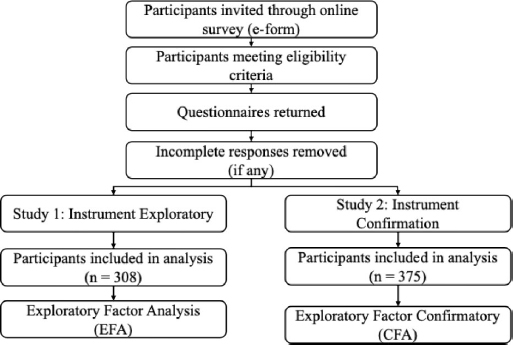
Flow diagram.
The sample size for Study 2 was determined based on the recommended ratio for factor analysis (n/p ≥ 10), where the number of participants should be at least ten times the number of parameters or items analyzed [10, 40]. Therefore, a total of 375 participants were included in the study to ensure adequate statistical power and the robustness of the factor analysis. Prior to conducting the factor analysis, the normality of the data was assessed using the Kolmogorov–Smirnov test. The results indicated that the maximum absolute deviation (.068) was lower than the critical value (.096), and the Asymp. Sig. (2-tailed) was .062 (p > .05), suggesting that the data did not significantly deviate from a normal distribution. These findings indicate that the assumption of normality was satisfied, supporting the appropriateness of the subsequent analyses.
The instrument was distributed via electronic form (e-form) to facilitate the efficient and broad collection of data from participants [41, 42]. Eligible participants included individuals who had an interest in entrepreneurship, entrepreneurial experience, or who currently owned or had previously owned a business. The Study 2 sample comprised 375 participants, including men (n = 124, 33%) and women (n = 251, 67%). The participants included undergraduate students (n = 234, 62.4%), master’s students (n = 83, 22.13%), doctoral students (n = 10, 2.67%), diploma students (n = 17, 4.53%), and high school students (n = 31, 8.27%). During the data collection process, some individuals did not participate due to lack of interest in entrepreneurship or limited time to complete the questionnaire. In addition, incomplete responses were excluded from the dataset. Only fully completed questionnaires from participants that met the eligibility criteria were included in the final analysis.
2.4. Variables
In this study, the primary outcome variable was entrepreneurial achievement motivation (EAM). The construct was operationalized through two domains: entrepreneurial achievement thought (EAT) and entrepreneurial achievement behavior (EAB).
The EAT domain consisted of four dimensions: needs, action, hope of success, and fear of failure [43]. Meanwhile, the EAB domain included five dimensions: success feelings, failure feelings, world obstacles, personal obstacles, and help. All items were measured using a five-point Likert scale ranging from 1 (strongly disagree) to 5 (strongly agree). Item responses were treated as continuous variables and aggregated into composite scores representing the EAT and EAB subscales before statistical analysis.
The predictor variables included locus of control (LoC) and self-efficacy (SE) [44-46]. Locus of control refers to individuals’ beliefs regarding their ability to control outcomes in entrepreneurial activities, while self-efficacy refers to individuals’ confidence in their ability to perform tasks and achieve desired goals. These variables were measured using established scales adapted from previous studies [47]. In addition, several potential confounding variables were considered in this study, including participants’ demographic characteristics such as age, gender, educational level, and prior entrepreneurial experience [48, 49]. These variables may influence individuals’ entrepreneurial motivation and therefore were described as background characteristics of the participants.
Potential effect modifiers such as educational level and prior entrepreneurial experience were also examined descriptively, as these factors may influence the relationship between psychological variables and entrepreneurship achievement motivation. Since this study focused on the development and validation of a psychometric instrument, no diagnostic criteria were applied [32]. The items were designed using positive (+) and negative (-) or R (reverse) statements. Each item has a different value.
2.5. Correlation Analysis between Entrepreneurial Achievement Motivation, Locus of Control, and Self-efficacy
Locus of Control (LoC) refers to individuals’ beliefs about the extent to which they can influence or control particular outcomes [50, 51]. Individuals with a strong sense of locus of control believe that they can influence outcomes and take responsibility for the results of their actions, including those related to entrepreneurship [52]. LoC is considered an important motivational factor in achieving desired goals [53] and has been identified as a predictor of achievement motivation [24]. LoC is commonly divided into two dimensions: internal and external locus of control. The measurement of locus of control based on the Internal-External (I-E) LoC framework includes several areas of life, such as love, dominance, and social and political events [10, 54]. Based on this theoretical framework, the instrument included items representing these areas, such as love (i.e., “I do not like staying in a place that has many flaws”), dominance (i.e., “I like to dominate a job”), and social-political events (i.e., “I am concerned about social conditions in my local area” and “I contribute to the development of my region”).
The reliability of the LoC scale was assessed using Cronbach’s alpha, which yielded a coefficient of .79. In addition, all retained items had factor loadings greater than .40. Self-efficacy (SE) theory suggests that self-efficacy influences individuals’ motivation [55, 56]. SE refers to individuals’ beliefs in their ability to organize and execute the actions required to achieve particular goals [57, 58]. Individuals with high levels of self-efficacy are generally more motivated to pursue and achieve their goals [59]. SE may also influence individuals’ expectations regarding their ability to perform tasks in unfamiliar or new situations [60]. The self-efficacy measure was developed across four subscales: motivation, risk-taking, confidence, and creativity [60]. Based on the underlying theoretical framework, items were developed to represent each subscale. Examples include motivation (i.e., “I can do a good job”), risk-taking (i.e., “I like work that involves substantial risk”), confidence (i.e., “I am confident in my ability to do a good job”), and creativity (i.e., “I like to do things differently from other people”). The SE scale demonstrated a Cronbach’s alpha coefficient of .82, and all retained items had factor loadings greater than .40. All items were rated by participants using a five-point Likert scale (1 = strongly disagree, 2 = disagree, 3 = neutral, 4 = agree, and 5 = strongly agree) [32].
3. RESULT AND DISCUSSION
3.1. Result
Prior to conducting the exploratory factor analysis (EFA), the normality of the data was assessed using the Kolmogorov-Smirnov test. The results showed an Asymp. Sig. (2-tailed) value of .897 (p > .05), indicating that the data did not significantly deviate from a normal distribution. The data had a mean of 139.09 and a standard deviation of 12.91 (n = 308). The suitability of the data for factor analysis was assessed using the Kaiser-Meyer-Olkin measure. The KMO value was .731, indicating acceptable sampling adequacy. The statistical significance value (p <.05) should be reported separately for Bartlett’s test of sphericity, if that is the test to which this value refers. Exploratory factor analysis was conducted to identify the underlying factor structure of the Entrepreneurial Achievement Motivation Measure (EAMM) and determine which items were suitable for retention. Factors with eigenvalues greater than 1 were retained, whereas items with factor loadings of .40 or below were considered for removal or revision. As presented in Table 1, the constructs demonstrated acceptable levels of reliability and convergent validity. Cronbach’s alpha values ranged from.683 to .835, while composite reliability (CR) values ranged from .716 to .869. Although the Cronbach’s alpha value for EAB (.683) was slightly below the conventional threshold of .70, it was close to the acceptable level. Furthermore, average variance extracted (AVE) values ranged from .518 to .646, exceeding the recommended cutoff of .50, and indicating adequate convergent validity. Overall, these findings suggest that the measurement model exhibits satisfactory reliability and convergent validity.
| - | Cronbach Alpha | CR | AVE |
|---|---|---|---|
| EAM | .835 | .869 | .646 |
| EAT | .786 | .828 | .589 |
| EAB | .683 | .716 | .518 |
The reliability and convergent validity of the measurement model were assessed using Cronbach’s alpha, Composite Reliability (CR), and Average Variance Extracted (AVE). As shown in Table 1, all constructs demonstrated acceptable reliability and convergent validity. The CR values ranged from .716 to .869, exceeding the recommended threshold of .70, while the AVE values ranged from .518 to .646, all above the recommended cutoff of .50. Cronbach’s alpha values ranged from .683 to .835, indicating satisfactory internal consistency. Overall, these findings support the reliability and convergent validity of the proposed measurement model.
Based on the EFA results, the original 32 items were evaluated for their suitability for retention. Four items (eam14, eam20, eam23, and eam27) were eliminated due to their poor parameter scores, leaving 28 items for further analysis in Study 2 (Table 2). The retained items were subsequently evaluated for internal consistency using Cronbach’s alpha to assess the reliability of the measurement instrument. This evaluation provided evidence to support the retention of items demonstrating acceptable psychometric properties for the subsequent phase of the study. Overall, the reliability estimates supported the use of the 28 retained items in Study 2.
| Code | EAMM Items | LF |
|---|---|---|
| eam1 | I have benefited a lot from entrepreneurship. | .612 |
| eam2 | I really want to be successful in entrepreneurship. | .738 |
| eam3 | Entrepreneurship is a futile thing. (R) | .694 |
| eam4 | I made a list of activities to avoid failure when doing entrepreneurship. | .688 |
| eam5 | I have a strong desire to become a successful entrepreneur. | .697 |
| eam6 | I planned carefully because the company’s future was full of uncertainty. | .761 |
| eam7 | I have no definite future plans for my company. (R) | . 453 |
| eam8 | When I got into trouble in entrepreneurship, I tried everything I could to solve it. | .696 |
| eam9 | I like to plan and follow up on company activities efficiently. | .576 |
| eam10 | I can maintain consistency for the long-term goals of my company. | .541 |
| eam11 | I know my performance while working. | .608 |
| eam12 | I don’t have a target in building a company. (R) | .673 |
| eam13 | Success is the luck that I have earned through my work so far. | .453 |
| eam14 | I don’t think about failure when running the Company. (R) | .365 |
| eam15 | When I started entrepreneurship, I was afraid of failure. | .800 |
| eam16 | I am worried that if I start a business, there will be failure. | . 541 |
| eam17 | I feel proud when my company is successful. | .723 |
| eam18 | I am proud of the company that I have built myself. | .672 |
| eam19 | I would love to have a company that I’m doing well. | .671 |
| eam20 | I prefer to know what I have done for my company. | .332 |
| eam21 | When the company I built failed, I felt sad. | .547 |
| eam22 | I don’t feel disappointed when there is a failure. (R) | .574 |
| eam23 | I am happy if there is a failure in building a business. (R) | .176 |
| eam24 | I try to follow the existing rules to become a successful entrepreneur. | .658 |
| eam25 | I like getting high-risk assignments. | .665 |
| eam26 | I don’t care about people trying to bring down the company I have built. | .623 |
| eam27 | I will be sad when my company fails. (R) | . 376 |
| eam28 | I don’t like working when I have personal problems. (R) | .607 |
| eam29 | I would rather build a good company than blame myself for past failures. | .633 |
| eam30 | I prefer to work with experts rather than with friends or someone I just know. | .676 |
| eam31 | I don’t care about other people’s help. (R) | .583 |
| eam32 | I love asking successful entrepreneurs for help and advice. | .608 |
Table 3 presents the descriptive statistics for Study 1 and Study 2, together with the intercorrelation matrix between the Entrepreneurial Achievement Thought (EAT) and Entrepreneurial Achievement Behavior (EAB) subscales. The reliability and convergent validity of the underlying constructs were assessed to evaluate the quality of the measurement model. Internal consistency was examined using Cronbach’s alpha and composite reliability (CR) values for each dimension. Convergent validity was assessed using the average variance extracted (AVE) for each construct. Together, these indices provide evidence supporting the reliability and convergent validity of the measurement model.
| - | Study 2 | EFA (n = 308) | CFA (n = 375) | ||
|---|---|---|---|---|---|
| - | - | 1st Calculate Est. | 2nd Calculate Est. | 1st Calculate Est. | 2nd Calculate Est. |
| 1 | EAT | - | *, 54 | - | *, 57 |
| 2 | EAB | - | - | - | - |
| - | Grand Mean | 4,021 | 4.14 | 4.14 | 4.16 |
| - | Std. Dev | 1,207 | 1.16 | 1.13 | 1.17 |
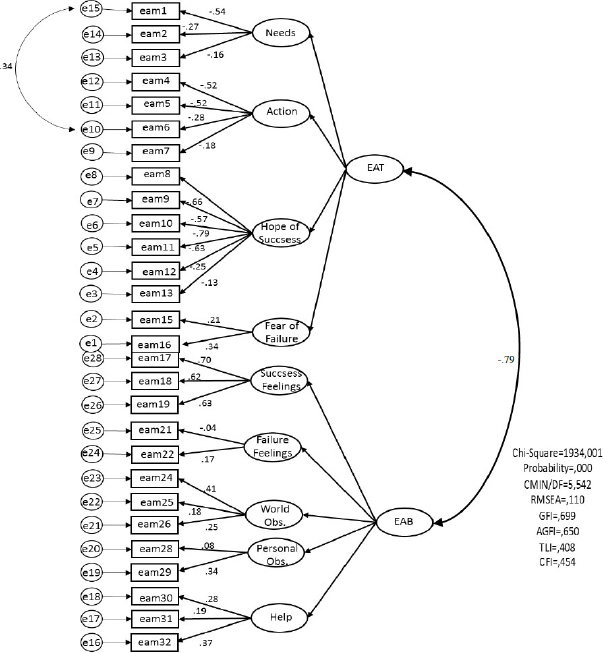
Building on the initial validation results, a more detailed examination of the relationships among the items and the overall model fit indicated the need for further structural refinement. Appendix 1 presents the relationships between all items and their respective subscales, while Table 3 presents the descriptive statistics for the Entrepreneurial Achievement Motivation Measure (EAMM), including the mean and standard deviation. The CFA results indicated that the initial measurement model did not demonstrate an acceptable fit to the data. The chi-square value was 1934.001, p = .000, CMIN/ DF = 5.542, RMSEA = .110, GFI = .699, AGFI = .650, TLI = .408, and CFI = .454. These indices were outside the recommended criteria for acceptable model fit, indicating that the proposed factor structure required further refinement. In addition, as shown in Appendix 1, several items had factor loadings below the recommended threshold of .40. Based on the model fit indices and the item-level factor loadings, the structure of the measurement model was subsequently modified to improve its fit to the data.
3.1.1. First Modification
To identify a more suitable model, the measurement model was refined by removing items with high modification indices and weak standardized parameter estimates. Four items (eam4, eam7, eam9, and eam11) were eliminated. The revised model showed improved fit compared with the initial model: χ2 = 1134.021, p = .008, CMIN/df = 1.325, RMSEA = .029, GFI = .952, AGFI = .836, TLI = .846, and CFI = .549. Although some indices improved, the overall model fit remained inadequate, indicating the need for further refinement (see Appendix 1).
3.1.2. Second Modification
Further modifications were made to obtain a satisfactory model. Based on the modification indices (MIs), items eam13, eam17, eam24, and eam30 were identified as contributing to model misfit and were subsequently removed. The revised model demonstrated excellent goodness-of-fit: χ2 = 44.658, p = .104, CMIN/df = 1.313, RMSEA = .029, GFI = .977, AGFI = .962, TLI = .976, and CFI = .982. All retained items had factor loadings greater than .40, supporting the suitability of the EAMM for use in the subsequent study. As the model demonstrated satisfactory fit and no further substantial modifications were required, the final measurement model was retained (Figs. 3 and 4).
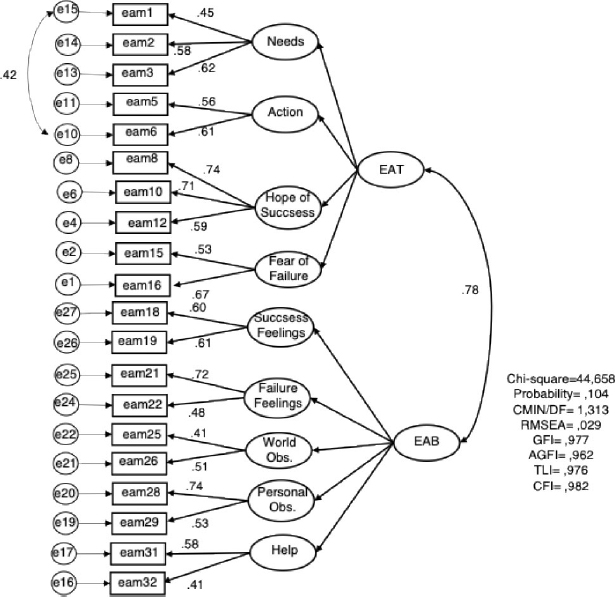
The final confirmatory factor analysis model of entrepreneurship achievement motivation measure.
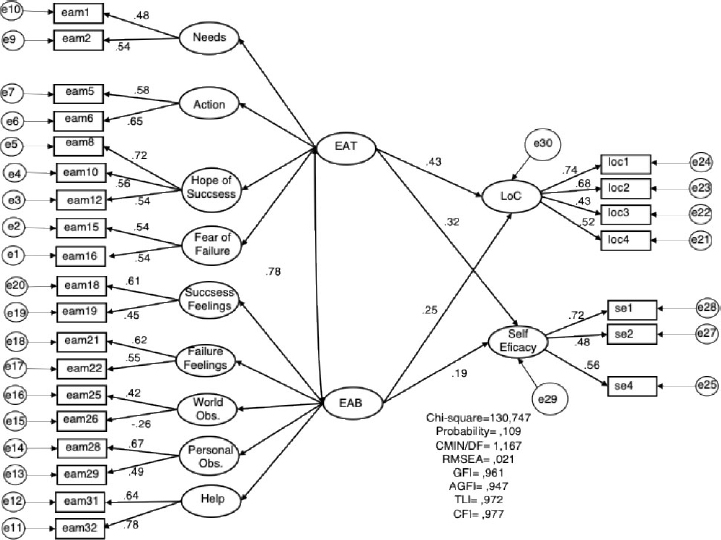
Fit model.
3.1.3. Evidence of Validity based on the Correlation to the LoC and SE Variables
The relationships between the Entrepreneurship Achievement Motivation Measure (EAMM) and related psychological constructs were examined by correlating its two subscales, Entrepreneurial Achievement Thought (EAT) and Entrepreneurial Achievement Behavior (EAB), with locus of control (LoC) and self-efficacy (SE). LoC and SE were selected because they are theoretically related to entrepreneurial achievement motivation and therefore provide relevant constructs for examining validity evidence based on relationships with other variables. Table 4 presents the descriptive statistics and correlation matrix for the EAMM, LoC, and SE scales.
| Scale | Total | Men | Women | 1 | 2 | 3 | 4 | |||||||
|---|---|---|---|---|---|---|---|---|---|---|---|---|---|---|
| N | GM | SD | N | GM | SD | N | GM | SD | - | - | - | - | ||
| 1 | EAT | 375 | 4.14 | 1.13 | 124 | 4.14 | 1.11 | 251 | 4.14 | 1.14 | - | .57* | .43** | .32** |
| 2 | EAB | 375 | 4.04 | 1.12 | 124 | 4.01 | 1.13 | 251 | 4.06 | 1.12 | - | - | .25** | .19** |
| 3 | LoC | 375 | 4.67 | .55 | 124 | 4.68 | .56 | 251 | 4.67 | .55 | - | - | - | - |
| 4 | S-E | 375 | 3.69 | 1.11 | 124 | 3.71 | 1.11 | 251 | 3.68 | 1.11 | - | - | - | - |
Additional analyses were conducted to examine the relationships between Entrepreneurship Achievement Motivation, locus of control, and self-efficacy using correlation analysis [61]. These analyses provided further evidence supporting the construct validity of the developed measurement model.
These analyses provided further evidence supporting the construct validity of the developed measurement model. In addition, discriminant validity was assessed to determine whether the two dimensions of the instrument, Entrepreneurial Achievement Thinking (EAT) and Entrepreneurial Achievement Behavior (EAB), represent empirically distinct constructs. Two complementary approaches were employed: the Heterotrait–Monotrait Ratio (HTMT) and the Fornell–Larcker criterion.
The HTMT analysis indicated that the ratio between EAT and EAB was below the recommended threshold of .85, suggesting adequate discriminant validity and confirming that the two constructs are sufficiently distinct. Consistent with this finding, the Fornell–Larcker criterion demonstrated that the square root of the Average Variance Extracted (AVE) for each construct exceeded its correlation with the other construct. Together, these results provide robust evidence that EAT and EAB capture related yet conceptually and empirically distinct dimensions of entrepreneurial achievement motivation, thereby further supporting the validity of the proposed measurement model.
Discriminant validity was assessed using HTMT and the Fornell–Larcker criterion. As shown in Table 5, all HTMT values ranged from .154 to .866, remaining below the recommended threshold of .90, thereby indicating satisfactory discriminant validity among the constructs. Furthermore, the Fornell–Larcker criterion (Table 6) was also satisfied, as the square root of the AVE for each construct (diagonal values) exceeded its correlations with the other constructs. These findings confirm that each construct is empirically distinct and adequately captures its intended concept.
| - | EAB | EAT | LoC | SE |
|---|---|---|---|---|
| EAB | - | - | - | - |
| EAT | .866 | - | - | - |
| LoC | .154 | .207 | - | - |
| SE | .349 | .208 | .456 | - |
| - | EAB | EAT | LoC | SE |
|---|---|---|---|---|
| EAB | .781 | - | - | - |
| EAT | .585 | .812 | - | - |
| LoC | -.052 | -.154 | .826 | - |
| SE | -.021 | -.191 | .136 | .734 |
The final calculated estimation results show positive results. The value shows a positive and significant relationship (p <.05) between EAM on LoC and SE. A positive and significant relationship was found between EAM and LoC. The findings from [62] also showed a positive and significant relationship between achievement motivation and locus of control. Achievement motivation has a positive and significant contribution to locus of control [63-65]. However, previous findings found that there is a negative relationship between achievement motivation and locus of control [10, 24].
There is a positive and significant influence and relationship between EAM and SE. Previous findings found that there is a significant and positive influence between achievement motivation and self- efficacy [66]. Table 3 describes the relationship of each variable. There is a correlation between EAT and LoC (.043), EAT and SE (.32), EAB and LoC (.25), and EAB and SE (.19). These results were obtained from the final modification of the model structure. The final GoF modification obtained a score of chi-square= 130.747, p = .109, CMIN / DF = 1.167, RMSEA = .021, GFI = .961, AGFI = .947, TLI = .972, and CFI = .97.
3.2. Discussion
Existing achievement motivation measures, including those based on the dimensions of achievement thought and achievement behavior, have provided valid approaches for assessing achievement motivation [10]. However, these measures have not been specifically developed to assess achievement motivation within the context of entrepreneurship. Therefore, this study aimed to develop the Entrepreneurial Achievement Motivation Measure (EAMM) as a context-specific instrument for assessing achievement motivation in entrepreneurial settings.
Achievement motivation theory has been developed and examined by numerous scholars [10, 22], with influential measurement approaches originating from the work of Atkinson and McClelland [23]. Building on this theoretical foundation, the EAMM was developed to address the specific context of entrepreneurship. The instrument comprises two subscales: Entrepreneurial Achievement Thought (EAT) and Entrepreneurial Achievement Behavior (EAB). These two subscales were developed based on the theoretical dimensions of achievement thought and achievement behavior [10].
The test results were modified twice until the results obtained are fit. In Study 1, the researchers used exploratory factor analysis to obtain good items. There were thirty-two (32) original items that were tested to obtain the validity of the items. The thirty-two items consisted of 16 original items of EAT and 16 original items of EAB. EAT includes the dimensions of needs, actions, hope of success, and fear of failure. Then, EAT includes the dimensions of success feeling, failure feeling, world obstacles, personal obstacles, and help [67].
Entrepreneurial Achievement Thought (EAT) focuses on the cognitive processes and motivational orientations associated with achieving entrepreneurial success. It comprises four dimensions: needs, action, hope of success, and fear of failure. Needs refer to an individual's desire to achieve success and progress through their entrepreneurial abilities. Action refers to the knowledge and initiative required to undertake activities that contribute to entrepreneurial success. Hope of success reflects an individual's strong expectations and aspirations to become a successful and progressive entrepreneur. Fear of failure refers to an individual's anticipation of potential failure and concerns about their ability to manage entrepreneurial risks. Entrepreneurial Achievement Behavior (EAB) focuses on the behavioral responses and actions associated with building and managing a business. It comprises five dimensions: success feelings, failure feelings, world obstacles, personal obstacles, and help. Success feelings refer to the positive feelings individuals experience following successful entrepreneurial activities, whereas failure feelings refer to individuals' perceptions and emotional responses to difficulties or unsuccessful outcomes. World obstacles involve individuals' awareness and analysis of external challenges, such as those arising from the broader market environment. Personal obstacles refer to challenges associated with personal circumstances that may affect the pursuit of entrepreneurial goals. Finally, help refers to seeking or receiving advice and support from individuals with relevant experience [68].
Although the two subscales demonstrated a relatively high correlation, this result is consistent with the theoretical premise that achievement thought and achievement behavior constitute closely related facets of entrepreneurial achievement motivation. The cognitive orientation toward achievement is expected to translate into corresponding behavioral tendencies, resulting in substantial covariance between the two dimensions. Nevertheless, the discriminant validity results confirmed that the magnitude of this association remained within acceptable limits, indicating that the subscales possess sufficient empirical distinctiveness while jointly representing a coherent multidimensional construct. This pattern of findings provides further support for the construct validity of the proposed measurement model.
The EFA results indicated that four items (eam14, eam20, eam23, and eam27) had factor loadings below .40 and were therefore removed from the instrument for subsequent analysis. Of these items, one belonged to the EAT subscale and three belonged to the EAB subscale. The remaining items were subsequently examined using confirmatory factor analysis (CFA). The initial CFA model did not demonstrate an acceptable overall goodness-of-fit. The first model modification involved removing four additional items (eam4, eam7, eam9, and eam11). Although the revised model showed improvement, several fit indices remained below the recommended criteria (χ2 = 1134.021, p = .008, CMIN/df = 1.325, RMSEA = .029, GFI = .952, AGFI = .836, TLI = .846, and CFI = .549). A second modification identified further model misfit associated with eam13, eam17, eam24, and eam30, and these items were subsequently removed. After re-estimating the model, the final structure demonstrated an acceptable fit to the data (χ2 = 44.658, p = .104, CMIN/df = 1.313, RMSEA = .029, GFI = .977, AGFI = .962, and TLI = .976).
The researchers tried to prove the validity and reliability of EAMM by correlating it with other variables. The variables chosen were locus of control and self-efficacy because both variables have the same theoretical approach as Achievement Motivation. Statistically, there was a significant influence and a positive relationship between EAMM sub-scale scores and locus of control and self-efficacy have valid criteria. The results of the analysis explained that the positive and significant relationship between entrepreneurship achievement thought and locus of control sub-scale was .43 (p <.05) greater than the correlation between entrepreneurship achievement thought and self-efficacy (.32, p <.05). Then, the positive and significant relationship between entrepreneurship achievement behavior and locus of control also has a direct effect of .25 (p <.05) greater than the correlation of entrepreneurship achievement behavior and self-efficacy (.19, p <.05). These findings indicate that EAMM has a positive relationship with locus of control and self-efficacy. Higher levels of locus of control and self-efficacy were associated with higher levels of entrepreneurial achievement motivation.
The EAMM comprises two subscales: Entrepreneurial Achievement Thought (EAT) and Entrepreneurial Achievement Behavior (EAB), each consisting of nine items. Following the estimation of the measurement model, three items were eliminated because they exhibited high error estimates: eam3 (“Entrepreneurship is a futile thing”) from the EAT subscale, eam26 (“I do not care about people trying to bring down the company I have built”) from the EAB subscale, and se3 (“I believe I can do a good job”) from the self-efficacy scale. The final modification obtained the value of goodness-of-fit, namely chi-square= 130.747, p = .109, CMIN/DF= 1.167, RMSEA= .021, GFI= .961, AGFI= .947, TLI= .972, and CFI=.977. The model is categorized as fit.
This study is useful for measuring entrepreneurial achievement motivation in personal and educational contexts [69], as well as for screening individual interest in business. If the motivation to become an entrepreneur can be indicated, then educators in schools and universities will be able to focus on the curriculum for students who have high entrepreneurial motivation. Then, by developing the achievement motivation theory, it will enrich the current theory. The Entrepreneurial Achievement Motivation Measure can be used by educational institutions and government sectors to identify individuals with entrepreneurial achievement motivation [70, 71]. Entrepreneurial achievement motivation reflects an individual’s intrinsic drive to attain excellence, persist in the face of challenges, and achieve superior performance through entrepreneurial activities. Therefore, each retained item was expected to capture a unique aspect of this motivational process. Items that primarily reflected entrepreneurial intentions, self-confidence, or general entrepreneurial attitudes, rather than the motivation to achieve entrepreneurial excellence, were excluded because they were conceptually inconsistent with the underlying construct [72, 73]. Likewise, items with redundant meanings were removed to improve conceptual clarity and preserve discriminant representation among the dimensions. Consequently, the final 20-item model demonstrated not only superior statistical fit but also stronger theoretical consistency with the conceptual framework of entrepreneurial achievement motivation.
This study has several limitations. First, the sample was dominated by undergraduate students, which may limit the generalizability of the findings to broader entrepreneurial populations. Future studies should therefore include participants with more diverse educational backgrounds and greater representation of individuals with direct entrepreneurial or business experience. Second, the correlations between the EAMM and the related constructs were relatively modest, and further research is needed to examine these relationships in different samples and contexts. Third, the use of self-report questionnaires may have introduced response bias, as the data were based on participants' subjective perceptions and responses. Fourth, one of the EAMM subscales demonstrated relatively low reliability, indicating the need for further refinement and evaluation of its items. Finally, the EAMM was developed and validated using samples from Indonesia. Given that entrepreneurial motivation may be influenced by cultural values, educational systems, and economic environments, further cross-cultural validation is necessary before the instrument can be generalised for use across different countries and cultural contexts.
CONCLUSION
In a nutshell, this study developed and validated the Entrepreneurial Achievement Motivation Measure (EAMM) as an instrument for assessing individuals’ achievement motivation in entrepreneurial contexts. The EAMM comprises two related subscales: Entrepreneurial Achievement Thought and Entrepreneurial Achievement Behavior. Together, these subscales assess cognitive and behavioral aspects of achievement motivation associated with entrepreneurship. The findings provide evidence supporting the reliability and validity of the EAMM and suggest meaningful relationships between entrepreneurial achievement motivation, locus of control, and self-efficacy. The instrument may therefore be useful for assessing entrepreneurial achievement motivation among individuals who are preparing for or engaging in entrepreneurial activities. The EAMM may also be useful for evaluating changes in entrepreneurial achievement motivation before and after entrepreneurship training or educational programmes. In future research, entrepreneurial achievement motivation may be examined as an independent, mediating, or other theoretically relevant variable in quantitative studies. The measure may also support efforts to understand and foster entrepreneurial development, particularly among students in higher education.
AUTHOR’S CONTRIBUTIONS
The author confirms sole responsibility for the following: study conception and design, data collection, analysis and interpretation of results, and manuscript preparation.
LIST OF ABBREVIATIONS
| EAMM | = Entrepreneurial Achievement Motivation Measure |
| EAT | = Entrepreneurial Achievement Thought |
| EAB | = Entrepreneurial Achievement Behavior |
| EFA | = Exploratory Factor Analysis |
| CFA | = Confirmatory Factor Analysis |
| EAT | = Entrepreneurial Achievement Thought |
| EAB | = Entrepreneurial Achievement Behavior |
ETHICS APPROVAL AND CONSENT TO PARTICIPATE
This study was approved by the Ethics Committee of the Department of Economics Education, Faculty of Teacher Training and Education, Universitas Lambung Mangkurat, Indonesia (Approval No.: 031/UN8.1.2.1.3/PS/2025).
HUMAN AND ANIMAL RIGHTS
All procedures involving human participants were conducted in accordance with the ethical standards of the committee responsible for human experimentation (institutional and national), and with the Helsinki Declaration of 1975, as revised in 2013.
CONSENT FOR PUBLICATION
Written informed consent was obtained from all participants before completing the questionnaire.
AVAILABILITY OF DATA AND MATERIALS
All the data and supporting information are provided within the article.
ACKNOWLEDGEMENTS
The authors would like to express their sincere gratitude to the participants who voluntarily took part in this study. The authors also thank the experts in entrepreneurship and psychometrics who provided valuable feedback during the development and validation process of the Entrepreneurship Achievement Motivation Measure. Their constructive comments and suggestions contributed significantly to improving the quality of the instrument used in this research.