All published articles of this journal are available on ScienceDirect.

Real-World Fermented Food Consumption and Depression, Anxiety, and Stress Symptoms in a Southeast Asian University Population: A Cross-Sectional Study
 Nicholas Tze Ping Pang2
Assis Kamu3
Chong Mun Ho3
Walton Wider4
Nicholas Tze Ping Pang2
Assis Kamu3
Chong Mun Ho3
Walton Wider4
Authors Info & Affiliations
Abstract
Introduction
Controlled psychobiotic trials suggest fermented foods may influence mental health via the microbiota-gut-brain axis. However, whether habitual consumption of diverse fermented foods in real-world Southeast Asian settings is associated with psychological symptoms remains unclear. This study examined the association between fermented food intake and depression, anxiety, and stress among Malaysian university students.
Methods
A cross-sectional online survey was conducted among 212 undergraduates at a public university in Malaysia. Fermented food intake, including traditional and commercial products, was assessed using a culturally adapted food frequency questionnaire and converted to servings/week. Psychological symptoms were measured using the validated Malay DASS-21. Multivariable logistic regression estimated adjusted Odds Ratios (aOR) for moderate-to-extremely severe symptoms per additional serving/week and across intake quartiles, adjusting for sociodemographic and health-related factors.
Results
Median fermented food intake was 2.0 servings/week. In fully adjusted models, intake was not significantly associated with moderate-to- extremely severe depression (aOR 1.04, 95% CI 0.92-1.16), anxiety (aOR 1.04, 95% CI 0.95-1.13), or stress (aOR 0.87, 95% CI 0.65-1.05). Quartile and spline analyses showed no consistent dose-response relationship.
Discussion
These findings suggest that typical real-world consumption of heterogeneous fermented foods may not replicate the psychobiotic effects observed in controlled intervention studies. Variability in microbial composition, modest intake levels, and non-clinical population context may limit detectable associations.
Conclusion
Habitual fermented food intake was not independently associated with psychological symptom severity in this Southeast Asian university sample, highlighting the need for culturally specific and mechanistically informed research in nutritional psychiatry.
1. INTRODUCTION
Common mental health problems, including depression, anxiety, and stress, are highly prevalent among university students and are associated with impaired academic performance, reduced quality of life [1, 2], and increased risk of long-term psychiatric morbidity. In Malaysia, multiple studies have documented high levels of psychological distress among tertiary students, underscoring the need for preventive, population-level, and modifiable approaches to mental health promotion [3, 4].
In recent years, nutritional psychiatry has emerged as a rapidly expanding field, supported by accumulating evidence that dietary factors play a significant role in mental health and emotional regulation [5, 6]. Central to this paradigm is the gut-brain axis, a bidirectional communication system linking the gastrointestinal microbiota with the central nervous system through immune, metabolic, neural, and endocrine pathways [7, 8]. Dysbiosis of the gut microbiota has been associated with depressive and anxiety symptoms, altered stress responsivity, and low-grade systemic inflammation [9, 10], suggesting that diet-mediated modulation of the microbiome may influence mental health outcomes.
Evidence supporting a relationship between diet, the gut microbiota, and mental health originates from several distinct lines of research. Mechanistic studies have demonstrated that gut microorganisms and their metabolites can influence immune regulation, neurotransmitter production, stress responsivity, and neural signalling pathways involved in emotional regulation [11-13]. These findings provide biological plausibility for microbiota-gut-brain interactions but do not directly establish clinical effects in human populations. In contrast, probiotic intervention studies have examined whether administration of specific microbial strains can influence psychological outcomes under controlled conditions. Several randomized controlled trials and meta-analyses have reported modest improvements in depressive and anxiety symptoms following supplementation with selected probiotic strains, particularly among clinically vulnerable or highly stressed populations [14, 15]. However, these interventions typically involve standardized microbial formulations, defined dosages, and tightly controlled exposure conditions.
A separate body of evidence comes from observational studies investigating habitual fermented food consumption and mental health outcomes in community populations. Some studies have reported associations between higher fermented food intake and lower levels of social anxiety, depression, or perceived stress [16, 17], although findings remain inconsistent and cannot establish causality. Furthermore, fermented foods differ substantially from probiotic interventions because microbial composition, viability, dosage, and consumption patterns are often heterogeneous and difficult to quantify. These findings suggest that fermented foods may have potential relevance to psychological wellbeing, but mechanistic studies, probiotic intervention trials, and observational dietary studies represent different levels of evidence and should not be interpreted as interchangeable.
Despite Southeast Asia’s long history of fermented food consumption, important evidence gaps remain regarding the relationship between fermented foods and mental health. Most studies investigating fermented food intake and psychological outcomes have been conducted in Western populations and have primarily focused on commercially standardized products such as yogurt, kefir, and kimchi [18, 19]. Comparatively little is known about traditional Southeast Asian fermented foods, including bosou, tuhau, tempoyak, tapai, budu, and belacan, which differ substantially in ingredients, preparation methods, microbial composition, and patterns of consumption.
These traditional fermented foods are more than dietary items within Malaysian communities; they are closely linked to cultural identity, heritage, and everyday food practices. Many have been prepared and consumed across generations, particularly among indigenous and local populations in Sabah, where they remain integrated into routine meals and social traditions. Understanding their relationship with mental health is therefore relevant not only from a nutritional perspective but also for developing evidence that reflects local dietary practices and cultural contexts. Investigating foods that are already embedded within Malaysian diets may help bridge emerging microbiota-gut-brain research with the lived experiences of local populations.
Furthermore, few studies have examined whether habitual consumption of these culturally specific fermented foods is associated with symptoms of depression, anxiety, and stress among young adults. University students represent a particularly important population given the high prevalence of psychological distress and the potential influence of modifiable lifestyle factors on mental wellbeing [20, 21]. To our knowledge, no published Malaysian study has specifically evaluated the association between habitual fermented food intake and depression, anxiety, and stress symptoms using the validated DASS-21 instrument. Addressing this gap may help clarify whether findings from psychobiotic and fermented-food research are applicable to real-world dietary practices in Southeast Asian settings.
Against this background, the present study aimed to examine the association between fermented food intake and the odds of moderate-to-extremely severe depression, anxiety, and stress symptoms among Malaysian university students. We hypothesised that higher fermented food consumption would be associated with lower odds of depression, anxiety, and stress symptoms. In addition, the study explored potential dose-response relationships using intake quartiles and non-linear spline models and examined whether associations differed according to probiotic supplement use and health-motivated fermented food consumption.
2. METHODOLOGY
2.1. Study Design and Participants
This cross-sectional study was conducted at Universiti Malaysia Sabah (UMS), Sabah, Malaysia. Undergraduate students were recruited between 1 June 2025 and 31 December 2025 through institutional communication channels and social media platforms.
The study was conducted using an anonymous online survey platform. Participants were required to review the participant information sheet, declare any possible exclusion criteria, and provide electronic informed consent before accessing the study questionnaire. The survey platform was configured to retain data only from respondents who consented to participate; therefore, information regarding the number of individuals who received the survey invitation, accessed the survey without consenting, or declined participation was not available. Only responses from consenting participants were recorded and screened for eligibility and completeness prior to analysis.
2.2. Inclusion and Exclusion Criteria
Participants were eligible for inclusion if they were aged between 18 and 30 years and were currently enrolled as undergraduate students at Universiti Malaysia Sabah (UMS) during the study period. Participants were required to be able to understand either English or Malay and to provide electronic informed consent prior to completing the online questionnaire. Only respondents who completed all key components of the survey, including the fermented food frequency questionnaire and the DASS-21, were included in the final analysis.
Students were excluded if they self-reported currently undergoing treatment for a diagnosed psychiatric disorder, such as major depressive disorder or generalized anxiety disorder, as ongoing treatment could influence symptom reporting. Individuals who reported following a medically prescribed diet that restricted or eliminated fermented foods (e.g., low-histamine or low-FODMAP diets) were also excluded to reduce potential dietary misclassification.
2.3. Sample Size
The required sample size for this cross-sectional study was determined based on power analysis for logistic regression with a binary outcome. Assuming a two-sided α of 0.05, 80% statistical power, and an anticipated prevalence of moderate-to-extremely severe anxiety symptoms of approximately 35%, a minimum sample of 210 participants was required to detect an odds ratio of 1.8 or greater for the association between fermented food intake and psychological symptoms.
The final analytic sample comprised 212 participants, meeting the calculated minimum requirement for the primary logistic regression analyses. This sample size was considered adequate for evaluating the primary association between fermented food intake and psychological symptoms while adjusting for key covariates. However, the study was not specifically powered to detect small effects in subgroup, interaction, quartile-based, or non-linear dose-response analyses. These secondary analyses were therefore considered exploratory and are interpreted with appropriate caution [22, 23].
2.4. Measurements
2.4.1. Fermented Food Intake
Habitual fermented food intake was assessed using a culturally adapted Food Frequency Questionnaire for Fermented Malaysian Foods (FFQ-FMF), designed to capture consumption over the previous month. Food frequency questionnaires are commonly used tools for assessing habitual dietary intake in epidemiological research [24, 25]. The questionnaire included commonly consumed traditional (e.g., bosou, tuhau, tempoyak, tapai, belacan, budu, taucu) and commercial fermented foods (e.g., yogurt, kefir, kimchi, tempeh).
The FFQ-FMF was developed specifically for this study to capture the intake of both traditional Malaysian fermented foods and commercially available fermented products. To establish content validity, the preliminary questionnaire underwent expert review by three registered dietitians with experience in nutritional assessment and Malaysian dietary habits. Face validity was subsequently evaluated by a psychiatrist and a dietitian to assess item clarity, comprehensibility, and appropriateness for the target population. Revisions were made based on expert feedback to improve wording and content coverage.
A pilot administration among university students was then conducted to assess feasibility, comprehension, and completion time prior to formal data collection. However, formal psychometric validation, including test-retest reliability assessment and validation against another dietary assessment method, was not performed.
Participants reported intake frequency using structured response categories ranging from “never” to “daily.” Frequency categories were converted into estimated servings/week using predefined midpoint values commonly applied in FFQ-based nutritional epidemiology. The midpoint conversion values were selected to provide standardized estimates of habitual intake and were reviewed by dietitians familiar with Malaysian dietary practices to ensure that serving definitions reflected typical local consumption patterns. One serving was defined using standard household portions appropriate for each food category (e.g., one tablespoon for condiments such as budu or belacan, one small bowl or portion for foods such as tapai or bosou, and one standard container for yogurt products). For analysis, responses were converted to estimated servings/week using predefined midpoint values, and total fermented food intake was calculated by summing weekly servings across items.
2.4.2. Psychological Symptoms
Depression, anxiety, and stress symptoms were assessed using the validated Malay version of the Depression Anxiety Stress Scales (DASS-21). The DASS-21 comprises 21 items, with seven items per subscale, rated on a 4-point Likert scale. Subscale scores were summed and multiplied by two according to standard scoring procedures.
The Malay version (BM DASS-21) has demonstrated good psychometric properties in Malaysian populations, with reported Cronbach’s alpha coefficients of 0.84 for depression, 0.74 for anxiety, and 0.79 for stress. Confirmatory factor analysis has supported the three-factor structure of the instrument [26]. In the present sample, internal consistency of the DASS-21 subscales was good: Cronbach’s alpha = 0.86 for depression, 0.82 for anxiety, and 0.84 for stress.
2.5. Data Analysis Methods
All statistical analyses were conducted using R (version 2023.06.1+524). Data were first screened for completeness, implausible values, and internal consistency. Continuous variables were summarised using means and standard deviations (SD) or medians and interquartile ranges (IQR), depending on distribution. Categorical variables were summarised using frequencies and percentages.
Fermented food intake was calculated as total estimated servings/week by converting frequency categories from the food frequency questionnaire to midpoint values and summing across items. Intake was analysed both as a continuous variable (per additional serving per week) and categorised into quartiles based on the sample distribution. The aggregated intake variable was intended to reflect overall habitual fermented food exposure in a real-world dietary context rather than standardised probiotic or strain-specific intake. Given the exploratory epidemiological nature of the study, fermented foods were analysed collectively despite expected heterogeneity in microbial composition and preparation methods.
Depression, anxiety, and stress symptoms were assessed using the DASS-21. Subscale scores were summed and multiplied by two according to standard scoring procedures. The primary outcomes were binary indicators of moderate-to-extremely severe symptoms (moderate+) for each subscale, defined using established cut-offs. The DASS-21 is a validated symptom-screening instrument and does not constitute a clinical diagnosis of depression, anxiety, or stress disorder.
Bivariate analyses were conducted to explore associations between fermented food intake and participant characteristics using χ2 tests for categorical variables and t-tests or ANOVA for continuous variables, as appropriate. Correlation analyses (Pearson or Spearman, depending on normality) were used to examine relationships between continuous fermented food intake and DASS-21 subscale scores.
Multivariable logistic regression models were fitted to estimate odds ratios (OR) and 95% confidence intervals (CI) for moderate+ depression, anxiety, and stress. Models were constructed sequentially: (1) unadjusted; (2) adjusted for age and gender; and (3) fully adjusted for age, gender, ethnicity, year of study, living arrangement, chronic illness, and probiotic supplement use.
Dose-response relationships were examined using intake quartiles (lowest quartile as reference) and natural spline models (degrees of freedom = 3) to assess potential non-linearity. Exploratory interaction analyses were conducted to assess potential effect modification by probiotic supplement use and health-motivated fermented food consumption. Given the relatively small number of events in several subgroups, these analyses were considered hypothesis-generating and interpreted cautiously.
To account for multiple testing across the three primary outcomes, false discovery rate (Benjamini-Hochberg) correction was applied. All statistical tests were two-tailed, and a p-value <0.05 was considered statistically significant.
3. RESULTS
3.1. Participant Characteristics and Fermented-food Intake
A total of 212 participants were included in the complete-case analysis. The mean age was 21.2 years (SD 3.4), with 48% male and 77.4% female. The median fermented food intake was 2.0 servings/week (IQR 0.75-3.50; range 0.00-28.25).
Across intake quartiles (Table 1), median intake increased from 0.25 servings/week in Q1 to 6.12 servings/week in Q4. The proportion of females decreased across quartiles (84.7% in Q1; 67.3% in Q4). Ethnic distribution varied across intake groups, with Dusun participants comprising 22.0% of Q1 and 51.9% of Q4. The proportion of Malay participants decreased across increasing quartiles.
Table 1.
| Characteristic | Overall | Q1 (lowest) | Q2 | Q3 | Q4 (highest) |
|---|---|---|---|---|---|
| Sample size, n | 212 | 59 | 54 | 47 | 52 |
| Age (years), mean (SD) | 21.2 (3.4) | 22.0 (4.5) | 20.6 (1.6) | 21.1 (4.4) | 21.2 (1.4) |
| Fermented food intake (servings/week), median [IQR] | 2.00 [0.75, 3.50] | 0.25 [0.25, 0.62] | 1.31 [0.88, 1.62] | 2.75 [2.38, 3.12] | 6.12 [4.69, 9.31] |
| Male, n (%) | 48 (22.6%) | 9 (15.3%) | 12 (22.2%) | 10 (21.3%) | 17 (32.7%) |
| Female, n (%) | 164 (77.4%) | 50 (84.7%) | 42 (77.8%) | 37 (78.7%) | 35 (67.3%) |
| Depression symptoms (Moderate+), n (%) | 29 (13.7%) | 9 (15.3%) | 3 (5.6%) | 6 (12.8%) | 11 (21.2%) |
| Anxiety symptoms (Moderate+), n (%) | 75 (35.4%) | 24 (40.7%) | 14 (25.9%) | 17 (36.2%) | 20 (38.5%) |
| Stress symptoms (Moderate+), n (%) | 22 (10.4%) | 9 (15.3%) | 4 (7.4%) | 3 (6.4%) | 6 (11.5%) |
More detailed subgroups: ethnicity, year of study, and living arrangements breakdowns are available in Appendix A.
Year of study distribution differed between quartiles, with Year 3 students representing 78.8% of the highest intake group. Probiotic supplement use increased from 10.2% in Q1 to 28.8% in Q4. Chronic illness was reported by 2.4% of the overall sample.
The number of participants meeting criteria for moderate-to-extremely severe symptoms was 29 for depression (13.7%), 75 for anxiety (35.4%), and 22 for stress (10.4%). These event counts were used in the logistic regression analyses examining associations between fermented food intake and psychological symptoms. Symptom prevalence across quartiles did not demonstrate a consistent linear pattern.
The full distribution of DASS-21 symptom severity is presented below (see Table 2):
| Category | Depression | Anxiety | Stress |
|---|---|---|---|
| Normal | 167 (78.8%) | 117 (55.2%) | 165 (77.8%) |
| Mild | 16 (7.5%) | 20 (9.4%) | 25 (11.8%) |
| Moderate | 23 (10.8%) | 42 (19.8%) | 13 (6.1%) |
| Severe | 5 (2.4%) | 14 (6.6%) | 7 (3.3%) |
| Extremely Severe | 1 (0.5%) | 19 (9.0%) | 2 (0.9%) |
3.2. Association between Fermented-food Intake and Moderate-to-extremely Severe Symptoms
Table 3 presents logistic regression models examining the association between fermented food intake (per additional serving/week) and moderate-to-extremely severe symptoms of depression, anxiety, and stress.
| Outcome (Moderate+) | Model | OR (95% CI) per +1 Serving/week | p-value |
|---|---|---|---|
| Depression | Unadjusted | 1.04 (0.95, 1.12) | 0.319 |
| Depression | Age + Gender adjusted | 1.03 (0.95, 1.11) | 0.419 |
| Depression | Fully adjusted* | 1.04 (0.92, 1.16) | 0.532 |
| Anxiety | Unadjusted | 1.01 (0.95, 1.08) | 0.687 |
| Anxiety | Age + Gender adjusted | 1.01 (0.95, 1.08) | 0.702 |
| Anxiety | Fully adjusted* | 1.04 (0.95, 1.13) | 0.359 |
| Stress | Unadjusted | 0.92 (0.76, 1.05) | 0.324 |
| Stress | Age + Gender adjusted | 0.92 (0.75, 1.04) | 0.281 |
| Stress | Fully adjusted* | 0.87 (0.65, 1.05) | 0.254 |
For depression, the unadjusted model showed an odds ratio (OR) of 1.04 (95% CI 0.95-1.12; p=0.319). After adjustment for age and gender, the OR was 1.03 (95% CI 0.95-1.11; p=0.419). In the fully adjusted model, the OR was 1.04 (95% CI 0.92-1.16; p=0.532).
For anxiety, the unadjusted OR was 1.01 (95% CI 0.95-1.08; p=0.687). The age- and gender-adjusted model yielded an OR of 1.01 (95% CI 0.95-1.08; p=0.702), and the fully adjusted model showed an OR of 1.04 (95% CI 0.95-1.13; p=0.359).
For stress, the unadjusted OR was 0.92 (95% CI 0.76-1.05; p=0.324). After adjustment for age and gender, the OR was 0.92 (95% CI 0.75-1.04; p=0.281). In the fully adjusted model, the OR was 0.87 (95% CI 0.65-1.05; p=0.254).
False discovery rate correction applied across the three fully adjusted primary models did not materially change statistical significance.
3.3. Dose-response and Non-linearity
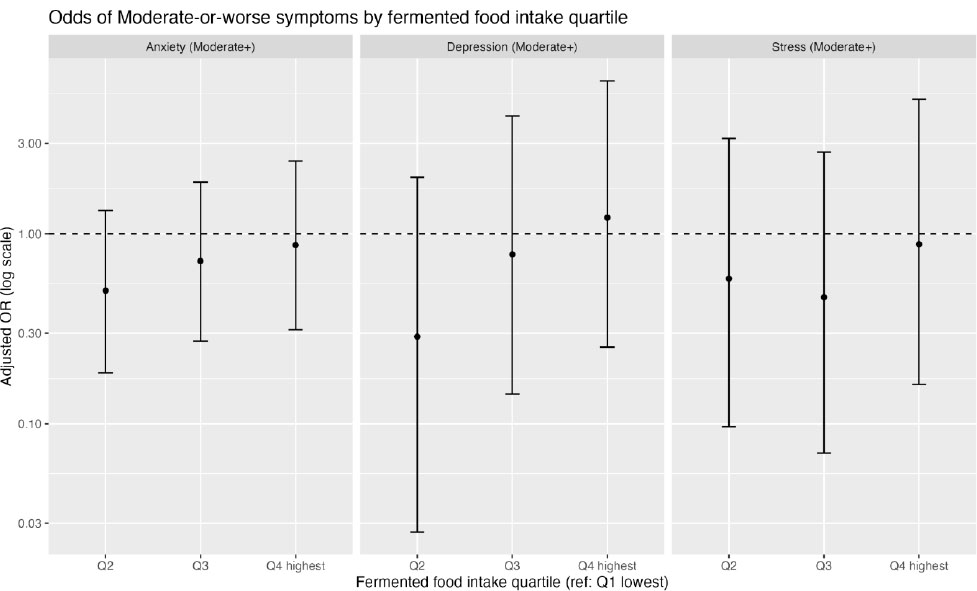
Compared with the lowest intake quartile (Q1), adjusted odds ratios in higher quartiles were generally imprecise and did not indicate a consistent dose-response pattern (as shown in Appendix B). For example, depression odds were lower in Q2 (aOR 0.29 (0.03, 1.99)) but higher in Q4 (aOR 1.22 (0.25, 6.40)), with wide confidence intervals.
Spline models likewise did not demonstrate a stable monotonic relationship across the intake range, with widening uncertainty at higher intakes (See Appendix B).
3.4. Interaction Analyses
Exploratory interaction analyses from fully adjusted logistic regression models assessed whether the association between fermented food intake (per additional serving/week) and moderate-to-extremely severe symptoms differed by probiotic supplement use or health-motivated fermented food consumption (See Appendix C). No interaction term reached statistical significance after accounting for the limited statistical power available for subgroup analyses. Given the small number of outcome events in several modifier subgroups, particularly for depression and stress outcomes, these findings should be considered hypothesis-generating only and interpreted with caution.
4. DISCUSSION
4.1. Null Association between Fermented Food Intake and Psychological Symptoms
In this cross-sectional sample of Malaysian university students, habitual fermented food intake was not independently associated with moderate-to-extremely severe symptoms of depression, anxiety, or stress after adjustment for relevant sociodemographic and health-related factors. No consistent dose-response relationship was observed across intake quartiles or spline analyses, and the observed effect estimates remained small and statistically non-significant across models. These findings suggest that, within the intake range observed in this population, habitual fermented food consumption was not associated with meaningful differences in psychological symptom severity.
The present findings differ from some previous studies that reported beneficial associations between fermented foods or probiotic intake and mental health outcomes. However, much of the existing literature derives from controlled intervention studies using standardised probiotic strains, defined dosages, and more homogeneous exposure conditions [27-29]. In contrast, the present study assessed naturalistic dietary intake within a real-world university population, where fermented food exposure is likely to be intermittent, variable, and influenced by broader lifestyle and cultural dietary practices.
Several explanations may account for the absence of detectable associations in the present study. First, median fermented food intake in this sample was relatively modest, potentially limiting the ability to detect small exposure-related effects. Second, the study population consisted primarily of non-clinical young adults, among whom severe depressive and stress symptoms were relatively infrequent. Dietary influences on psychological symptoms may therefore be more difficult to detect within relatively healthy populations where symptom variability is limited.
Interpretation of potential microbiota-related mechanisms should remain cautious. The present study did not assess gut microbiota composition, microbial viability, inflammatory markers, metabolomic profiles, or broader dietary patterns. Thus, no mechanistic conclusions regarding microbiota-gut-brain interactions can be directly inferred from the current findings. References to possible psychobiotic mechanisms are therefore intended only as theoretical context supported by prior literature rather than mechanisms demonstrated in this study.
4.2. Translational Gap between Psychobiotic Trials and Habitual Dietary Intake
A central issue highlighted by the present findings is the translational gap between controlled psychobiotic research and real-world dietary behaviour. Many randomised controlled trials demonstrating beneficial effects of probiotics or fermented foods on mood have used standardised microbial strains, high Colony-Forming Unit (CFU) concentrations, daily dosing schedules, and relatively short intervention windows [30, 31]. These conditions differ substantially from habitual dietary consumption patterns observed in community settings.
This distinction is critical for the field of nutritional psychiatry. While mechanistic and intervention studies support the plausibility of microbiota-gut-brain interactions, translating these findings into population-level dietary recommendations requires evidence that typical consumption patterns exert measurable effects [32].
These findings therefore contribute to a more nuanced understanding of psychobiotic research, emphasizing that evidence derived from supplement-based or strain-specific trials should not be directly generalized to diverse, real-world fermented food consumption without careful consideration of dosage, microbial characterization, and exposure context.
4.3. Cultural Heterogeneity and Microbial Diversity of Traditional Fermented Foods
An important dimension of the present study is its inclusion of traditional Southeast Asian fermented foods, many of which remain microbiologically undercharacterised. Unlike commercially produced yogurt or kefir, which contain standardised and well-documented probiotic strains, traditional fermented foods such as bosou, tuhau, tempoyak, tapai, and belacan are produced using spontaneous fermentation processes. Their microbial composition may vary substantially depending on ingredients, environmental conditions, household preparation methods, and storage practices.
This heterogeneity introduces both scientific opportunity and analytical complexity. From a mechanistic perspective, traditional ferments may contain diverse microbial communities with potential psychobiotic properties. However, without strain-level identification or quantification of viable organisms, it is difficult to determine whether such foods deliver consistent or biologically meaningful exposure [33, 34]. Aggregating culturally distinct fermented foods into a single “total intake” variable may therefore obscure potential differential effects between food types.
For epidemiological feasibility, the present study operationalised fermented food intake as a cumulative exposure variable representing habitual fermented food consumption patterns rather than attempting food-specific microbial quantification. This approach is consistent with exploratory nutritional psychiatry studies assessing broad dietary exposure patterns, although it may reduce specificity regarding individual fermented food effects [35, 36].
The present findings highlight the need for greater microbial profiling of indigenous fermented foods in Southeast Asia. By examining fermented food intake within a Malaysian university population, this study broadens the geographical and cultural scope of the field.
4.4. Limited Statistical Power for Subgroup and Interaction Analyses
Although exploratory subgroup and interaction analyses were conducted to examine potential effect modification by probiotic supplement use and health-motivated fermented food consumption, these findings should be interpreted cautiously due to limited statistical power. Several subgroup categories contained relatively small numbers of participants and sparse outcome events, particularly for depression and stress outcomes. This resulted in wide confidence intervals and reduced precision of the interaction estimates.
Interpretation of the spline analyses should be cautious. Although spline modelling was used to explore potential non-linear relationships, uncertainty increased substantially at higher intake levels where observations were sparse. As a result, the spline findings do not support strong inference regarding the presence or absence of a non-linear association between fermented food intake and psychological symptoms.
The absence of statistically significant interaction effects therefore should not be interpreted as definitive evidence that no subgroup differences exist. Rather, the current sample may have been insufficiently powered to reliably detect modest interaction effects or context-dependent associations. Sparse-event conditions in logistic regression modelling may also increase instability of parameter estimates and reduce interpretability of subgroup findings.
Additionally, the overall prevalence of moderate-to-extremely severe depressive and stress symptoms was relatively low within this predominantly non-clinical university sample. While the study was adequately powered for the primary regression analyses, it was not specifically designed to detect small subgroup differences or interaction effects across multiple modifiers.
These limitations underscore the importance of cautious interpretation of secondary analyses and highlight the need for larger studies with greater subgroup representation and higher event frequencies. Future research using larger multicentre samples or longitudinal designs may provide greater statistical precision for evaluating whether associations between fermented food intake and psychological symptoms differ according to demographic, clinical, or lifestyle-related factors.
4.5. Implications for Nutritional Psychiatry
The present findings carry several implications for the evolving field of nutritional psychiatry. First, the findings highlight the methodological challenges involved in evaluating fermented foods within nutritional psychiatry research. Variability in microbial composition, food preparation methods, and exposure assessment may contribute to inconsistent findings across studies and populations. They highlight the methodological challenges involved in assessing fermented food exposure within epidemiological studies. Future nutritional psychiatry research may benefit from integrating dietary assessment with microbiome profiling, biomarker analysis, and longitudinal study designs to better clarify potential pathways linking fermented food consumption and psychological wellbeing. Context-sensitive research is necessary before incorporating traditional fermented foods into mental health promotion frameworks.
Second, the results suggest that fermented food intake alone may not function as an independent determinant of psychological symptom severity in non-clinical young adult populations. Mental health outcomes are multifactorial, influenced by complex interactions among genetic, psychosocial, behavioural, and environmental factors. Fermented food consumption, particularly at modest levels, may represent only a small component within a broader lifestyle matrix. Therefore, interventions aimed at improving student mental health may require integrated approaches that address diet alongside sleep, physical activity, social support, and stress management.
Third, the absence of statistically significant associations should not be interpreted as evidence that fermented food intake has no influence on psychological wellbeing. Rather, the present findings indicate that no detectable association was observed within this study population and exposure range. Given the heterogeneity of fermented foods, limitations of dietary exposure assessment, and the possibility of residual confounding, modest or context-dependent effects cannot be excluded.
5. STRENGTHS AND LIMITATIONS
This study has several strengths. It represents one of the first investigations examining fermented food intake and psychological symptoms within a Southeast Asian university population, incorporating both commercial and traditional fermented foods that are culturally relevant to Sabah. By extending nutritional psychiatry research beyond Western dairy-based fermentation models, the study contributes geographical and dietary diversity to the literature. The use of a validated Malay version of the DASS-21 enhances measurement reliability for mental health outcomes, and multiple analytic approaches, including continuous modelling, quartile-based categorisation, spline analysis, and interaction testing, were employed to assess robustness of findings.
The present findings carry several implications for the evolving field of nutritional psychiatry. First, the findings highlight the methodological challenges involved in evaluating fermented foods within nutritional psychiatry research. Variability in microbial composition, food preparation methods, and exposure assessment may contribute to inconsistent findings across studies and populations. They highlight that the predominance of female participants further limits the generalisability of the findings to broader university populations.
Third, fermented food intake was assessed using the FFQ-FMF, which underwent expert review, face validity assessment, and pilot testing but did not undergo formal psychometric validation. Consequently, measurement error and exposure misclassification remain possible. In addition, intake estimates were derived from frequency categories and standard serving assumptions rather than precise portion-size measurements. The questionnaire also did not capture information on microbial strain composition, Colony-Forming Unit (CFU) concentration, microbial viability, fermentation methods, or food preparation processes, limiting interpretation of biologically active exposure.
Fourth, fermented foods included in the questionnaire differed substantially in ingredients, microbial ecology, fermentation techniques, and nutritional composition. Aggregating these foods into a single intake variable may have obscured food-specific associations and diluted potential effects of individual fermented food categories.
Fifth, although the analyses adjusted for several sociodemographic and health-related variables, important potential confounders were not assessed. These included overall diet quality, body mass index, sleep quality, physical activity, antibiotic exposure, academic stress, inflammatory status, and other lifestyle factors that may influence both dietary behaviour and psychological wellbeing. Therefore, residual confounding cannot be excluded.
Sixth, psychological symptoms were measured using the DASS-21, which is a validated screening instrument for symptom severity rather than a clinical diagnostic tool. Consequently, the outcomes reflect self-reported symptom burden rather than clinically diagnosed depressive, anxiety, or stress disorders.
Finally, while the study achieved its target sample size for the primary analyses, the number of moderate-to-extremely severe depression (n = 29) and stress (n = 22) cases was relatively small. This reduced statistical precision, particularly for quartile, spline, and interaction analyses. The interaction analyses should therefore be regarded as exploratory and hypothesis-generating rather than confirmatory. Collectively, these limitations indicate that the findings should be interpreted as evidence of no detectable association within the present study context rather than definitive evidence of no effect.
CONCLUSION
No statistically significant association was detected between habitual fermented food intake and moderate-to-extremely severe symptoms of depression, anxiety, or stress in this sample of Malaysian university students. By extending nutritional psychiatry research to a culturally specific Southeast Asian context, this study contributes ecologically valid evidence and highlights the need to consider microbial heterogeneity and exposure intensity when evaluating fermented foods in relation to mental health.
RECOMMENDATIONS
Future research should adopt longitudinal and experimental designs to clarify temporal directionality and causal pathways between fermented food intake and psychological outcomes. Given the translational gap between controlled psychobiotic trials and real-world dietary exposure, studies should differentiate between standardised probiotic interventions and habitual consumption of heterogeneous fermented foods. More precise dietary assessment methods are needed, including quantification of portion sizes, frequency standardisation, and evaluation of microbial viability and colony-forming unit concentrations.
Particularly in Southeast Asian contexts, microbial profiling of traditional fermented foods such as bosou, tuhau, and tempoyak is warranted to characterise strain composition and potential psychobiotic properties. Integrating dietary data with microbiome sequencing, inflammatory markers, and stress-related biomarkers would strengthen mechanistic inference within nutritional psychiatry.
Future investigations should also consider dose-response thresholds and context-dependent effects. Studies targeting populations experiencing elevated psychological stress, inflammatory conditions, or clinically significant mood disorders may help determine whether fermented food effects emerge under vulnerability states. Additionally, examining fermented foods within broader dietary patterns and lifestyle clusters may clarify whether intake reflects an independent exposure or a marker of health-oriented behaviours.
AUTHORS’ CONTRIBUTIONS
The authors confirm their contributions to the paper as follows: V.C.T., N.T.P.P.: Study conception and design; G.G., A.K.: Data collection; V.C.T., A.K.: Analysis and interpretation of results; G.G., V.C.T., N.T.P.P.: Draft manuscript preparation; W.W., C.M.H.: Review and Validation. All authors reviewed the results, critically revised the manuscript for important intellectual content, and approved the final version of the manuscript.
LIST OF ABBREVIATIONS
| aOR | = Adjusted Odds Ratio |
| CI | = Confidence Interval |
| DASS-21 | = Depression Anxiety Stress Scales-21 |
| FFQ | = Food Frequency Questionnaire |
| FFQ-FMF | = Food Frequency Questionnaire for Fermented Malaysian Foods |
| HPA | = Hypothalamic-Pituitary-Adrenal |
| IQR | = Interquartile Range |
| OR | = Odds Ratio |
| SD | = Standard Deviation |
| UMS | = Universiti Malaysia Sabah |
ETHICS APPROVAL AND CONSENT TO PARTICIPATE
All procedures involving human subjects/patients were approved by the Research Ethics Committee of University Malaysia Sabah, Malaysia, approval code JKEtika 5/25(73).
HUMAN AND ANIMAL RIGHTS
All human research procedures followed were in accordance with the ethical standards of the committee responsible for human experimentation (institutional and national), and with the Helsinki Declaration of 1975, as revised in 2013.
AVAILABILITY OF DATA AND MATERIALS
All the data and supporting information is provided within the article.
ACKNOWLEDGEMENTS
Declared none.
APPENDIX
Appendix A: Detailed participant characteristics overall and by quartile of fermented food intake.
| Characteristic | Overall | Q1 (lowest) | Q2 | Q3 | Q4 (highest) |
|---|---|---|---|---|---|
| Sample size, n | 212 | 59 | 54 | 47 | 52 |
| Age (years), mean (SD) | 21.2 (3.4) | 22.0 (4.5) | 20.6 (1.6) | 21.1 (4.4) | 21.2 (1.4) |
| Fermented food intake (servings/week), median [IQR] | 2.00 [0.75, 3.50] | 0.25 [0.25, 0.62] | 1.31 [0.88, 1.62] | 2.75 [2.38, 3.12] | 6.12 [4.69, 9.31] |
| Female, n (%) | 164 (77.4%) | 50 (84.7%) | 42 (77.8%) | 37 (78.7%) | 35 (67.3%) |
| Ethnicity: Dusun, n (%) | 66 (31.1%) | 13 (22.0%) | 10 (18.5%) | 16 (34.0%) | 27 (51.9%) |
| Ethnicity: Melayu, n (%) | 29 (13.7%) | 12 (20.3%) | 9 (16.7%) | 5 (10.6%) | 3 (5.8%) |
| Ethnicity: Bajau, n (%) | 29 (13.7%) | 10 (16.9%) | 8 (14.8%) | 9 (19.1%) | 2 (3.8%) |
| Ethnicity: Cina, n (%) | 19 (9.0%) | 4 (6.8%) | 7 (13.0%) | 3 (6.4%) | 5 (9.6%) |
| Ethnicity: Other, n (%) | 69 (32.5%) | 20 (33.9%) | 20 (37.0%) | 14 (29.8%) | 15 (28.8%) |
| Year of study: 3, n (%) | 116 (54.7%) | 30 (50.8%) | 27 (50.0%) | 18 (38.3%) | 41 (78.8%) |
| Year of study: 1, n (%) | 53 (25.0%) | 16 (27.1%) | 17 (31.5%) | 15 (31.9%) | 5 (9.6%) |
| Year of study: 5, n (%) | 26 (12.3%) | 8 (13.6%) | 6 (11.1%) | 9 (19.1%) | 3 (5.8%) |
| Year of study: 2, n (%) | 14 (6.6%) | 3 (5.1%) | 4 (7.4%) | 4 (8.5%) | 3 (5.8%) |
| Year of study: Other, n (%) | 3 (1.4%) | 2 (3.4%) | 0 (0.0%) | 1 (2.1%) | 0 (0.0%) |
| Living arrangement: ASRAMA, n (%) | 117 (55.2%) | 27 (45.8%) | 29 (53.7%) | 30 (63.8%) | 31 (59.6%) |
| Living arrangement: BERSAMA KAWAN-KAWAN, n (%) | 52 (24.5%) | 16 (27.1%) | 15 (27.8%) | 9 (19.1%) | 12 (23.1%) |
| Living arrangement: BERSAMA KELUARGA, n (%) | 28 (13.2%) | 7 (11.9%) | 9 (16.7%) | 5 (10.6%) | 7 (13.5%) |
| Living arrangement: BERSENDIRIAN, n (%) | 15 (7.1%) | 9 (15.3%) | 1 (1.9%) | 3 (6.4%) | 2 (3.8%) |
| Living arrangement: Other, n (%) | 0 (0.0%) | 0 (0.0%) | 0 (0.0%) | 0 (0.0%) | 0 (0.0%) |
| Probiotic supplement use (yes), n (%) | 46 (21.7%) | 6 (10.2%) | 14 (25.9%) | 11 (23.4%) | 15 (28.8%) |
| Chronic illness (yes), n (%) | 5 (2.4%) | 4 (6.8%) | 0 (0.0%) | 0 (0.0%) | 1 (1.9%) |
| Consumes fermented foods for health purpose (yes), n (%) | 23 (10.8%) | 3 (5.1%) | 6 (11.1%) | 7 (14.9%) | 7 (13.5%) |
| Depression symptoms (Moderate+), n (%) | 29 (13.7%) | 9 (15.3%) | 3 (5.6%) | 6 (12.8%) | 11 (21.2%) |
| Anxiety symptoms (Moderate+), n (%) | 75 (35.4%) | 24 (40.7%) | 14 (25.9%) | 17 (36.2%) | 20 (38.5%) |
| Stress symptoms (Moderate+), n (%) | 22 (10.4%) | 9 (15.3%) | 4 (7.4%) | 3 (6.4%) | 6 (11.5%) |
Appendix B. Restricted Cubic Spline Analysis of Fermented Food Intake and Psychological Symptoms
Restricted cubic spline models showing the association between fermented food intake (servings/week) and the odds of moderate-to-severe depression, anxiety, and stress.
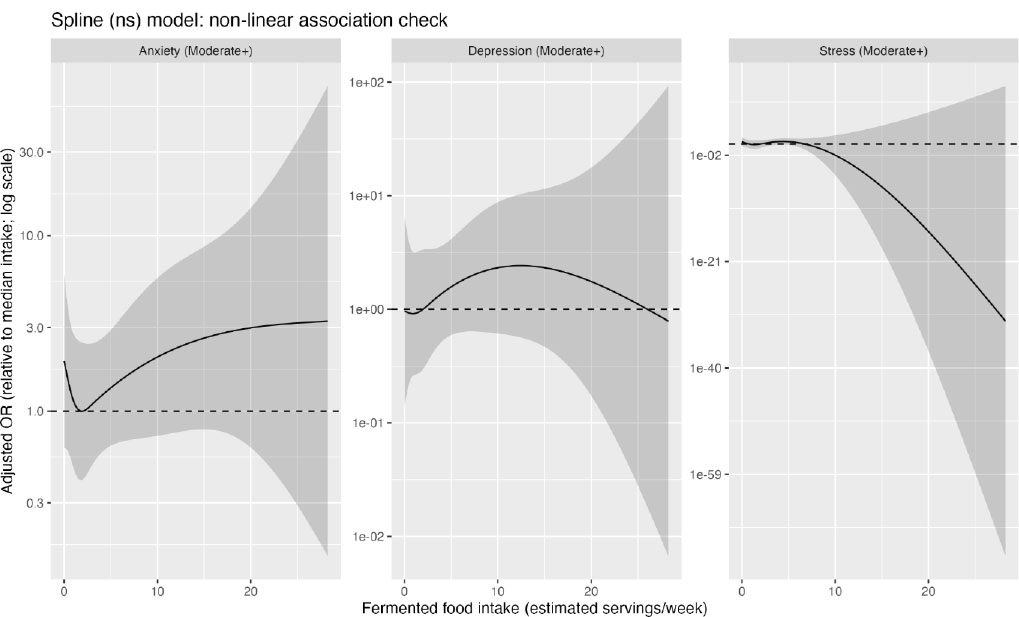
Natural spline model (df=3) assessing potential non-linear associations between fermented-food intake and odds of moderate+ symptoms (relative to median intake).
Note: Curves represent adjusted odds ratios estimated from restricted cubic spline models. The shaded areas indicate 95% confidence intervals. Models were adjusted for age, gender, ethnicity, year of study, living arrangement, chronic illness, and probiotic supplement use. Spline analyses were conducted to explore potential non-linear associations between fermented food intake and psychological symptoms. The estimates beyond approximately the 90th percentile of intake (~10 servings/week) should be interpreted with caution due to limited data support. The wide confidence intervals observed across portions of the exposure range reflect substantial statistical uncertainty. Overall, the spline analyses did not demonstrate a consistent dose-response pattern and do not support strong inference regarding a non-linear association.
Appendix C. Exploratory effect modification (interaction) analyses from fully adjusted models.
| Outcome | Potential Effect Modifier | Interaction OR (95% CI) | Interaction p-value |
Modifier Subgroups, n (events) | Sparse Events* | Interpretation |
|---|---|---|---|---|---|---|
| Depression | Probiotic supplement use | 0.94 (0.73, 1.17) | 0.574 | No: 166 (24); Yes: 46 (5) | No | No evidence of interaction |
| Depression | Health-motivated fermented food intake | 0.29 (0.01, 0.94) | 0.251 | No: 189 (27); Yes: 23 (2) | Yes | Exploratory finding; underpowered subgroup |
| Anxiety | Probiotic supplement use | 0.90 (0.75, 1.06) | 0.243 | No: 166 (61); Yes: 46 (14) | No | No evidence of interaction |
| Anxiety | Health-motivated fermented food intake | 0.86 (0.51, 1.09) | 0.372 | No: 189 (70); Yes: 23 (5) | No | No evidence of interaction |
| Stress | Probiotic supplement use | 0.51 (0.15, 1.13) | 0.209 | No: 166 (18); Yes: 46 (4) | Yes | Exploratory finding; underpowered subgroup |
| Stress | Health-motivated fermented food intake | 0.44 (0.05, 1.22) | 0.313 | No: 189 (19); Yes: 23 (3) | Yes | Exploratory finding; underpowered subgroup |